

It is time for me to find Osamu Dazai again; the message in Sakata was clear. Every day, as I left and returned to the hotel, the writer looked at me with his sad expression, weary of life. The cover of the Japanese edition of No Longer Human, standing upright in the bookcase, gave me no respite. A new chapter has to be written: that of my relationship with the accursed writer in his own country, that of the mark left by his work in the minds of his compatriots encountered by chance along the journey.
On the train to Hirosaki I have time to dream, to let my thoughts wander, to let the precise or vague impressions that have accumulated drift for a while. They mingle, form knots, build hypotheses, sketch out paths, sometimes re-emerge in absurd ways. I do not know it yet, but my path is about to cross that of an old man, a volunteer guide at the house, now a museum, where Dazai lived as a student in Hirosaki. In front of the alcove where Dazai wrote, the place where, according to the story, he first tried to take his own life, the old man, searching his memory, will tell me about a mysterious Belgian writer whom Dazai is said to have read avidly. But I am getting ahead of myself.
Among all the Japanese people asleep on a train in Japan, is there one dreaming of Dazai? Perhaps that one, his head tilted to one side, his chin resting in his hand; he makes me think of the writer. My mind wanders, my gaze moves from one passenger to another. Does this woman with a ferocious appetite, faced with a generous bento, know that Dazai saw many things in food: a social marker, a local identity, guilt? The conductor passes back and forth, bowing in greeting as he enters and leaves the carriage. Does he think of this line from the short story The Train: “How many tens of thousands of bonds of love has this train torn apart?”
These suppositions are not mere fantasies; they are based on the experience of this journey. As conversations unfold, everyone asks me what my plans are in Japan, and I mention Tōhoku and Osamu Dazai’s return to Tsugaru. The surprise works both ways. They are surprised by my interest in this writer who died so long ago. I, in turn, am surprised to discover how well known he is among the Japanese. The vast majority, almost all of the people I speak to, know him, and many have read him. The writer so often described as cursed is a genuine point of reference in Japan, not merely a literary figure imposed by school, but a human one as well. His tragic life, his talent as a writer, his attraction to communism and his opposition to his bourgeois origins give him a particular status.
“If you can eat plenty of good, inexpensive food, what more could you wish for?” Dazai wrote in 1942 in his essay The Gourmet. That is a very un-French definition of gastronomy for a gourmet to devote himself to. Perhaps, then, it would be better to translate the word as “gourmand.” Never mind; in Japan it is possible to eat good, inexpensive food every evening. To do so, you have to avoid places aimed at tourists, accept that you will sometimes be refused entry, take the time to search carefully, and favour local recommendations.
食通
Shokutsū – gourmet, gourmand.
Hirosaki is livelier than Sakata in the evening; there are more possibilities. This surprises me; I had remained with the image Dazai gives of it in Return to Tsugaru. The street where my izakaya is located is very quiet, even though the sounds of the other streets can clearly be heard. At first I think I have the wrong place: no door opening onto the street with a lit lantern swaying in front of it, but a garage. There is a light upstairs; it looks like an apartment. Yet the izakaya really is there; a discreet little sign announces it. You have to push open the door and climb a straight, narrow staircase. As I climb the steps, laughter, conversations and orders echo above me.
I arrive in a small room dominated by a counter behind which the chef is busy. It is the crucial moment, when the newcomer has to be accepted. There is only one seat free; I announce that I am alone, as one should in Japan. The chances of being welcomed increase markedly if you speak a little Japanese and know the essential custom of stating the number of diners. The chef points to the empty seat with a simple gesture. The two young waitresses move nimbly through the cramped spaces, putting on and taking off their shoes with the casual naturalness of the Japanese. I could stay in places like this without eating or drinking, simply to watch, to admire the ritual dance of service. A few details change: gestures, ways of pouring sake, explaining the menu, taking an order.
The menu is handwritten, which makes it much harder to read, impossible for me. Today we have artificial aids; they are invaluable. They allow us to explore the infinite variety of Japanese cuisine, to experience its tastes, textures, colours and smells. A cuisine of fresh produce, cooked to order, depends on the market, the chef’s eye and nose, his mood, sometimes the requests of regulars. The more usual dishes are generally displayed on wooden plaques written vertically, sometimes on simple sheets of paper hanging up.
はすや is a perfect place for a first approach to Tsugaru cuisine. Dazai would have liked it. The closeness, the liveliness, the apparent disorder, the lack of frills all speak his language. “In their own inimitable fashion they really work at making sure this region’s products are as tasty in the eating as possible.” (Osamu Dazai, 母 (Haha, Mother), 1947). I eat sea urchin wrapped in sheets of nori. The raw salmon from the Tsugaru Strait has an unrivalled delicacy. It develops it by fighting against the strong sea currents. Finally, hoya is a real experience. I enjoy the very strong, iodine-rich taste of this marine animal. I hear Dazai’s voice gently scolding me: “don’t get attached to food.” I raise a glass of sake to his advice.
はすや
Hasuya – the house of the lotus.
In the morning I am disappointed; Hirosaki Castle is closed for construction work. I wanted to climb to the top to look at the city, to compare it with Osamu Dazai’s vision of it. In the prologue to Return to Tsugaru, he describes it with surprise; he discovers it and sees in it “the refuge of the soul of the people of Tsugaru.” His book needs to be put back into context: it is not a novel but an autobiographical travel narrative. In May–June 1944, he returns to his native region at the request of the publisher Koyama Shoten, which is publishing a “New Collection of Regional Geographies.” In the midst of the Pacific War, the timing is surprising; it also reflects the misinformation in which the Japanese are being kept. Dazai mentions restrictions, compulsory contributions to the war effort, and the need for discretion about certain sensitive places, but that is not the subject of the book. For him, it is about returning to his roots, trying through them to understand himself.
“Until then, I had simply believed that the castle stood isolated at the edge of the town. But what did I discover there? A district full of the grace of olden times, its little houses lined up, unchanged for centuries (…) For a reason that escapes me, I felt I understood Hirosaki, understood Tsugaru. I thought that, as long as this district existed, Hirosaki would never be a city like any other.”
Osamu Dazai, Return to Tsugaru, 1944.
In the castle park there is an immense botanical garden, almost deserted; it seems to belong to the crows, which caw their warnings from the treetops. They should be taken seriously; one must be watchful in open spaces, as they may be close to a nest. There are ponds, crossed by narrow wooden bridges just above the water. The place is perfect for an unexpected encounter. Perhaps with the writer, thinking of his studies in Hirosaki, of the moment when he chose literature. His face is already closing in; sadness and fear are taking precedence over the pleasure of writing. As the epigraph to his first collection of short stories, published in 1936, there is a line by Verlaine published 56 years earlier: “I have the ecstasy and the terror of being chosen.”
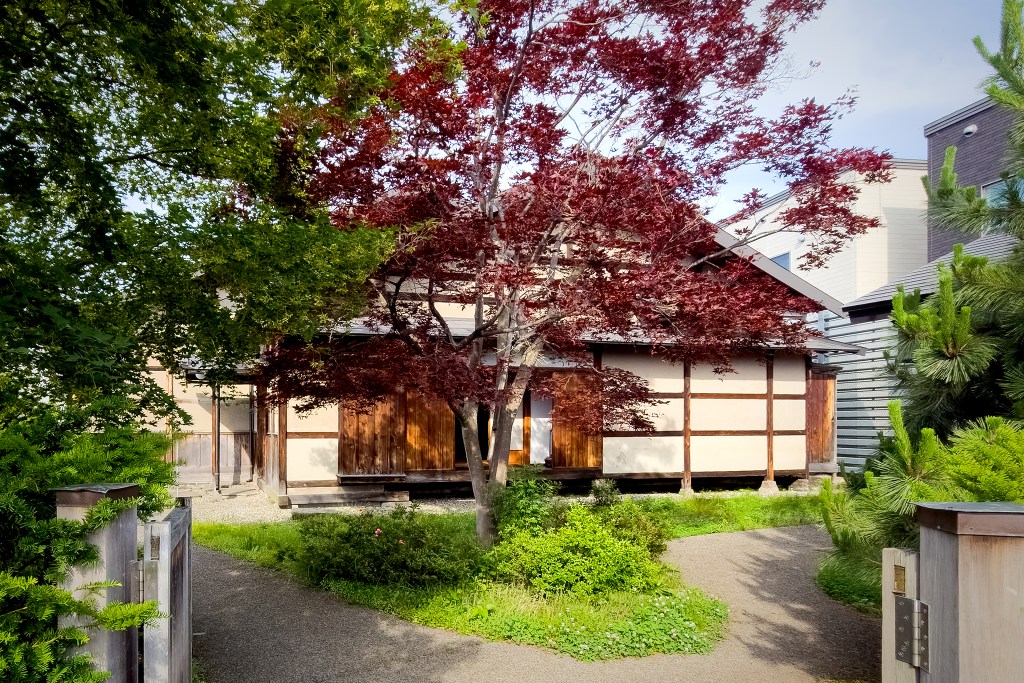
It is time to head for the house where an old man is waiting for me—not me in particular, but anyone interested in Osamu Dazai. The travelling student is a little naïve; without quite admitting it to himself, he believes in the atmosphere of a place, sees signs, hears the wind speak to him as it whistles the same refrain through the wood of a house. We are all alike, travelling students, student travellers; for us space and time are relative. Open eyes, eyes that look, are measuring instruments; they force the symmetries of the present to break, allowing the past to live again.
The old man is not alone; a middle-aged Japanese couple listen to him respectfully. I have taken off my shoes to join them on the tatami of the main room; I understand nothing, I simply try to guess. A word, a gesture gives me clues; the old man tells the history of the place, which I know in part. The house where Osamu Dazai occupied the equivalent of a student room belonged to relatives of his, the Fujita family. He arrived there at seventeen, in 1927, and left three years later after receiving his diploma from the literary section of Hirosaki Government Higher School.
Osamu Dazai lives upstairs; he shares the space with the family’s son, Fujita Mototarō. They become friends; Mototarō takes an interest in photography, and many portraits of the young writer were taken by him. The photographs are everywhere in the room, in a display case, but also casually placed on a piece of furniture. A very simple storage cupboard stands next to a low table. Farther to the left, the desk where Dazai wrote. The old man is now speaking to me alone; the middle-aged couple has left, apparently to catch a train. He takes the few words I addressed to him in Japanese as evidence of my command of the language. He explains something to me; eventually I understand: Osamu Dazai particularly liked a Belgian writer whose name he has forgotten. He says ブルッヘ.
ブルッヘ
Buruhhe – Bruges.
Osamu Dazai’s interest in French literature is no mystery. After graduating in Hirosaki, he enrolled in the French literature department at Tokyo Imperial University. He was not a very diligent student, he spoke French poorly, and he never completed his studies. On the other hand, he read a great deal, in Japanese, the translations of the great classics that were highly prized in Japan in the 1930s. Verlaine, Baudelaire, Rimbaud, Mallarmé, Proust, Gide and Radiguet are all major names found in Dazai’s library. But who can this Belgian writer be, the one the old man is talking about in this little room heavy with history?
Technology has this pleasant feature: it lets you search very quickly almost wherever you are. A name emerges: Georges Rodenbach, a Belgian Symbolist writer whose major novel is Bruges-la-Morte. The Belgian author had been translated into Japanese since the beginning of the twentieth century, so he was accessible to Dazai, even though the first complete translation of Bruges-la-Morte did not appear until 1933. Reading this work, considered one of the major writings of Symbolism, is consistent with Dazai’s previously mentioned interest in French Symbolist poets and novelists. I have no proof, nothing but a conversation in my deficient, awkward Japanese with an old man passionate about a great Japanese writer. I am a travelling student; I have never read Georges Rodenbach; I am simply delighted by the unexpected encounter with a fellow countryman. It teaches me to pull at a new thread in the story of this somewhat literary journey. That of the influence of Francophone culture, which is also mine, on a cursed Japanese writer.
“Mute analogies! Mutual penetration of the soul and things! We enter into them while they enter into us.
Cities above all have in this way a personality, an autonomous spirit, an almost externalized character corresponding to joy, new love, renunciation, widowhood. Every city is a state of mind […]”Georges Rodenbach, Bruges-la-Morte, 1892
Dazai’s description of Hirosaki is not without echoes of this passage by Rodenbach: the Belgian writer makes the city a character; the Japanese writer gives the city a social role, a collective identity. My perception of cities is a little different. I discover them by walking, without a goal, without trying to see what one is supposed to see; they show me what they want as my steps happen to take me there. In this way I discover traces of history, ancient or recent. Japanese cities tell their stories through streets, buildings, parks, shrines and temples. They are very reserved, often awkwardly put together; each possesses a hidden beauty that reveals itself little by little. You have to be understanding, patient, like walking, and not expect them to let themselves be loved at first sight by those who have no time. Japanese cities are not easy cities.
Tōkyō is a Godzilla to tame, Kanazawa is a complicated love story, Otaru has the charm of the people who live there, Kamakura has the slightly sad colour of hidden passions, Nagasaki shines through tears. These cities entered into me in this way; little by little they shaped my gaze as a travelling student, they agreed to become part of my own story. Hirosaki has not yet been defined; it is of course the city of my entry into Tsugaru, on the trail of Osamu Dazai’s native land. Yet it still has to acquire a unique, unforgettable identity.
The old man remains in my memory even more than Dazai. Guardian of the temple of the writer’s youth, he shares his passion day after day with strangers. He knows the story of every photograph, the adventure of every book. He tells, describes, explains, underlines the important moments Dazai lived through in Hirosaki. From his first important works to his first suicide attempt. Almost every Japanese person knows Dazai; the old man, though, lives with the writer every day. He is surrounded by his books, his photographs; his shadow, his texts, his handwriting are everywhere. I smile as I walk beneath a late-afternoon sun. It has been a beautiful day. At Obon, I know this: Osamu Dazai will return from among the dead to greet the old man with respect.
Mata ne

 Wanihondou