

There are many ways to get lost in Japan, willingly or not, and one of the most singular is to no longer quite know where the East and West of the country are. And yet the matter is well established: when one looks at a map, north is at the top, south at the bottom, west to the left and east to the right. In Japan, things are a little different; it took me quite some time to understand this. The compass rose or the compass itself remain the same, but the East or West of Japan is not necessarily where one thinks it is.
During my first trip, I had planned to go to Ōsaka. People from Tōkyō told me: “You’re going to discover western Japan, you’ll see, it’s very different.” I did not understand. On the map, Ōsaka and Tōkyō are on the same coast of the main island, so for me the two cities were on the east coast. I thought it was a misunderstanding, my Japanese being non-existent at the time, and my new friends’ English relatively acrobatic. The experience was repeated many times with different places. It took me time to understand the island’s geographical division; at first glance, it seems a little strange.
The revelation came through the great Japanese railway company, the JR Group. It is divided into six sub-companies, including JR East and JR West. Naturally, I thought the first one covered trains running along the east coast and the other those running along the west coast. But not at all: trains from the same company run along both the west coast and the east coast, but not in the same part of Japan! The matter can be summarized in this way. Tōkyō, the most important city, is clearly in the East; its name means “Eastern Capital”, so the whole part of Japan that lies on the side of the capital is the East. Everything on the side of Kyōto and Ōsaka is the West. This division between these two poles reflects the country’s history.
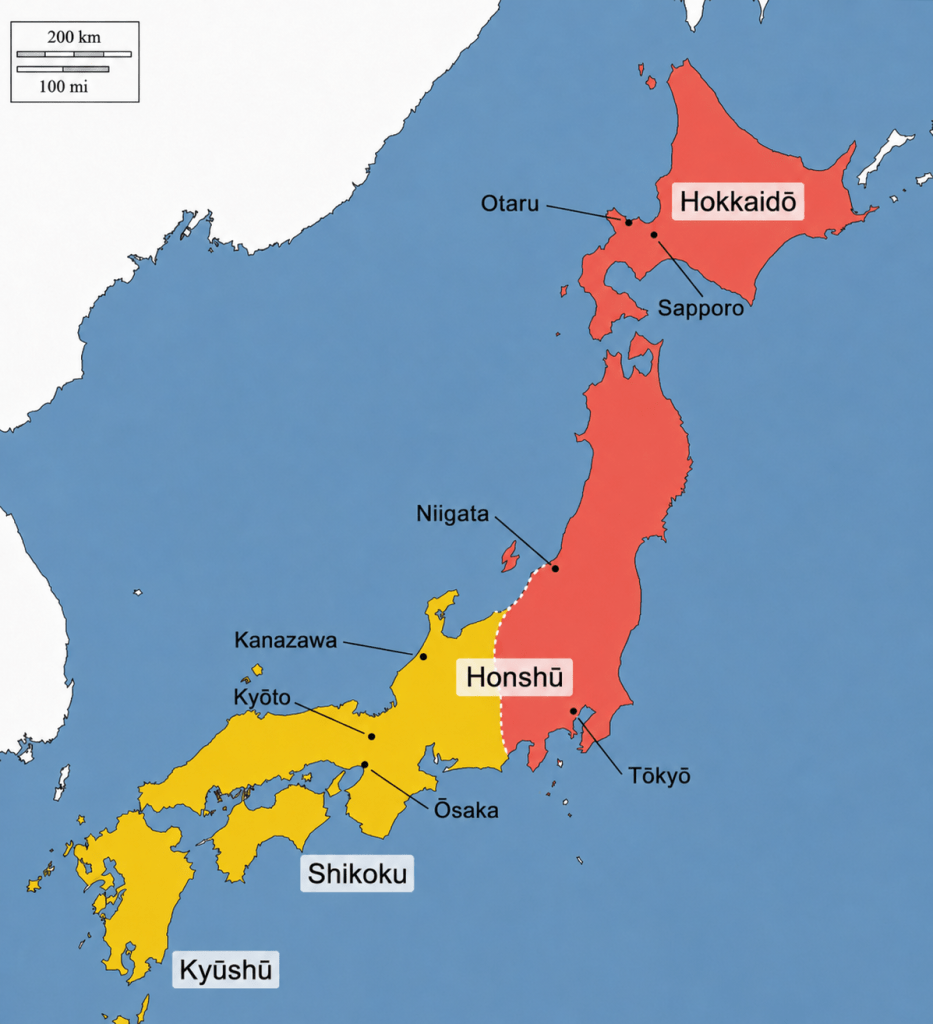
Leaving for Niigata, I am therefore heading east, even though the city is clearly located on the west coast, on the side of the Sea of Japan. Niigata is a large city, and its port was one of those opened to international trade in the nineteenth century. It is not known for its monuments or historic districts, but rather for the exceptional quality of its water, which makes it possible to grow the best rice in Japan, koshihikari. Other high-quality rices are used to make exceptional nihonshu.
Koshihikari is a cultivar dating from 1956, a plant produced through successive crossings to obtain the best result. It appeared at a time when Japan was beginning to recover after the war. It is a symbol of the new society emerging then: food shortages were over, and it was once again possible to think about the quality of food. Koshihikari is eaten white, as an accompaniment to dishes. It is glossy, tender, slightly sticky, elastic and gently sweet. It is widely used for onigiri, less so for sushi. Other rices from Niigata are used for them; whatever their name, the one I ate at the izakaya Marui was exceptional.
To reach this izakaya, there is a journey, that of the gradual discovery of Niigata. Thread by thread, the path is woven, made of chances, intentions, sometimes renunciations. To look at a city is also to make it exist. It began with Brazilian music, by chance, in a street. Music broadcast through speakers attached to houses, to streetlight poles in a covered street, a kind of roof protecting both pavements.
It is still surprising, all the same, to walk while listening to the wonderful album recorded by João Gilberto, Antônio Carlos Jobim and Stan Getz in 1963. Corcovado echoes on the shores of the Sea of Japan as I make my way to a Shinto shrine. This connection between Brazil and Japan is no coincidence; it is part of the history of both countries. Few people know it, but the largest Japanese expatriate community lives in Brazil, especially in the São Paulo region, but also in Paraná. The number of descendants of Japanese emigration to Brazil is now estimated at 2 million.
The story begins in 1895 with the signing of a treaty of friendship between the two countries. Brazil abolished slavery in 1888 and had a huge need for rural labour. Japan, for its part, was opening up to the world and seeking new destinations for emigration, as the United States was becoming less and less accessible. On June 18, 1908, a historic date, the Kasato Maru arrived at the port of Santos; several hundred Japanese people disembarked to work “temporarily” on coffee plantations. Most of them would never return. This community has a name: the Nikkei, a word used both in Japan and Brazil to refer to Brazilians of Japanese origin.
日系
Nikkei – of Japanese origin.

The integration of Japanese people in Brazil was not simple, but it allowed the relationship between the two countries to remain special to this day. Japan and Brazil maintain a unique relationship, widely celebrated in 2008 during the hundredth anniversary of the arrival of the Kasato Maru. That is why Brazilian music is so often present in Japan, to the point that some Japanese artists sing in Portuguese: Lisa Ono, born in São Paulo and raised in Japan; the singer Naomi Fuse, associated with the guitarist Goro Itō; Saigenji, strongly marked by samba and bossa nova; the hip-hop duo Cibo Matto covering Águas de Março; and Julia Oki.
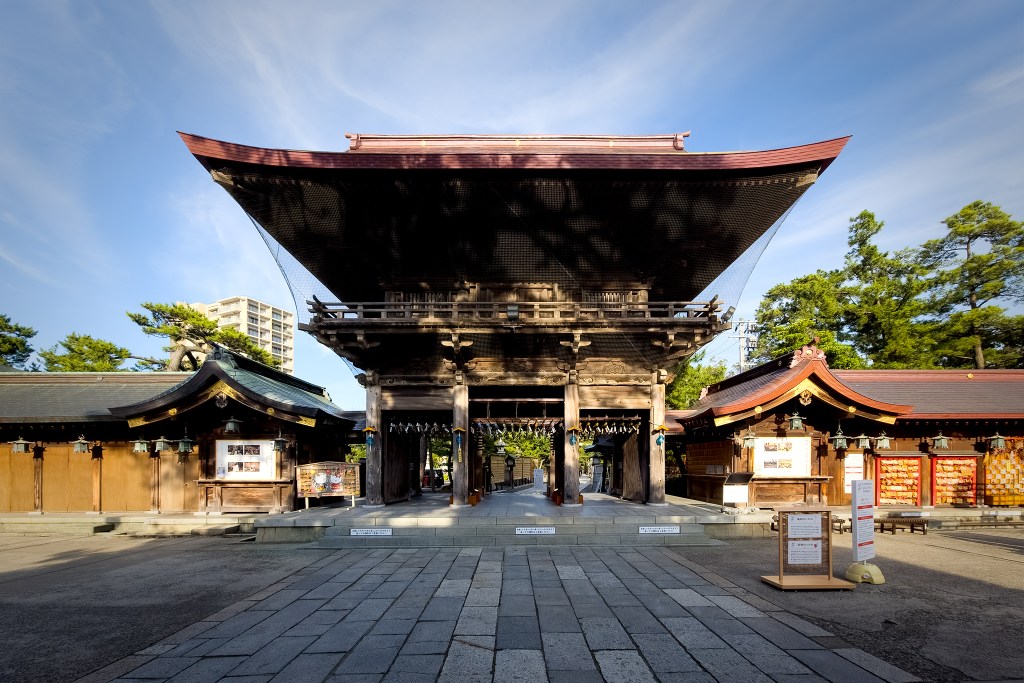
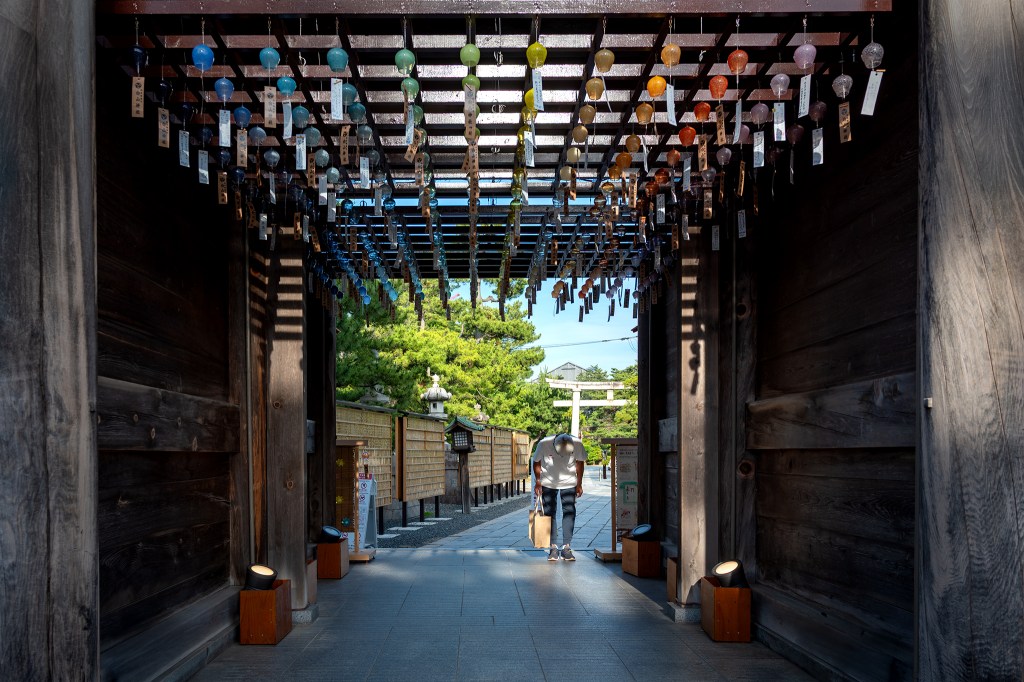
Another music awaits me at Hakusan Shrine, that of the 風鈴. Hundreds of these little glass and metal bells sway and chime together in the wind. It is the sound of summer in Japan, when windows are open and the wind composes changing music made of silences, frantic rhythms and slow, lazy beats. Today, the wind comes from the sea; it is steady, and everything tinkles away, giving the shrine an air of uncontrolled celebration. The park around the shrine is the first public park created in Japan by the city’s mayor, Kusumoto Masataka, in 1873. Born into a high-ranking samurai family, Kusumoto entered politics and worked to modernize his country. He would also become governor of Tōkyō and president of the House of Representatives.
風鈴
Fūrin – wind chime.
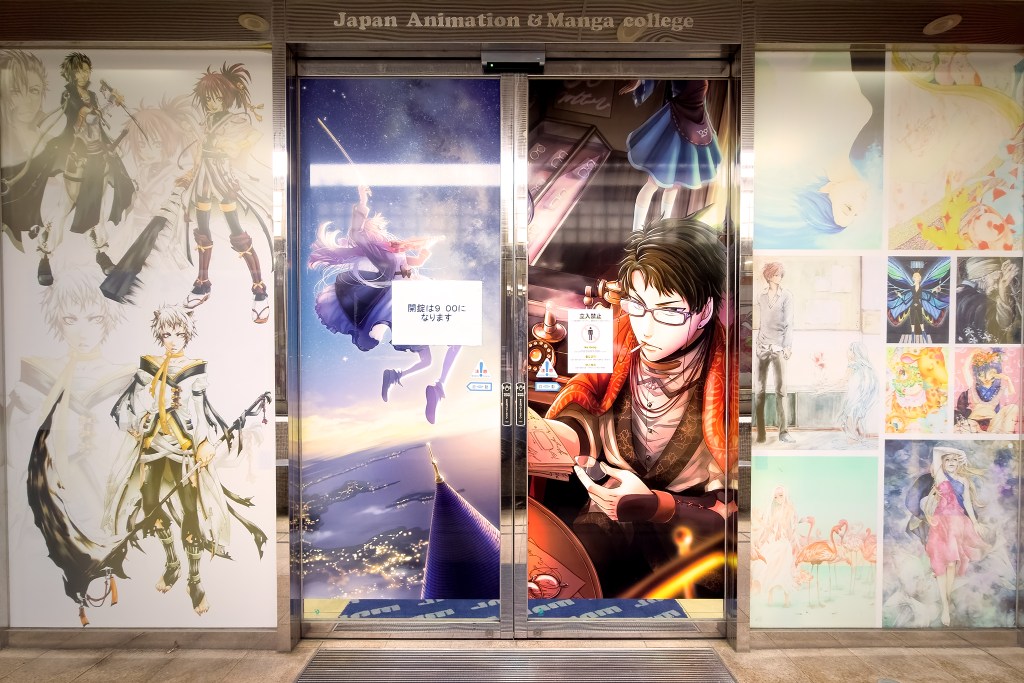
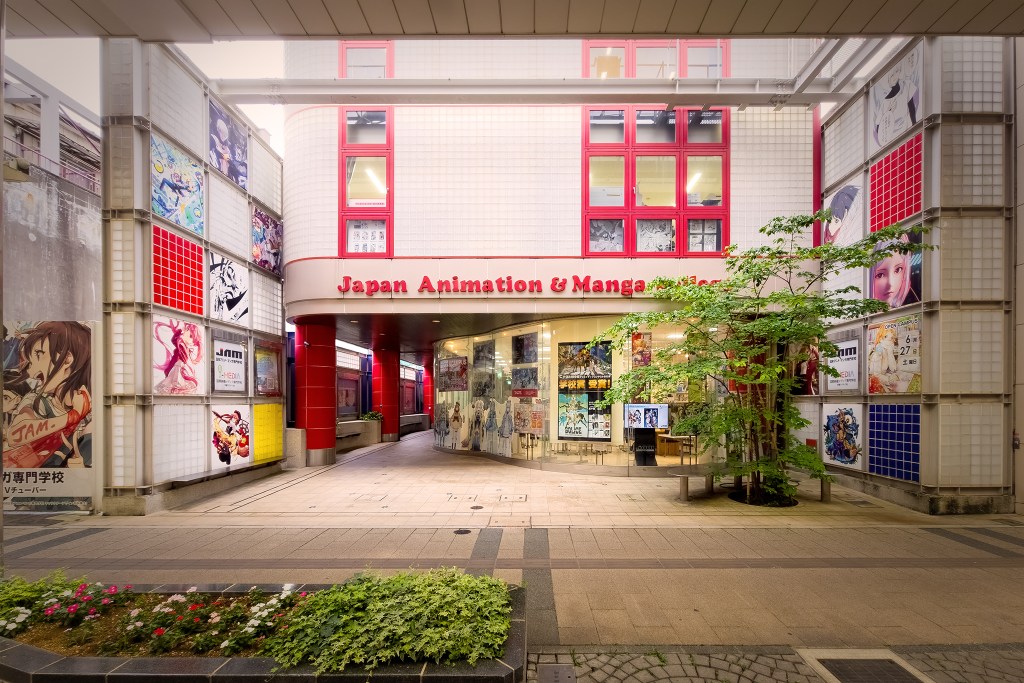
Heading towards the district of 古町, Niigata’s former geisha district, I discover the immense 商店街 crossing the city. These are no longer roofs covering the pavements, but a completely enclosed gallery. It is very long and full of shops, cafés, bars and izakaya. It allows social life to continue during winter. Winter here is particularly harsh; snow covers everything, and the wind bends the trees, so powerful is it. Today, it is rain that the gallery allows one to shelter from. It falls moderately and continuously; the tsuyu is beginning, the hot and humid rainy season is here. One building draws my attention: the Japan & Manga College. Its distinctive red-and-white façade emerges from the gallery. On the windows of the offices below, a few characters, a few posters, nothing I recognize. Walking along the outer corridor, I notice a small sign clearly indicating that visitors are not welcome.
古町
Furumachi – old town.商店街
Shōtengai – covered shopping arcade.
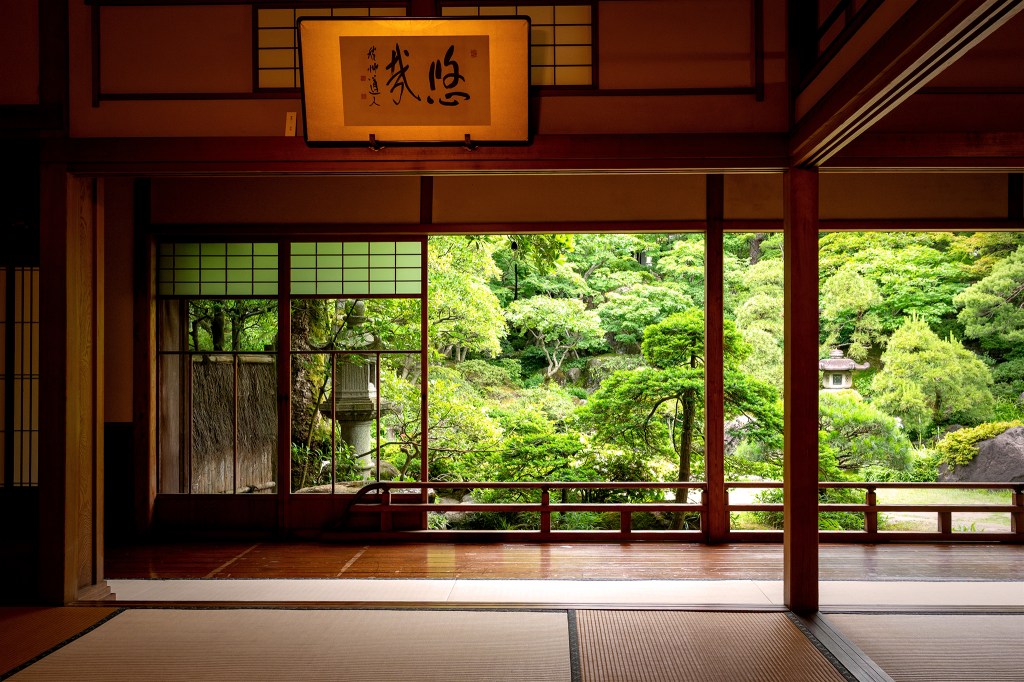
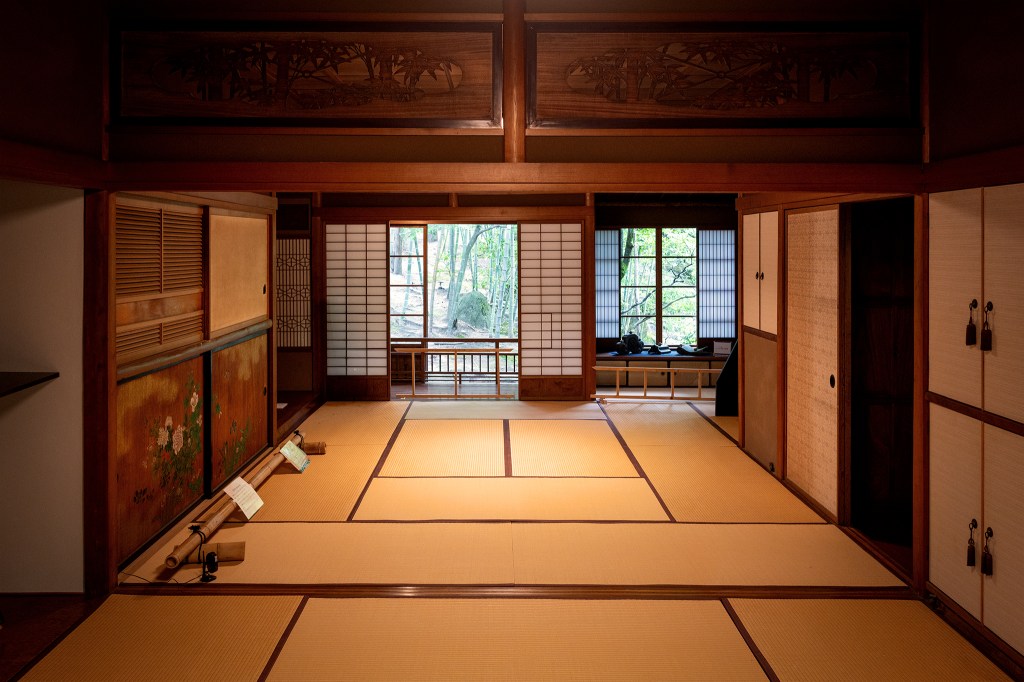
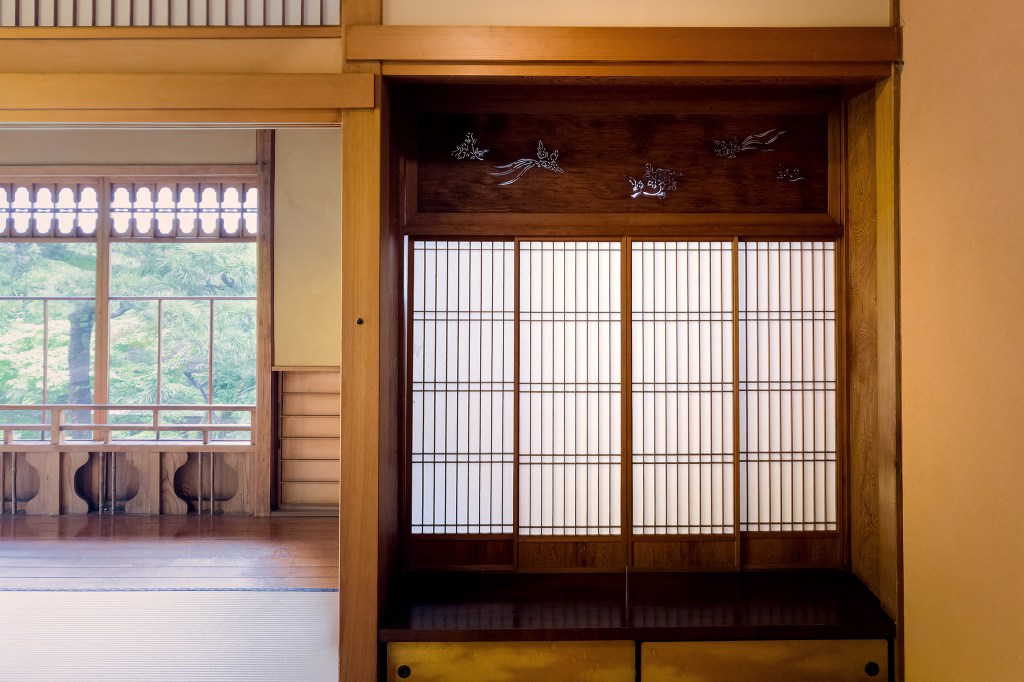
I go to the former villa of the Saito family, now converted into a museum. Despite the overcast weather, the house is splendid. It reflects the success of the merchants at the beginning of the last century, when Niigata became an international port. The woodwork is magnificent; sitting on the tatami, I look at the dense, intensely green garden. From the pond, paths rise towards small buildings. They allow one to sit down and simply contemplate the beauty of the place. The link to nature and to culture is visible everywhere; it is not a pretext, it is the very essence of the construction. This place has a flavour, it commands respect, it makes one want to sit down, simply to listen and hear whether the wind sings a little, whether today’s rain splashes with a sound from another time. The koïs open their mouths in search of food, dragons in the making, slightly beggarly.
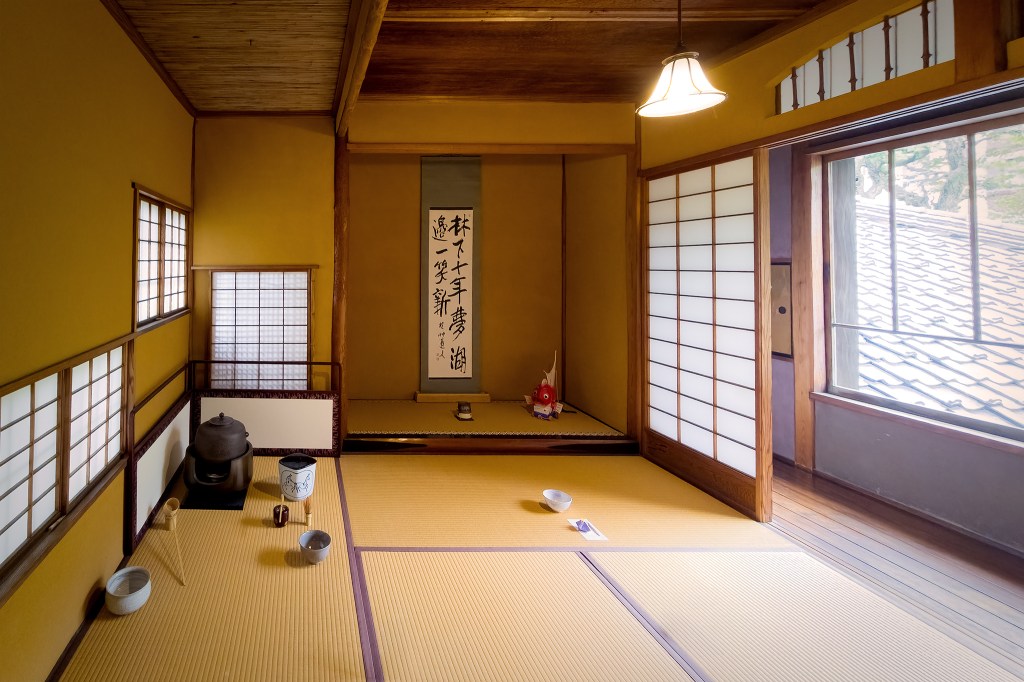
Upstairs, an immense room completely open onto the garden adjoins the place of the tea ceremony. It is small, discreet, almost erased, only a few tatami large. On the floor, the objects seem abandoned, ready to be used, now with no one left to bring to life the ritual gestures performed so many times. Time has stopped; only memories still pass by, brushing against the wood, the ceramic, the mother-of-pearl. A flavour can be sensed, it fills the palate, runs down the throat, warm; it is the green velvet of matcha tea. A sound passes, that of tabi brushing against woven rush; the sound recalls the discreet little footsteps of the past.
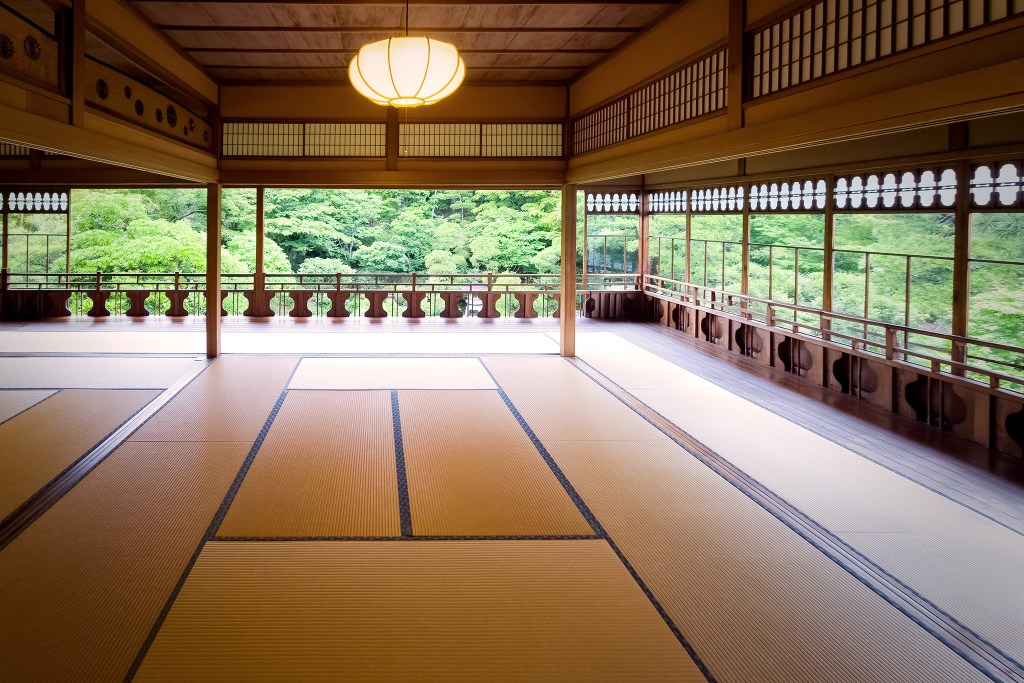
The room open onto the garden on three sides is perfectly empty. The tatami are surrounded by a wooden terrace adorned with carved balustrades. The intense green of the garden is framed by the spaces left by wooden panels removed during the day. At nightfall, they slide perfectly, pushed by expert hands closing the house off from darkness. It is evening time, the time of strident frogs, moths, lanterns with hesitant flames revealing the whims of the wind. The sounds change, seeming sharper, sometimes more unsettling; they tear through the shadow without revealing their intentions.
It is time to drink, to eat. One must not let oneself be fascinated by the shadows of the past; they are solitary, they want your company, I know them well. In a city, light is not difficult to find; it shines with a thousand electric fires. This is so true in Japan that bars and izakaya light a lantern when they are open. Come to my place, says the light. I accept. A journey always passes from shadow to light, from light to shadow; it tosses about, a hesitant bundle of sticks in the current.
The 04&Beer has a few stools along the bar, barely a table; it welcomes me without difficulty. The owner is a rugby player. He serves craft beers with meticulous care while casting knowledgeable glances at the matches of the Japanese team, broadcast continuously on the television. Other reminiscences of the past offered by the magic window, another shadow to avoid. It takes my neighbour seventeen seconds to speak to me in eccentric English. Surprise: he knows Europe, he has visited Brussels, he tells me about 小便小僧, the little boy who pees. The conversation suits a Japanese beer bar.
小便小僧
Shōbenkozō – Manneken-Pis.
What could be more natural than getting to know one another in a bar while discussing the various merits of Japanese breweries and microbreweries, which are already competing in excellence? Learning from the best, reproducing as well as possible, improving. An old Japanese habit; it has lost none of its effectiveness with time. A couple arrives and sits down at the bar; very quickly, the conversation begins with my new neighbours. Another surprise: the man too has visited Europe, Brussels. He laughs until he cries as he tells me about his discovery of dirty, foul-smelling urinals; we remain within the theme. Still, I need advice for my evening meal, and the place is ideal for obtaining the name of an izakaya where the nigiri are memorable.
In Japanese, sushi refers to a set of dishes based on vinegared rice mixed with fish, meat, vegetables or eggs. When the topping is placed on the rice in an individual portion, it is called nigiri. Rice rolled in sheets of nori with its filling is maki. Rice served in a bowl and covered with ingredients is chirashi. Rice surrounded by a sheet of nori with a soft topping on top, such as salmon roe, sea urchin or fish tartare, is gunkan. There are another half-dozen types of sushi whose essential base is vinegared rice, though not necessarily raw fish. Many different toppings are used. Raw fish alone is called sashimi; the term can also refer to raw meat.
The izakaya Marui is not far away; it lies in the heart of Furumachi. A place at the counter awaits me; I am seated beside an elegant couple. The izakaya is large, the counter forms an angle and can accommodate around ten people. Behind me, low tables follow one another on tatami; shoes must be removed, and one eats cross-legged on the floor, a demanding exercise, which I sometimes do. The izakaya seems deep; there are other rooms farther back, closed off with sliding panels for eating in discretion. Three sushi chefs are busy behind the counter in front of me; one of them smiles at me very kindly, and an elderly lady asks me what I would like to drink.
My neighbour barely gives me time to answer. He recommends the nihonshu he is already drinking and offers me a glass; his wife says good evening to me with a bow. That is the magic of being alone in Japan: with a little luck, chance brings you into contact with Japanese people curious about foreigners visiting their country. This is especially true in places where tourism is rare; Niigata is a perfect example. In front of me, warm pearls of rice are extracted by the expert hands of the chefs from large black pots. In a few precise gestures, the oblong form of the nigiri is sculpted, ready to receive the piece of raw fish previously cut with precision.
Each fish has its own cut; some are lightly incised on top, as if streaked by the sharp knife, barely marking the silvery skins. The gesture is always clean, a single pass along the entire length of the knife, the hand flat above the fish, without pressing, simply to hold it still. Fatty fish are cut a little thicker, fibrous fish a little thinner. There is a style, a rhythm, a precision; the final goal is to adapt perfectly to the pearls of rice. The chef decides the amount of wasabi placed under the fish. With the first nigiri, he always asks whether it is accepted. Not all nigiri take it; some call for ginger, others have enough flavour and even avoid soy sauce. Sometimes a few herbs are placed on top, and a brushstroke of house soy sauce accompanies certain fish.
With a final broad gesture, slightly theatrical, the chef places his composition before you. He sets beside the nigiri, in a small mound made with his fingertips, the young ginger, marinated in rice vinegar, sweet, salty, cut into thin slices. Its role is to cleanse the palate between each nigiri; it refreshes the mouth and makes it possible to move from one flavour to another. Nihonshu can also serve this function. One should look at the nigiri; it is a way of respecting the chef’s work. My neighbour is served at the same time as I am; I wait as he does. Then, with a clear gesture, the nigiri is picked up with the fingers, the fish dipped in soy sauce, never the rice, and finally put into the mouth in one greedy bite.
There begins the ritual of tasting. My neighbour and I grunt with pleasure as we chew, mouths full, smiles on our faces. The flavours, from rice to fish, from wasabi to soy sauce, give another dimension to the simple act of eating. A well-made nigiri has a unique texture, a unique warmth; it is the perfect food. That perfection defined by Jean-Pierre Léaud in Jean Eustache’s La Maman et la Putain: “…one must eat lukewarm and soft.”
The nigiri follow one another, interspersed with ginger and nihonshu; the conversation has settled in and drifts calmly to the rhythm of the pearls of rice. The three of us talk about our respective countries, about the pleasure of travelling, of encountering other cultures, of eating and drinking such delights in Niigata, in the Furumachi district where my friends for an evening live. In eastern Japan, surrounded by mountains, on the shores of the Sea of Japan, a particular day comes to an end. It has crossed geography, history and the culture of a country where emotions mingle with encounters. As evening falls, the nigiri and the glasses of nihonshu are offered to me, witnesses to the generosity of the people here.
Mata ne


