

Tōkyō lies before me. The city stretches much farther than my eyes can see, yet the height of my vantage point allows me to imagine its size. The first impression is intimidating, people, movement, images, sounds overwhelm the senses. The city seems immense and endless, it makes one want to take refuge somewhere so as not to be swept away by the crowd. Yet Tōkyō has many faces, many rhythms, many colours. The parks, the small streets, the cheerful evenings in the Izakaya, solitary nocturnal walks through the quiet night, discreet temples almost hidden away, all give Tōkyō a human dimension.
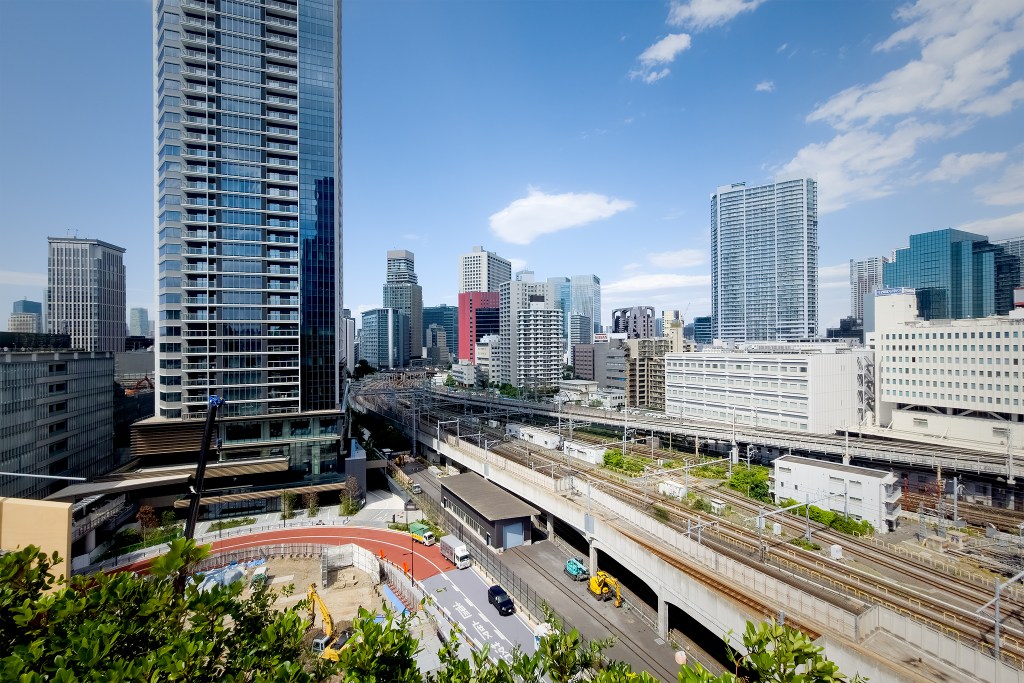
From the panoramic rooftop of the MoN Takanawa: The Museum of Narratives, I gaze out with Hisae, our feet in the water, at the giant electric train that the Japanese gods have offered me today. The tracks are countless and the trains keep passing by, Shinkansen, Express, Local, Metro, the whole range is there. In the distance, between two buildings, my friend points out the Monorail, floating high above the ground as it links Haneda Airport to Shinagawa.
We turn our heads in every direction, captivated by the view, our bare feet swirl in the cool water; in Tōkyō everything turns, eyes, tracks, hearts. The wind too, it turns in small warm and sensual gusts, without insisting. It announces, it warns, I am the emissary of the coming typhoon, it has risen from Okinawa and has already reached Shikoku, soon it will be over Tōkyō. What could be more Guruguru than a typhoon?
ぐるぐる
Guruguru – that which spins.
This term refers to things that whirl, things that go round and round, its sound is typical of a language that loves turning onomatopoeia into adjectives. The theme of the MoN Takanawa exhibition is precisely this, to show that many things in the world are Guruguru. From the modern representation of the expanding universe to the thoughts that endlessly loop inside our brains; from the daily cycle of human life to palindromes that can be read in both directions; from the cycles of nature that concern us all to the fingerprints that make each of us unique.
The very heart of Tōkyō contains a particularly remarkable Guruguru element, the Yamanote Line. This unique railway line shapes the daily lives of the people of Tōkyō who use it several times each day. The Japanese Ministry of Transport estimates its ridership at 4 million passengers per day! Being crushed inside a carriage during rush hour provides a genuine glimpse into what it means to live and work in Tōkyō. It is an unpleasant but essential experience if one wishes to understand life in this city.
The Yamanote Line defines a centre in Tōkyō, one is either inside or outside its loop, which extends for more than 34 kilometres. Its 30 stations provide access both to the other railway and metro lines that cross the city and to its main centres of attraction. Tōkyō Station, Shinagawa, Shibuya, Shinjuku, Ikebukuro, Ueno, Akihabara. Trains run in both directions, the complete circuit takes one hour and, because it runs above ground, it allows passengers to observe many aspects of the Japanese capital.
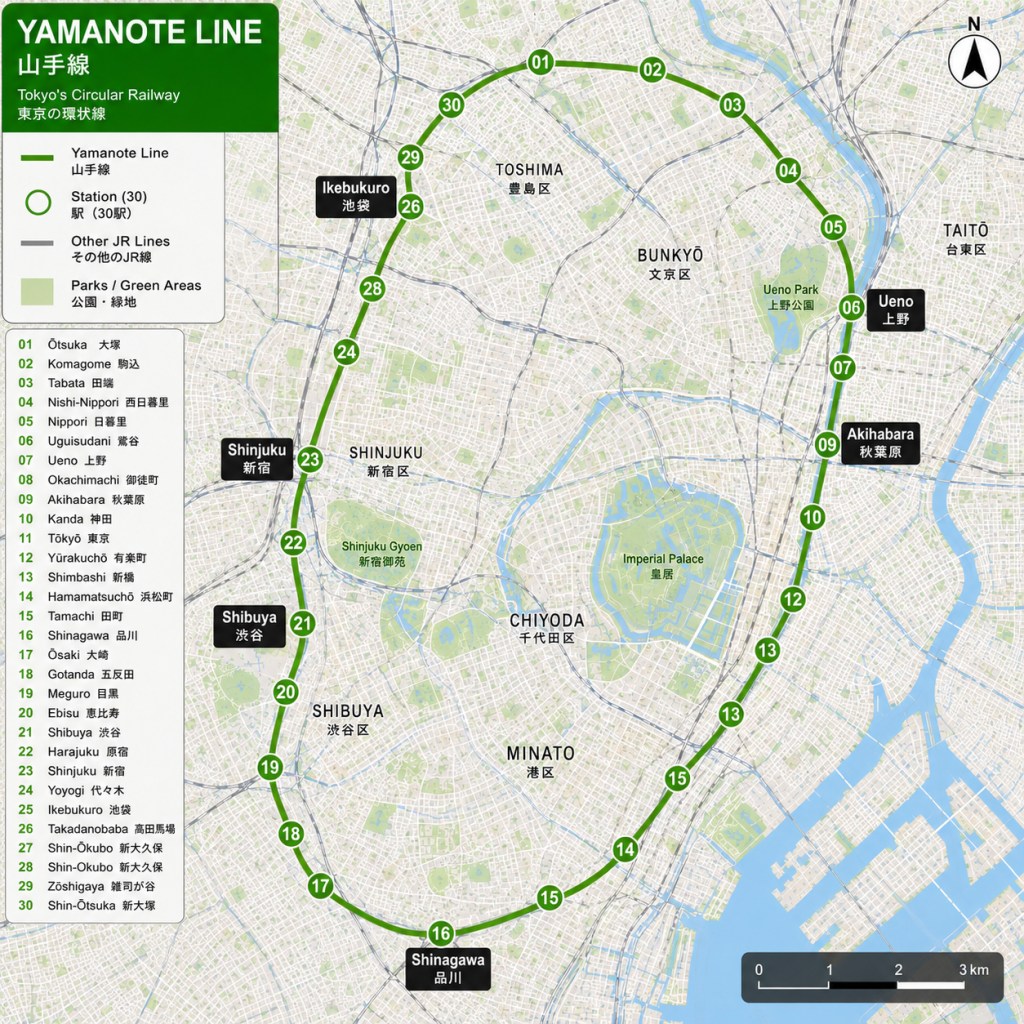
The following day, it is precisely at a station on the Yamanote Line that I meet Hisae as we head west of Tōkyō to Mitaka, where Osamu Dazai spent his final years and where his grave is located. From Gotanda we travel to Yoyogi to board the Chūō-Sōbu Line, whose terminus is Mitaka Station.
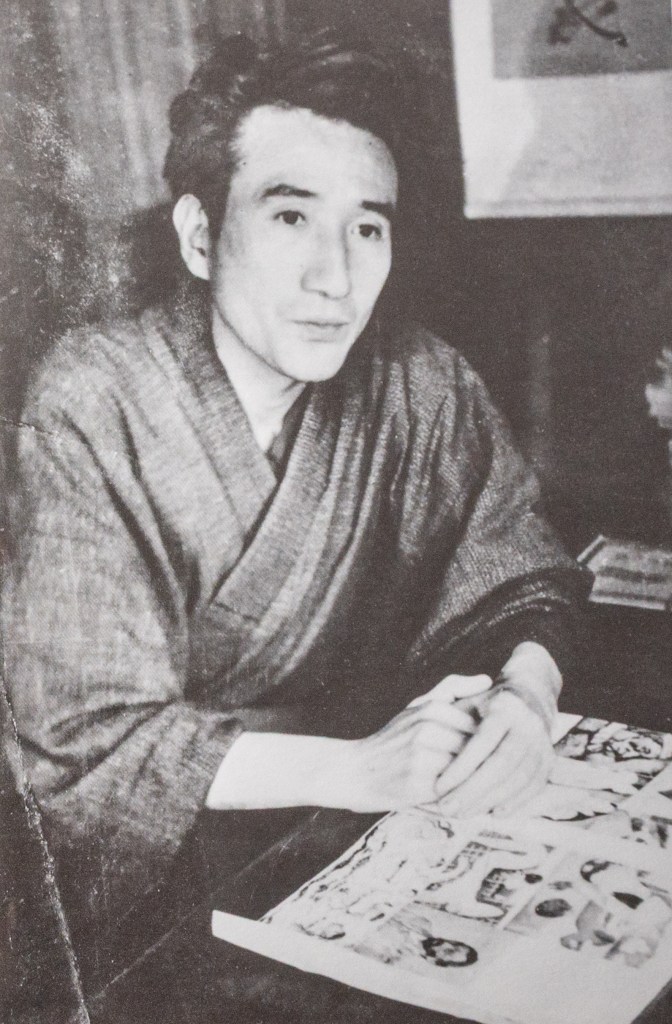
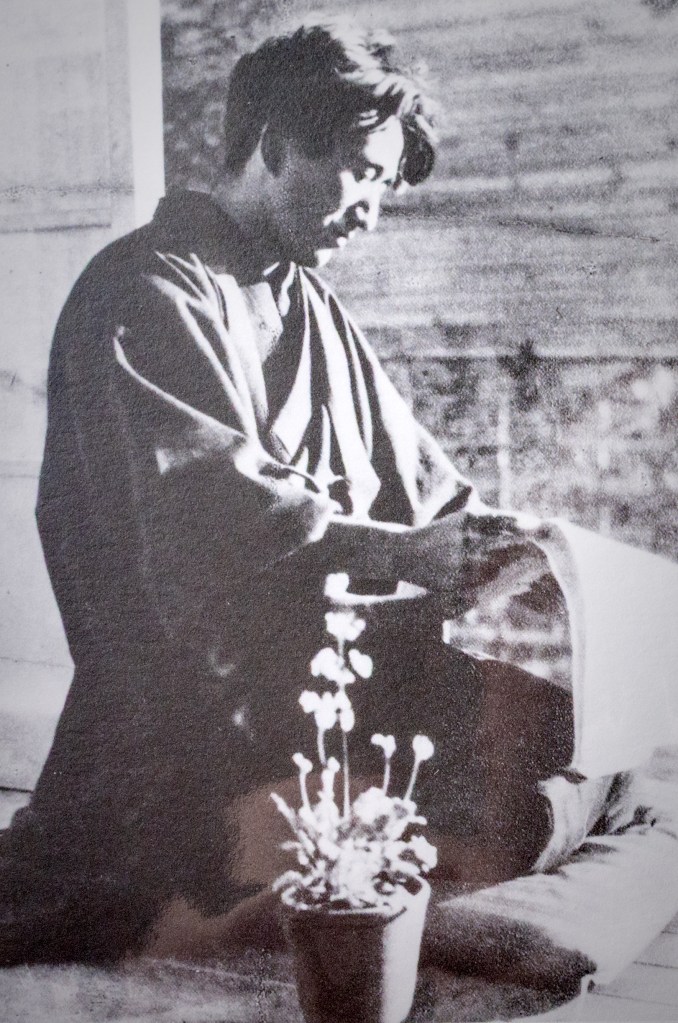
Osamu Dazai settled in Mitaka in November 1939 with his wife Michiko Ishihara. He was thirty years old and the most prolific period of his career began there. It would end with his suicide in June 1948 together with his lover Tomie Yamazaki. It was a 心中, the Japanese lovers’ double suicide; it was far from Dazai’s first attempt, but it was the successful one. The bodies of the two lovers were found in the Tamagawa Aqueduct, an irrigation canal built during the Edo period; they were identified on June 19, the very day of the writer’s birthday. Since then, that day has been known as 桜桃忌, the Cherry Festival, the annual commemoration dedicated to Osamu Dazai.
心中
Shinjū – lovers’ double suicide.
桜桃忌
Ōtōki – Osamu Dazai Memorial Day.
Mitaka no longer resembles the descriptions from the time when Dazai lived there. The rural village no longer exists, almost all of the paths where the writer used to walk have disappeared, as have the bars where he drank himself beyond reason. What remains is the canal where he ended his days, and it is still possible to walk along its tree-lined banks. The places where he lived are now reduced to plaques on joyless walls. It is a modern residential area with plenty of greenery where it nevertheless remains pleasant to stroll. The most famous place is the Ghibli Museum (the Japanese pronounce it Giburi), dedicated to the famous anime production studio whose leading figure is Hayao Miyazaki.
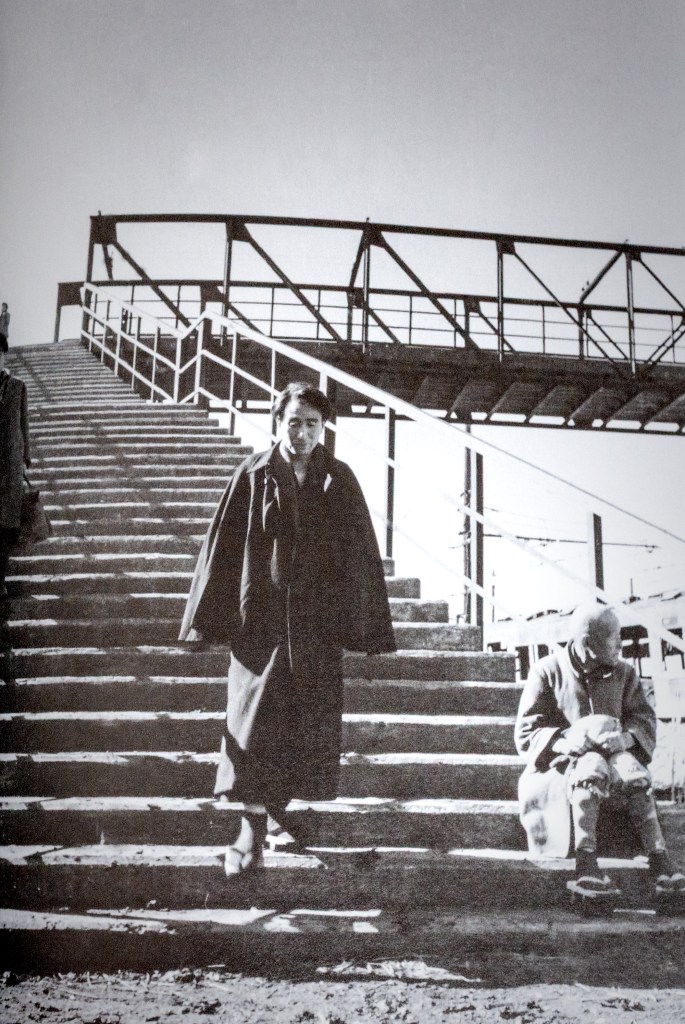
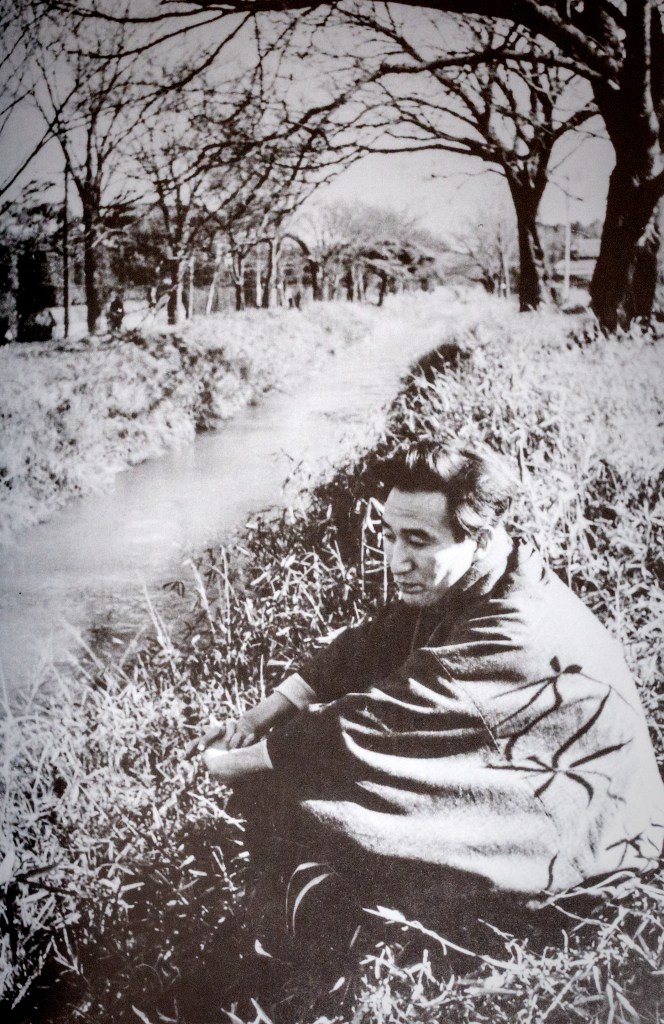
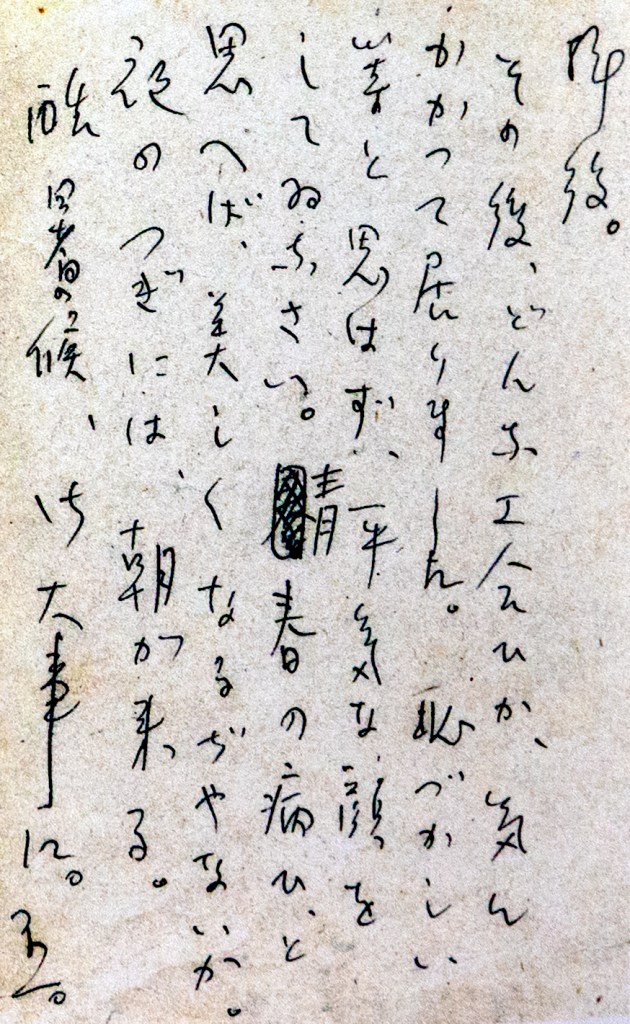
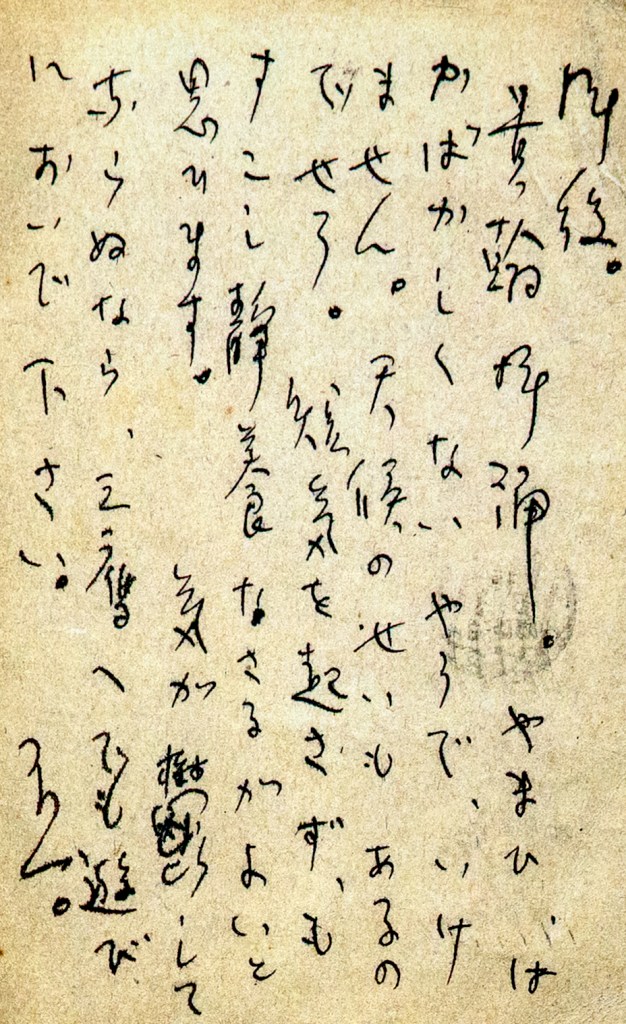
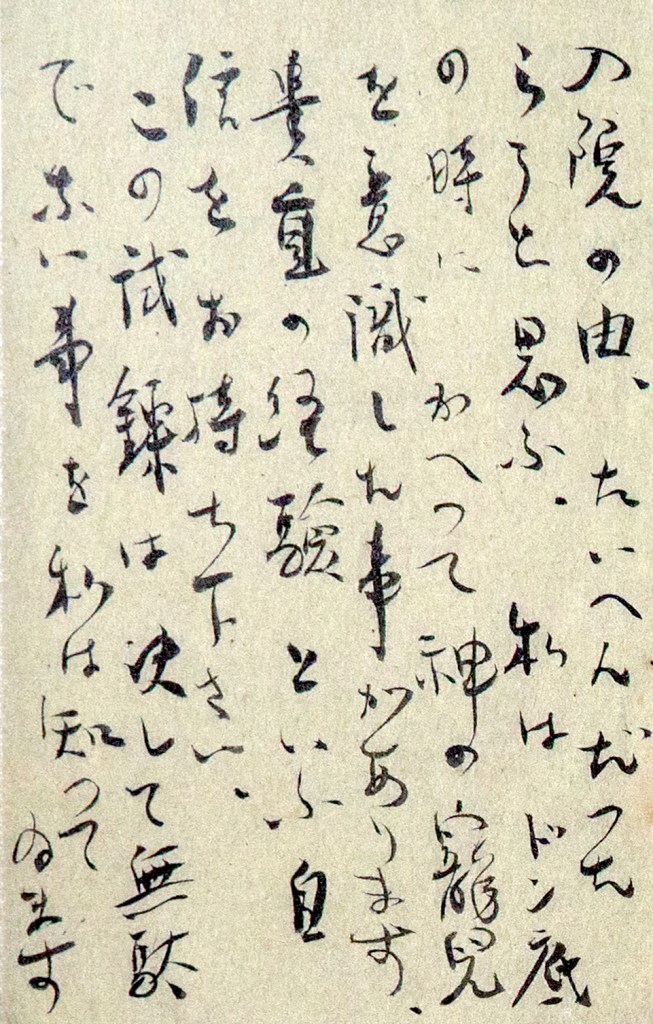
The Osamu Dazai Museum also exists, located on the fifth floor of a concrete building directly opposite Mitaka Station. It is not very large. Handwritten pages by the writer reveal a style of writing that is broad yet tortured. The kanji seem to have been written in pain, reflecting that familiar image of Dazai, a suffering face already lost to life, lost since the beginning. I cannot read anything, but Hisae translates certain titles and references to his work for me.
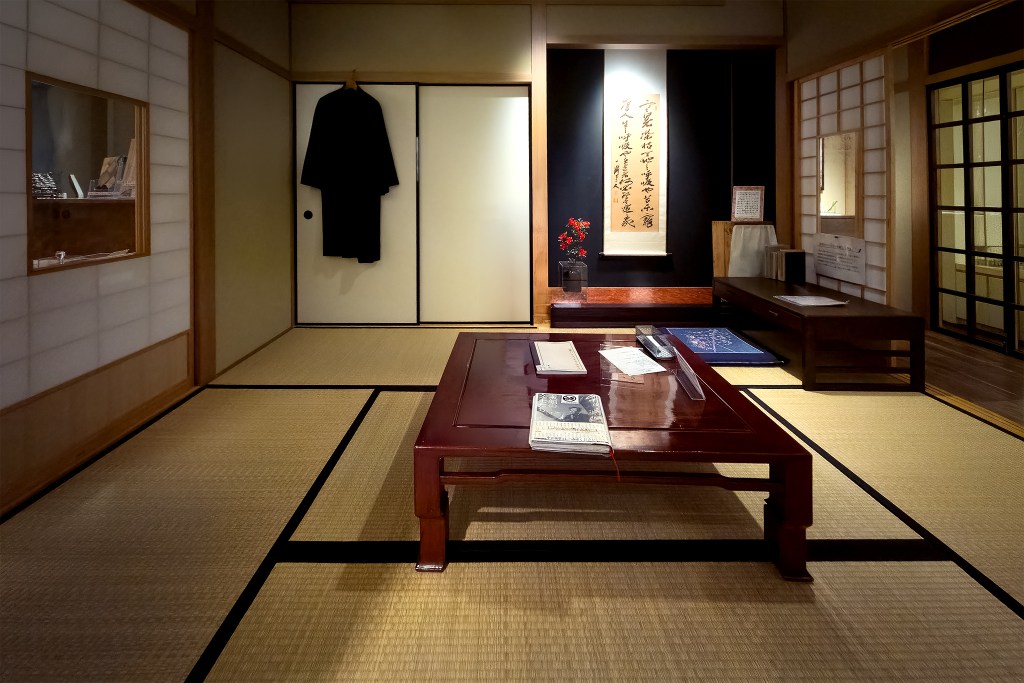
The six-tatami room where Dazai wrote has been recreated. A low table, his famous black coat hanging from a hanger, a 掛軸 suspended in the 床の間, the alcove where works of art are displayed. It is the only place where photographs are permitted. Visitors enter after removing their shoes. The place is moving, for a brief moment the writer’s solitude comes through. A discreet breath, like a respiration that stops and hesitates before beginning again. Dazai’s spirit is somewhere within these scattered pages, within the wood of the table where the texts were born, within that coat hanging alone and sadly.
掛軸
Kakejiku – hanging scroll.
床の間
Tokonoma – alcove where works of art or flowers are displayed.
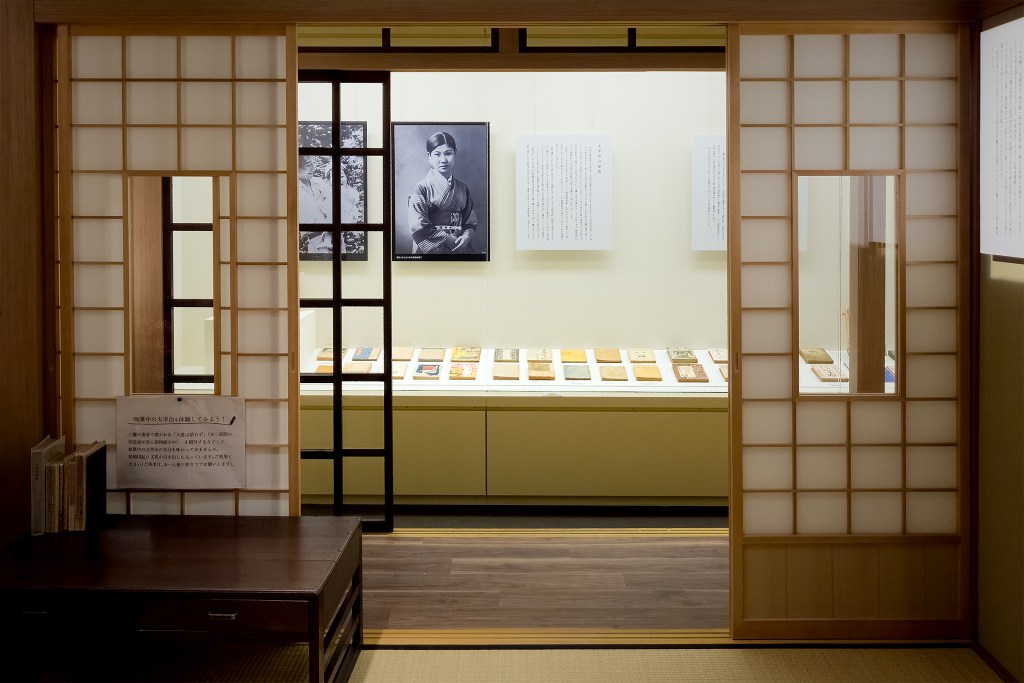
In the corridor running alongside the room stands a portrait of his wife in kimono, seemingly gazing at the recreated space where her husband wrote. Her face appears resigned, although the shadow of a smile emerges, probably an attitude dictated by the era when a Japanese woman posed for a photograph. Beneath the portrait, the complete works of Dazai are arranged in chronological order; I imagine they are first editions.
A few steps from the museum there is an Osamu Dazai literary salon. An entire wall is covered with books and his works can be found there in several languages. His novels, short stories, fairy tales and essays are available to readers. There are a few tables where one can drink coffee while reading. Small items connected to the author are for sale; a notebook bearing his likeness, pencils decorated with some of his quotations, photographs recalling his life in Mitaka.
A young woman is reading alone while drinking coffee, completely absorbed in her book. It moves me to see someone so young reading this author with such attention; her own parents had not yet been born when the writer died. What does she find in these texts? A critique of society that remains relevant today? The pastel tones of a Japan that no longer exists? An echo of her own difficulty with life? Simply the beauty of his writing? Perhaps all of these things at once. The scene is touching, but I keep it for my own eyes, for my own memory, there is no question of stealing it, one must simply remember it because it is beautiful.
Is she reading: “Human beings were born for love and for revolution.” (Villon’s Wife, 1947); or perhaps, “Society… but in the end, society is you.” (No Longer Human, 1948); or finally, “Are human beings truly capable of love?” (The Setting Sun, 1947).
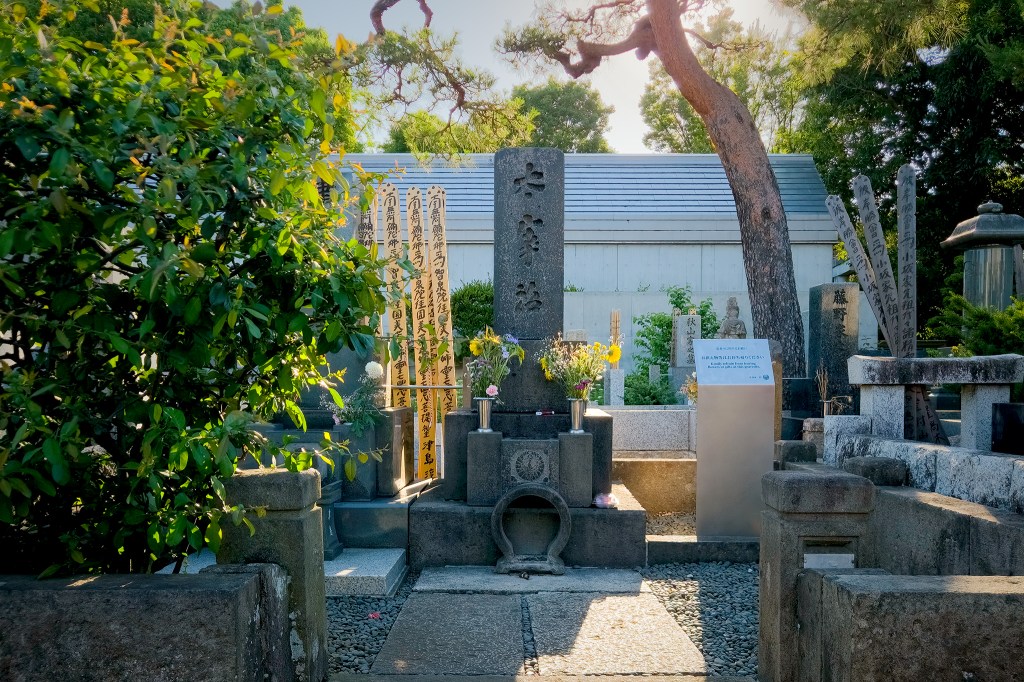
Time passes gently, one final step remains, to bow before the grave of the man I came to see. In the Buddhist cemetery it is clearly marked and not difficult to find. Upon it rest a lighter for the cigarettes of the afterlife and a few cherries in preparation for the June 19 commemoration. I think of Ozu’s grave in Kamakura, always adorned with various bottles of alcohol, and I am surprised not to see any here.
But then another young woman joins us before the grave, bowing respectfully for a long moment. In a certain way this keeps Dazai alive, he is still being read even though he is becoming difficult to find in some bookshops. It gives me hope for the future because the questions raised by the writer are essential, necessary for the continuation of life. On his grave, beyond the wall of the Buddhist cemetery, there is a setting sun. It thanks me for being there.


