

Returning to Kanazawa means seeing true friends again, walking once more through the streets of the old city that I know by heart, looking to see whether anything has changed since the last time, feeling the emotion grow with every step. Everything began here, in these streets where my love of Japan was born.
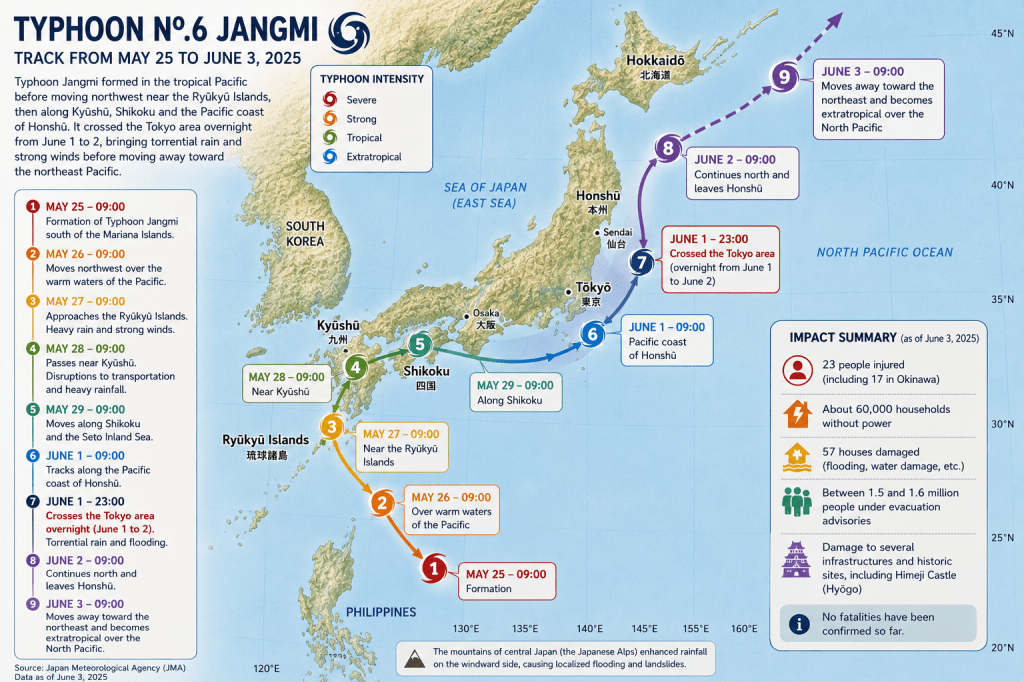
Something really has changed compared with every other visit. It is not hot, it is actually rather cool in the evening, and I am truly not used to that. Typhoon No. 6 passed over Tōkyō on the night before I left the city, but that cannot have affected the temperature in Kanazawa, the two cities are separated by the Japanese Alps. Travelling by Shinkansen, you cross them through numerous tunnels and can see the highest peak of the Northern Alps, Mount Okuhotaka, which rises to 3,193 metres.
Seven peaks above 3,000 metres are arguments that even a typhoon can understand. Having formed east of the Philippines, Typhoon Jangmi moved northwards within a few days to Okinawa. From there, its path bent towards the north-east, crossing Kyūshū and Shikoku before reaching Tōkyō and once again taking a northerly direction. The damage was considerable and 1.5 million people received evacuation orders. I was fortunate, the Shinkansen was running and during the journey I could see the rivers swollen with water, overflowing and still rushing at great speed beneath the bridges.
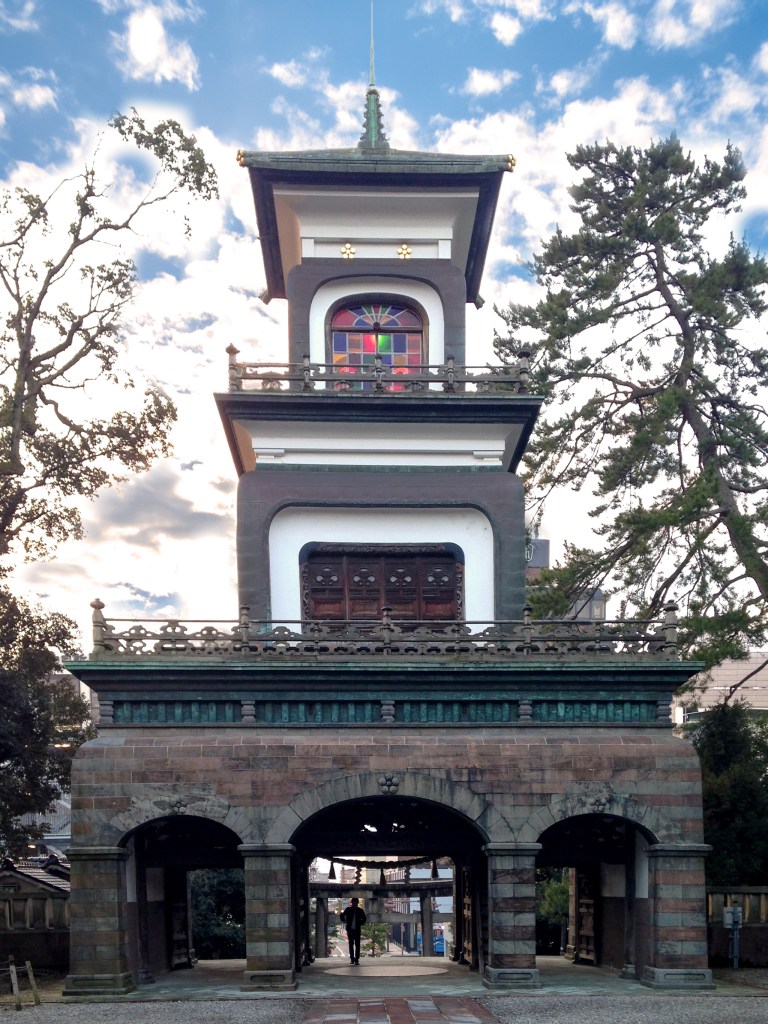
So it is cool for my first walk beneath a cloudy but rainless sky. The sun has not yet appeared, but patches of blue promise that it may. The ritual can begin, I leave my hotel in Katamachi and follow the Sai River, I cross the winding streets of Nagamachi, the old samurai district, before climbing towards the shinto shrine Oyama-jinja where I greet the guardian demon dogs that protect it.
Curiously, the main entrance is crowned by a strange structure that resembles a church, I have never seen another example of this kind of construction. Its story is in fact that of Japan’s passage from the feudal age to the modern era. This tower was built in 1875, at the time when Japan was opening itself to the world, and combines Japanese, Chinese and Western architecture. Perhaps its most surprising feature is its stained-glass windows, illuminated at night and reminiscent of a lighthouse.
Crossing the shrine grounds, it is possible to reach Kanazawa Castle through the imposing Nezumita-mon. You reach this gate by crossing a bridge and it leads to Gyokusen-inmaru, the magnificent little garden below the main castle. That is not my destination this morning, I cast a quick glance at the small pond crossed by winding stone bridges where people test their balance for the challenge of it, it is as beautiful as ever, and I continue on my way towards Ōmichō Market and my morning coffee.
Higashide Coffee opens at 9 a.m., a kissaten is not a place for breakfast before work, it is a place where coffee is prepared in the old way, by hand, with the only machine being the grinder that crushes the beans. This is where I write in Kanazawa, seated at a splendid wooden counter decorated with delicate cups patterned in bright colours, they carry the fragrance of another age, but even more than that they are filled with the aromas of precious coffees from around the world, Africa, South America, Asia and Europe.
I always begin with the owner’s own roast, the Higashide Blend, before moving on to slightly stronger flavours, Rwanda, Ethiopia, Colombia. Here, they know my habits. I then avoid passing through Ōmichō Market, too crowded at this hour, even though it is spectacular with its giant crabs and oysters, its unfamiliar fish with jaws that can sometimes look frightening. I shall come back later for lunch, for the moment the walk continues towards Kanazawa’s other river, the Asano, which separates Kazuemachi and Higashi Chaya, the two geisha districts.
To reach the river, I once again pass through the quiet little streets where no tourists ever come, crossing the small Hikoso Ryokuchi Park is essential. It is tiny, it is part of the pleasure of my walk without belonging to me. Sometimes, a couple gently take photographs of one another among the trees and shrubs identified by discreet little signs. Most of the time, there is no one there, nothing but the chirping of bold and mischievous little birds. They settle close to me, sing while looking at me, tilting their heads from side to side. I hear them say, “Well, here you are, 久しぶり.”
久しぶり
Hisashiburi – it’s been a long time.
I walk down towards the river, leaving the little park through its other wooden gate, the street leads to the bank downstream from the wooden bridge that geishas once crossed as they moved from one teahouse to another. During their long evenings of work, the most popular among them would move from engagement to engagement, performing dances, music, poetry recitals and taking part in social and political conversations while serving sake in gracefully decorated little cups. Geishas are artists of the world of flowers and willows, 花柳界. The flower evokes beauty, blossoming and the refined arts, the willow symbolises grace, suppleness and the elegance of movement.
花柳界
Karyūkai – the world of flowers and willows.
That world still exists and is accessible to Western visitors through performances intended for foreigners and presented in English. But for a genuine evening in the company of geishas, one must be introduced by a regular patron, a trusted person, in the hope of being accepted. There are several levels of access, simply sharing a drink at the bar of an お茶屋 in the company of geishas, I have been fortunate enough to experience that. But for a full evening, accompanied by songs, dances, poetry, dishes and sake served by the geishas themselves, the standards for admission are very high. Not quite as high as the prices.
お茶屋
Ochaya – teahouse.
I look at the teahouses of Kazuemachi along the Asano River, they are magnificent, often mysterious, difficult to enter even though many are now restaurants or izakaya. Not everyone is welcome. It is possible to leave the riverbank and enter through a narrow street into the heart of these old houses. With a little luck, for a few seconds, one is transported back to another age. The truly precious days are those, so very rare, when a geisha crosses your path for a brief moment without granting you the slightest glance. Faced with such beauty, one would like to disappear rather than spoil the moment. I have been fortunate enough to know that feeling.

The Higashi Chaya district is far more touristy, lively and crowded. Visitors compete for matcha tea shops and every imaginable product covered in gold leaf, the pride of Kanazawa. Cakes, ice cream, tea, everything is covered in gold, dragon figurines compete with shinto deities in displays of splendour. A thousand reflections sparkle in a single golden eye behind the crowded shop windows. I do not care for these shops, but the district remains very beautiful despite the crowds. The idea is to avoid the famous streets and make one’s way towards quieter corners where getting lost for a few moments is a welcome rest.
I retrace my steps towards the market. It is time for lunch at Ōmichō Ichiba Sushi, it is three o’clock in the afternoon, the perfect time, there will be very few people. Hidden away in the heart of the market, the little 寿司屋 has a heart-shaped counter, slightly misshapen, surrounding the sushi artists at work. Along the top of the counter, one can still see the rail that once carried sushi to the customers. No longer in use today, it serves as a display for the day’s recommendations. At every seat, a hot-water tap allows customers to prepare their complimentary green tea. I prefer to order directly from the sushi masters, it creates a bond, symbolised by their smiles when they see me take my seat. 久しぶり.
寿司屋
Sushiya – sushi bar.
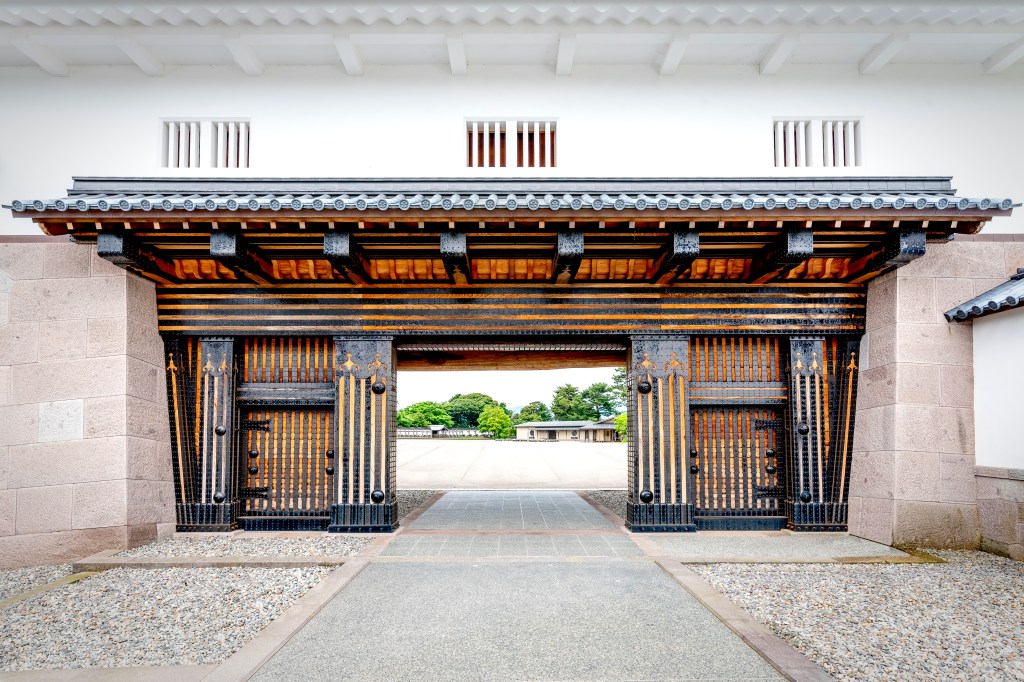
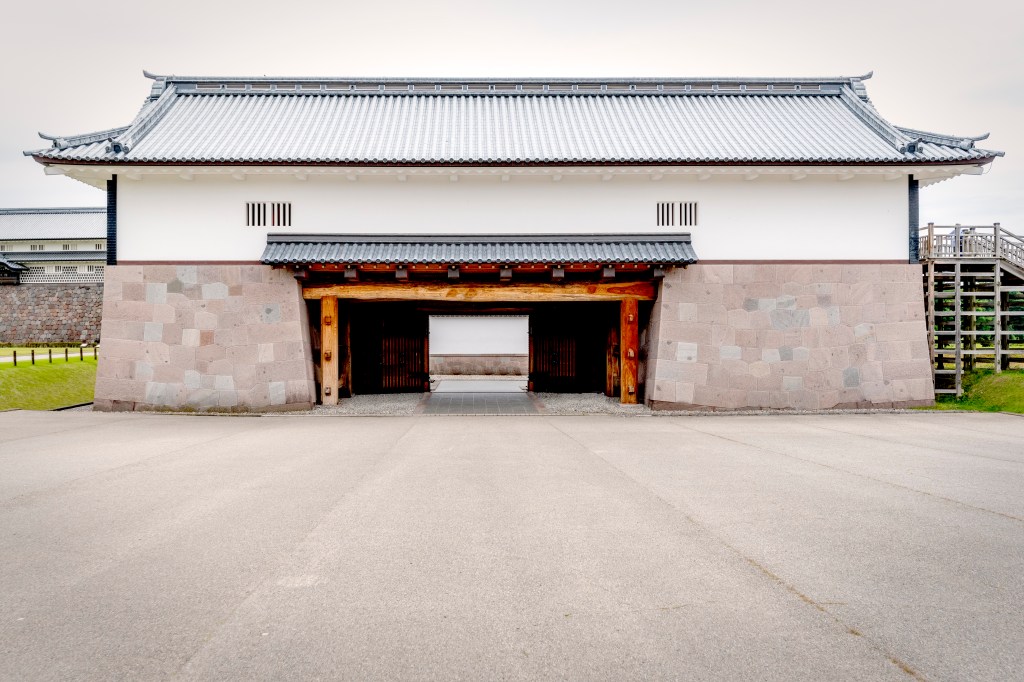
From Ōmichō Market, it is only a few hundred metres’ walk to reach the northern part of the castle grounds, the Shin-maru Hiroba, which must be crossed to arrive at the Kahoku-mon Gate. Rebuilt in 2010, it reflects what most castles in Japan actually are, recent constructions. They were destroyed by wars, floods, typhoons, fires, earthquakes, or simply abandoned. The rise of tourism in Japan has been an important driving force behind their reconstruction, that of Kanazawa Castle dates from the end of the twentieth century.
Beyond the Kahoku-mon Gate, the castle stands to the right, immense and majestic. It has been entirely rebuilt according to modern earthquake-resistant standards while using traditional construction techniques. The exterior is of stone, the interior entirely of wood, every joint is fitted together according to ancient methods, without a single screw or nail anywhere in the structure.
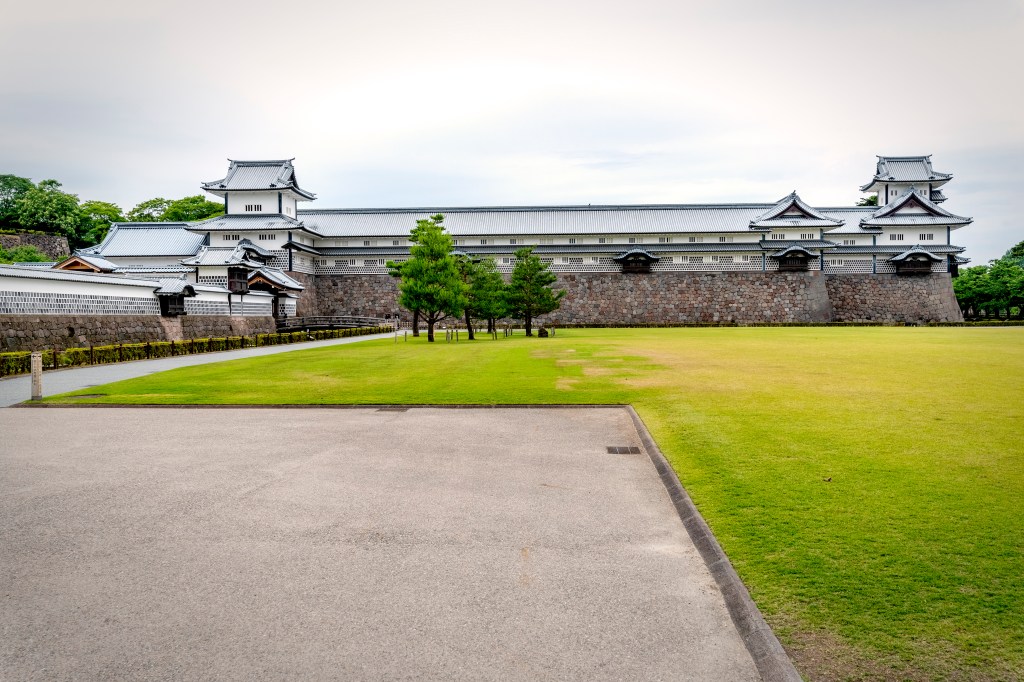
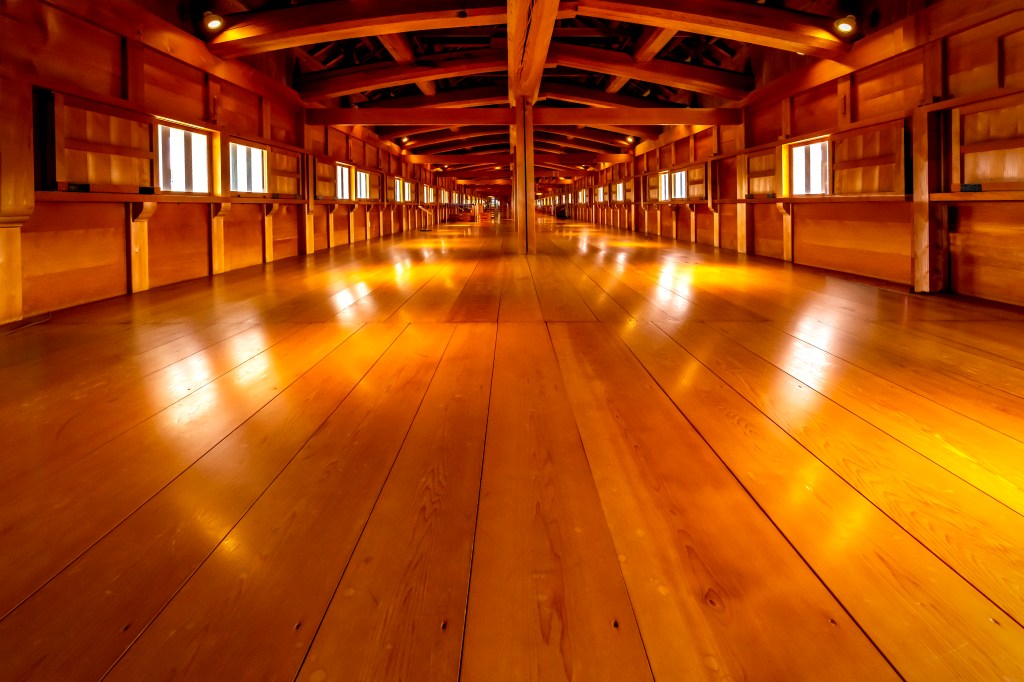
My destination today, however, is not the castle, but Kenrokuen, one of the most beautiful gardens in Japan. One should visit it late in the afternoon, around five o’clock, an hour before closing, when most of the tourists, whether travelling alone or in groups, have already left, leaving only the true lovers of gardens, among whom I count myself. The lantern, the koïs, the teahouse, the little white bridge, the streams, the ponds, the artificial rivers, the carefully placed stones, the rocks thoughtfully arranged, the birds, every year everything is the same and everything changes. Old stories and new stories come together here and become my own.
Today’s walk comes to an end at my adopted shrine, Kanazawa Jinja. It is dedicated to Tenjin, the shinto deity of learning, literature, poetry and examinations. People come here to pray for success in their studies and achievements in learning. I am nothing more than a student in Japan, I learn about the country, I learn about its people, I learn about its culture, I learn the language. To do so, I follow the harmonious ways every day, sometimes unexpected, sometimes improvised, always rewarding.
Tomorrow, I shall set out to discover the historic Hyakumangoku Festival, where thousands of people parade in period costume from the station to the castle in honour of the Maeda daimyō. The day after tomorrow, I shall attend a Noh performance, it will be my second experience. Every evening, I shall meet my friends in Kanazawa again, the friends of old stories and the friends of new ones. There is a particular languor here, that of nights that become days, a particular smile, that of those whom I am happy to see again, a particular flavour, that of 一期一会, the people one meets, speaks to, and will never see again.
一期一会
Ichigo ichie – one moment, one encounter.
Mata ne.


