

The journey from Kanazawa to Gifu, at the foot of the Japanese Alps, includes a stop in Tsuruga, the Shinkansen terminus for trains arriving from Tōkyō. It is a bit of a rush during the transfer, barely eight minutes to reach the platform for the Shirasagi Limited Express. The crowd is dense and hurries along so as not to miss this train linking Tsuruga to Nagoya.
The route follows Lake Biwa, but you have to wait before it comes into view as you approach Maibara, where the train seems to turn back on itself before heading deeper into the mountains. It is Japan’s largest freshwater lake, covering more than 670 km². Opposite Maibara, on the far shore of Lake Biwa, lies beautiful Kyōto, a city that should now be avoided. Between burgers and pizzas, the hordes roam its streets in pursuit of futile portraits of themselves. I have not returned since the autumn of 2022, and I think sadly of that little Zen temple I love so much.
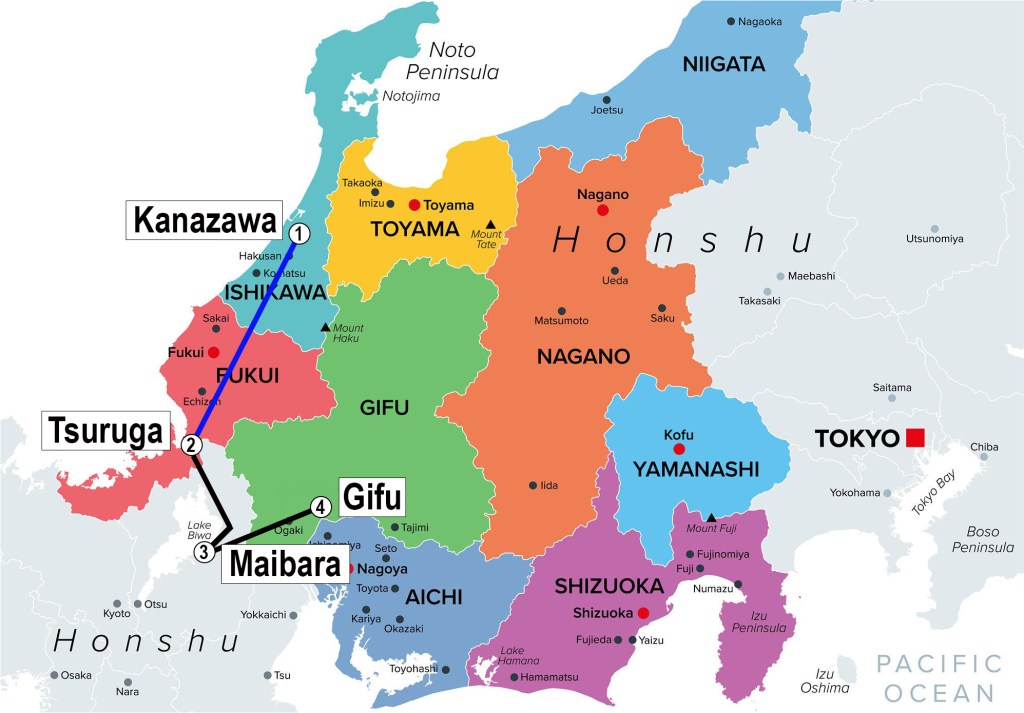
Gifu is the opposite of Kyōto. It attracts almost no foreign visitors; however, it is an important historical reference point for the Japanese. The city is linked to one of the most popular figures in Japanese history, Oda Nobunaga, the first great unifier of Japan. When he seized Gifu Castle in 1567, it was still called Inabayama and belonged to the Saitō clan. It occupied a strategic position in the mountains between Kyōto and eastern Japan.
By choosing the name Gifu for his castle, his new headquarters, Nobunaga listened to the scholars who advised him and made a major political statement. The first kanji of the name, 岐, refers to the Chinese Zhou dynasty, considered a model of power at the time. The second kanji, 阜, evokes the birthplace of Confucius. In doing so, Nobunaga proclaimed his desire to create a new Japan, a united Japan. He had a motto engraved on his seal that would become famous: 天下布武 (Tenka Fubu). It may be translated as: “Spread military power beneath heaven,” or more evocatively: “Unify Japan through arms.”
I am not a historian; I am a travelling student, but I enjoy context and it nourishes me. Yet it was not the famous samurai who drew me to Gifu, but a predator of a very different kind, the cormorant, terror of the ayu, a master fisherman at the heart of a tradition still practised on the Nagara River, the 鵜飼. The Japanese Imperial Family itself owns boats dedicated to this unusual form of fishing.
鵜飼
Ukai – cormorant fishing.鵜
U – cormorant.飼
Kai – to raise, use, direct.
Gifu is a small city away from the tourist trail, and it becomes apparent very quickly. In the streets, Japanese people smile at you, greet you, sometimes even talk to you. At a red light, a cyclist stops and asks me in English where I come from. I answer in Japanese. He is surprised. These fleeting encounters while travelling are perhaps the most memorable.
Gifu Castle stands atop Mount Kinka, more than 300 metres above sea level, dominating the city. It is easy to imagine how difficult it must once have been to capture. A ropeway takes me to the castle, but I can only look at it. It is undergoing renovations that will last several months. All the surrounding hills are forested, lush green, criss-crossed by hiking trails. They wind their way down towards the city, which stretches along both banks of the Nagara River.
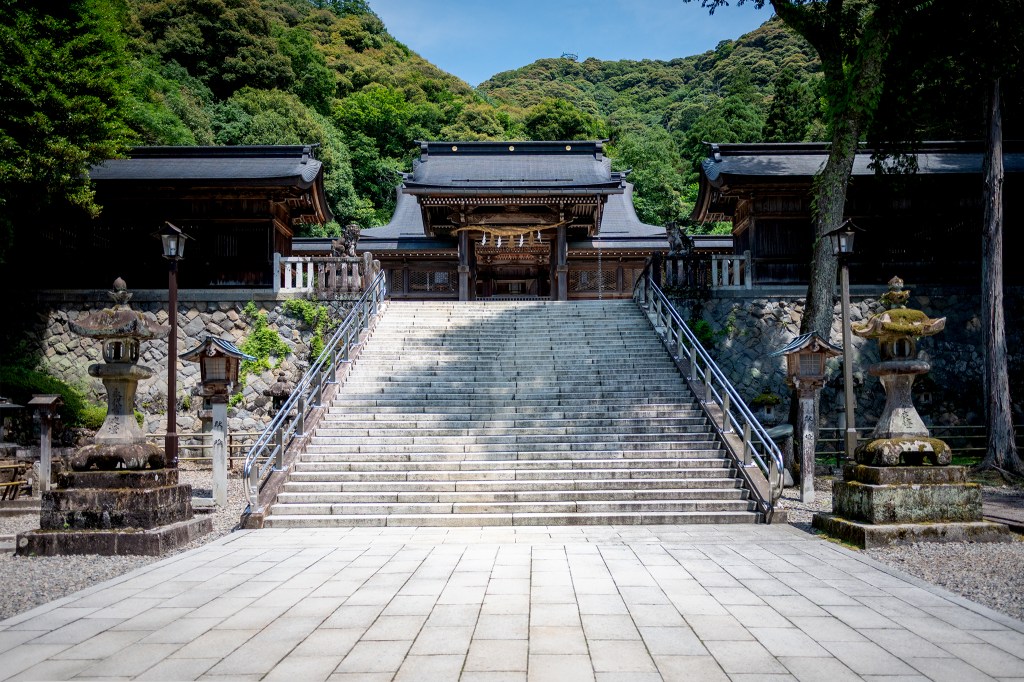
I am meeting Takehiro at the end of the afternoon, so I have plenty of time. I met him last year, we stayed in touch, and he suggested we meet in Gifu to experience cormorant fishing together. I head to Inaba Shrine at the foot of Mount Kinka. The place is magnificent, nestled among the trees and backed by the hillside. You must climb many steps beneath the sun to earn the right to make a wish. Bow twice, clap twice to attract the attention of the kami, make your wish respectfully, clap once more, and bow one final time.
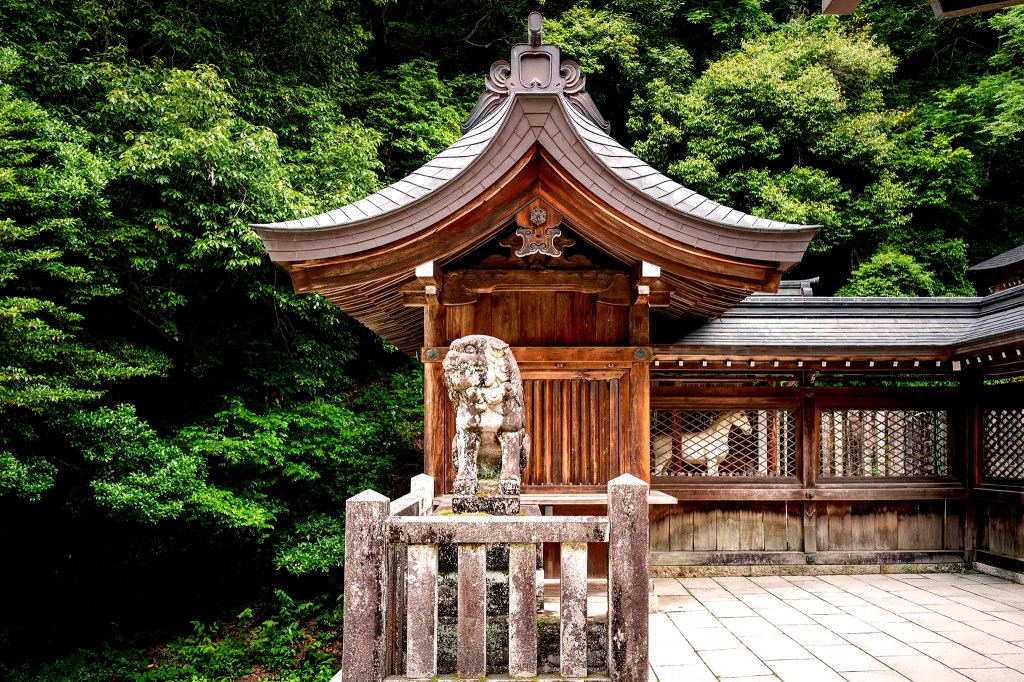
At the top of the steps stand the 狛犬, the lion-dogs that guard the inner precincts of Shintō shrines. They look very old, and I learn that they date from the Edo period. The shrine itself is far older. According to tradition, it was founded in the first century CE. Long before Nobunaga arrived, it was already one of the principal places of worship in the region. The shrine also preserves komainu dating from the sixteenth century, Nobunaga’s era. Protected within the sanctuary, they are artefacts of incalculable historical value.
狛犬
Komainu – lion-dogs guarding temples and shrines.
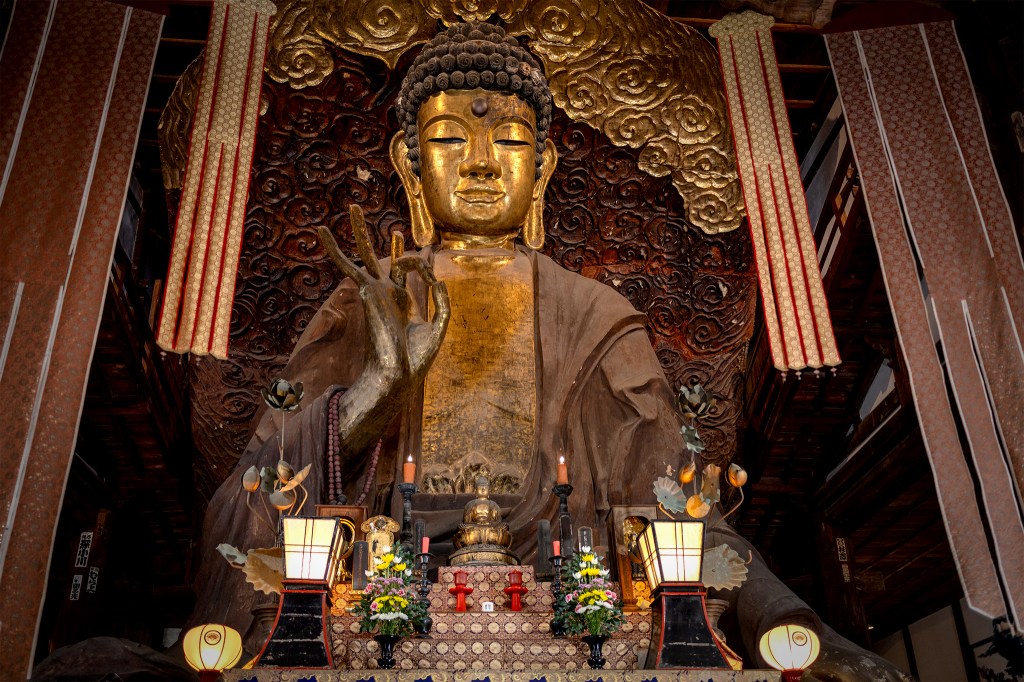
Before reaching Kawaramachi, the old merchants’ district, there is the Buddhist temple Shōhō-ji, where a majestic Daibutsu, a great seated Buddha, reigns. It is one of the three largest in Japan alongside those of Nara and Kamakura. Its distinctive feature is that it was built around a bamboo framework, over which clay was shaped before being covered with lacquer and gold leaf. Standing more than thirteen metres tall, it contemplates me in solitude. In Nara and Kamakura, crowds gather around the Buddha; here, there is almost nobody.
On either side of the Daibutsu stand rows of Rakan, five hundred in total. They represent disciples who attained enlightenment. Each differs in posture and expression, illustrating that people of many different personalities can achieve awakening. A Japanese friend told me about them in Morioka. According to her, everyone can find a reflection of themselves among these statues. I remember finding mine there, the Rakan unable to sit in the lotus position because he was too stiff. That was undoubtedly me.
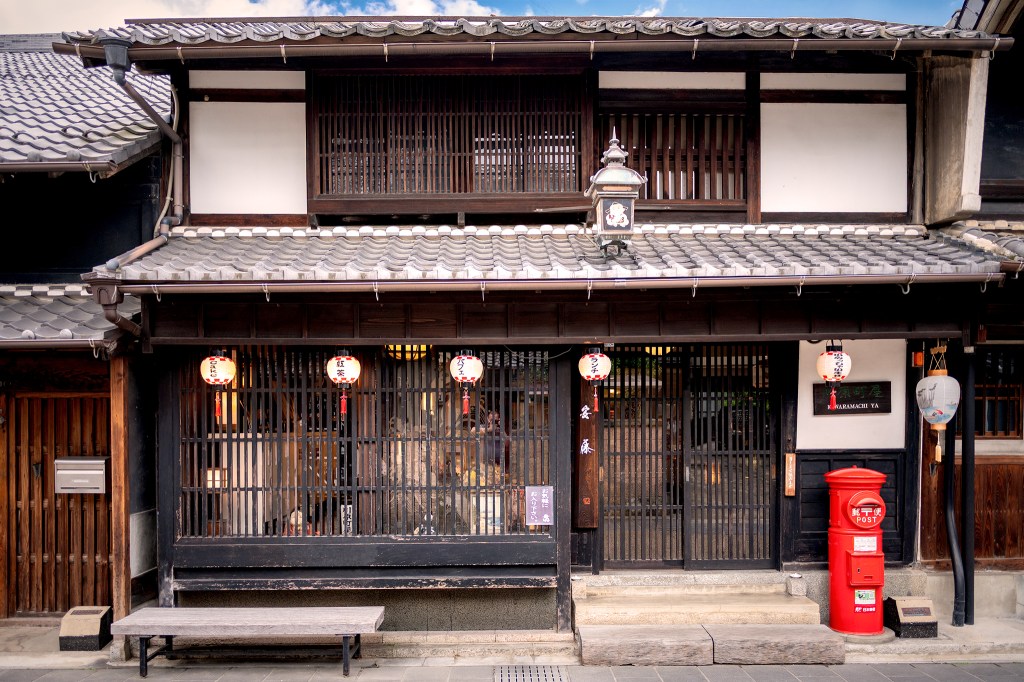
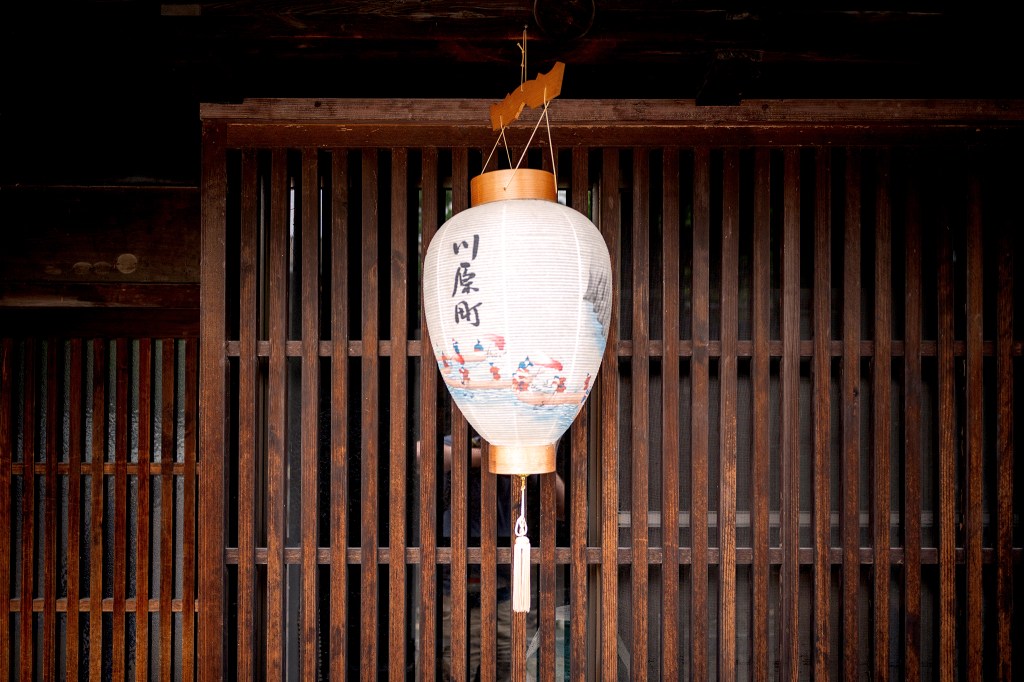
Kawaramachi is my final stop before meeting Takehiro at the pier where the boats await us. I still have time to wander among these magnificent wooden houses. Today they are restaurants, inns, and shops. The district first flourished during Nobunaga’s time, but most of the buildings visible today are restorations of structures dating from the late Edo period, in the mid-nineteenth century. Paper, wood, oil, lanterns, and fans were once Gifu’s specialties. What remains is the nostalgia of a stroll at the hour when shadows lengthen. The light gives the wooden façades warm colours, enhanced by the gentle swaying of lanterns decorated with cormorants and fishing boats.
At the end of the street, Takehiro is waiting while enjoying an Asahi Super Dry. It is time to experience the cormorants. He has already taken care of buying the food and beer we will enjoy aboard while waiting for sunset. Fish onigiri and ayu, the small river fish caught by the cormorants. We head towards the riverbank where the boats are lined up. A cormorant fisherman, an ushō, dressed in traditional clothing and wearing a straw apron, explains the technique used to prevent the birds from swallowing the fish they catch. A ring blocks the lower part of their throat, allowing only small fish to pass through. The bird can store six or seven large fish in its long neck, after which it is made to regurgitate them. A somewhat harsh but effective technique.
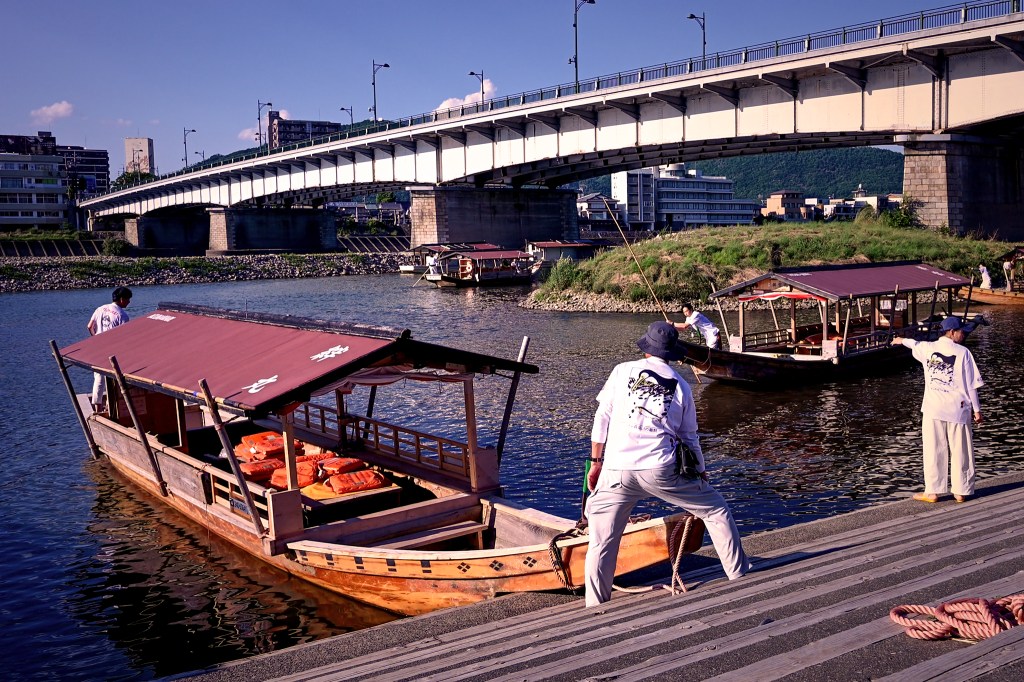
The wooden boats, covered by roofs, await us. They are lined up along the quay, some more luxurious than others. These are reserved for those who have chosen the meal served on board. Sitting face to face as if in a Japanese subway carriage, twenty of us board, shoes removed as custom dictates, each carrying our provisions. In Japan, no activity seems complete without food and drink. Apart from me, everyone aboard is Japanese. The sun slowly sinks to our left while two boatmen, armed with long bamboo poles, push us steadily in the opposite direction.
In the centre of the boat, a long table separates the passengers seated directly on the floor for safety reasons. There are benches, but we are not allowed to sit on them while the boat is moving. The sensation of being so close to the water is pleasant. I admire the sailors’ technique as they push alternately and move along the hull. At the stern, a single helmsman is enough. On other boats I notice women performing the same task with equal efficiency. The water glows with the red reflections of the setting sun. Everything is calm and beautiful.
We must wait for complete darkness. It gives us time to eat, drink, and exchange smiles and pleasantries with our travelling companions. The conversations are cheerful and happy. Boats filled with children pass just a few metres away while we remain moored along the bank. They wave at us and spontaneously challenge the adults to games of rock-paper-scissors from a distance. Whether they win or lose, they laugh just the same. In such moments, Japanese people reveal their childlike side, always ready to marvel at the simplest things, always willing to join an impromptu game. These are delightful moments full of emotion, when without warning the child we once were reappears.
The start of the fishing is announced by a small fireworks display. Each burst of fire, each 花火, draws admiring ooohs and aaahs; marvelling at simple things. In the distance, large glowing orbs appear beneath the fireworks. They are the boats of the master cormorant fishermen, their braziers lit at the bow, illuminating their steady progress along the current. In the water, twelve cormorants on leashes pull with all their strength in search of ayu to swallow. They dive and emerge with frantic energy. Their excitement is almost frightening beneath the ghostly light of the wood fires, which regularly release glowing embers that drift close to the agitated birds.
花火
Hanabi – fireworks (literally “flowers of fire”).
The spectacle is impressive. Were it not for the cameras clicking around me, one could easily believe oneself transported to ancient times, before the age of machines. Like pagan gods, the master cormorant fishermen control twelve leashes, watching over their winged prisoners, alternating firmness and gentleness according to their behaviour. The braziers fulfil their role perfectly, staging the fishing, giving it the appearance of a titanic feat and the fiery colours of a famous river that separated the world of the dead from that of the living. The metaphor works well for the ayu. Some pass from life to death in the throats of the cormorants, while others escape that grim fate.
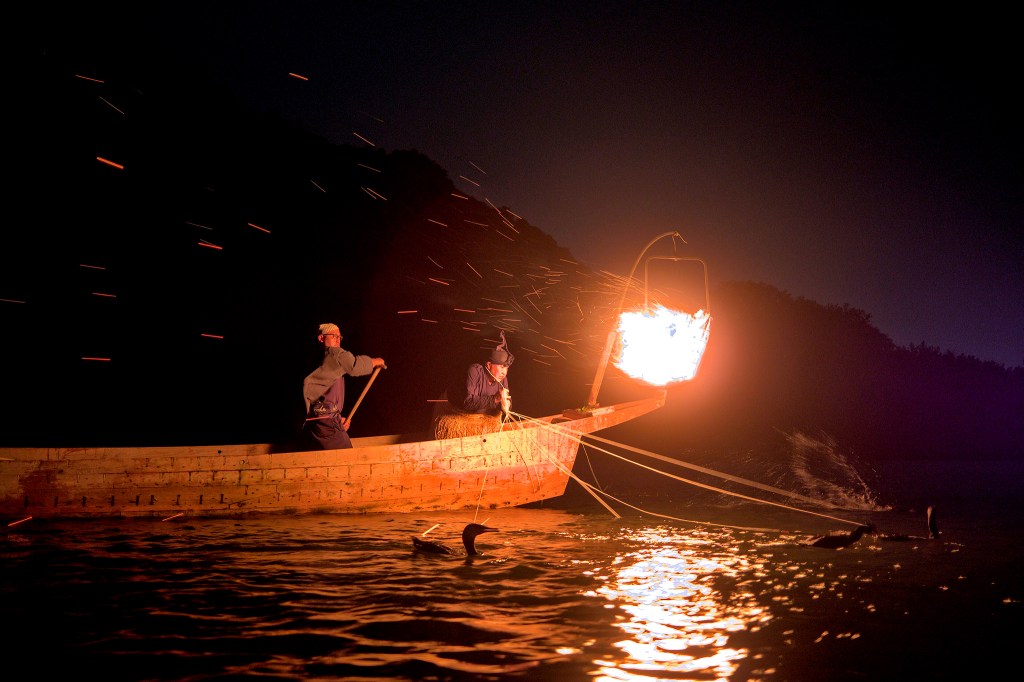
Several boats follow one another, and the spectators’ fascination never fades. Ours is attached to others in a long line. Takehiro and I are in the front row, on the right side of the vessel. Suddenly, the master fishermen’s boats stop. The scene becomes even more intense. The birds seem almost mad. In their eyes I can make out the gleam of the hunt, the disturbing frenzy of slaughter. The masters yank them from the water with precise movements of the leash before forcing them to regurgitate their catch. We are fascinated by the violence of the moment. Our childhood souls are buried somewhere within us, now overshadowed by the instincts of the hunters we once were long ago.
The fishing is over, and the return journey takes place in silence beneath the faint glow of the boats’ lanterns. What are we thinking about? The cormorants, the traditions, the fire, all the unusual images that have awakened something within us. Around me, I see mostly smiling faces, though a few traces of gravity remain. There is clearly an awareness that we have experienced something special, something that was more than a simple traditional fishing demonstration. A moment that reminds us of a long history of domination, exploitation, and predation of the living world.
In the taxi taking us back towards the city centre, Takehiro asks the driver for advice. I feel like finding a small local izakaya where I can eat local fish while drinking sake, thus embracing my role as a predator. The driver thinks for a moment. It is already late. He finally settles on a place called Gatsu. Without hesitation, he dials the number on the phone mounted to his dashboard. We can hear the conversation through the speaker. We are welcome. Last orders are at 11:00 p.m.
You have to go down to the basement, the Japanese B1 level, to enter a long, narrow izakaya. Two seats remain at the counter, waiting for us. The atmosphere is lively. Well-lubricated customers speak loudly, calling out to one another in laughter between the counter and the tables we pass on our way to our seats. The walls are covered from top to bottom with bottles: sake, shōchū, and Japanese whisky. People enjoy drinking at Gatsu. Behind the counter, the owner wears a mischievous smile and has clear eyes. He sizes us up immediately. We order sashimi. He suggests a few appetisers. Naturally, we want ayu grilled with salt.
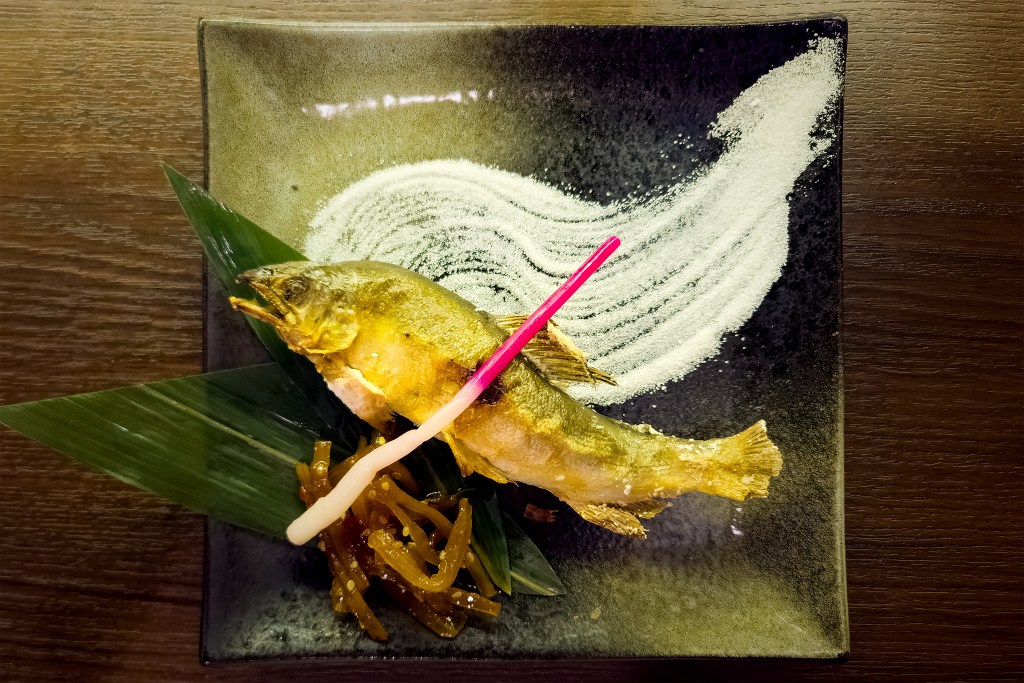
They are cooked skewered on sticks, giving their bodies a serpentine shape. You eat everything: the head, the tail, the bones, the skin. 塩焼き is delicious. A customer comes to sit beside us. He is perfectly drunk, extremely friendly, and orders sake which he shares with us. A foreigner in Gifu, in a place like this, remains something unusual. Alcohol quickly overcomes the natural shyness of our new companion. The owner tries to send him back to his own seat, but he does not bother us. He is simply part of the evening.
塩焼き
Shioyaki – salt-grilled.
At Gatsu, they play British rock from the second half of the twentieth century: the Stones, the Clash, the Beatles. It gives the place a distinctive charm. I returned alone the next day because the food is excellent, the sake outstanding, and the owner enjoyable company. We talked about travel, Europe, and Japan while sharing several fine sakes as his team prepared bentō boxes for the following evening’s cormorant fishing. Gifu is not a city that shows itself. It likes to be discovered. Travellers are welcome there, and I enjoyed watching it gently reveal itself.
Mata ne


