

Ohayou
July 2, 2025
Hakodate is located in the south of the island of Hokkaidō, which it remained the capital of until 1868, when the Japanese government decided Sapporo had a better geographical position for that role. Nevertheless, even today, Hakodate is a major communication port with the rest of Japan. It’s also the final stop on the Shinkansen line after passing under the sea through the Tsugaru Strait; it will be extended to Sapporo in 2030.


I’ve passed through many times without ever stopping—except to change trains and catch the Hokuto limited express connecting Hakodate to Sapporo in nearly four hours. It was my friend Hisae who gave me the urge to visit when she told me last year about the five-pointed star-shaped fort inspired by Vauban’s forts, the Hakodate 五稜郭. Sébastien Le Preste de Vauban, Marshal of Louis XIV, perfected the star-shaped fort as the ideal response to modern artillery and crossfire defense with its angular layout.
五稜郭
Goryōkaku – five-angled fort.

Goryōkaku was built under the Tokugawa shogunate between 1857 and 1866. It was designed by the samurai-architect Takeda Ayasaburō, inspired by the Citadel of Lille and with help from French military engineers sent by Napoleon III. Its role was to defend the residence of the island’s 奉行. Since 1853, the American “Black Ships” of Admiral Matthew Perry had forced the shogunate to open Japan to trade with the world. Hakodate thus became one of the first Japanese ports open to international trade. It was urgent to protect the representatives of the shogunal authority.
奉行
Bugyō – shogunal administrator, magistrate.
Two years after the fort’s completion, in 1868, the Tokugawa shogunate was overthrown by supporters of the emperor, who took back control of the country. The last loyalists of the shōgun, an army of 3,000 men led by naval officer Enomoto Takeaki, fled from Sendai aboard warships and seized Goryōkaku in Hakodate. They were accompanied by French officers who supported the shōgun, defying Napoleon III’s declared neutrality. Among them was Jules Brunet, a Polytechnique-trained artillery officer, whose mission—like that of the other French officers—was to modernize the shōgun’s army. Jules Brunet inspired the character played by Tom Cruise in the film The Last Samurai.
Hakodate was the site of the final battle of the Meiji Restoration, named after the emperor whose supporters overthrew the Tokugawa shōgun. Goryōkaku was the theater; 2,500 men lost their lives, mostly on the shogunate’s side. Rifles and cannons had long since replaced swords and wrought far greater destruction. It was the last episode of the Boshin War, also known as the Japanese Revolution. It lasted from January 3, 1868, to June 27, 1869, and ended two and a half centuries of shogunal rule.
Today, Goryōkaku is a garden with a few remaining walls. The Bugyō’s house is open for visits. The water-bordered star shape of the old fort can be admired from the 90-meter tower built next to it. I went up but had to flee—the chronic vertigo didn’t let me last more than five minutes. I couldn’t approach the windows or take a decent photo, so I borrowed one.

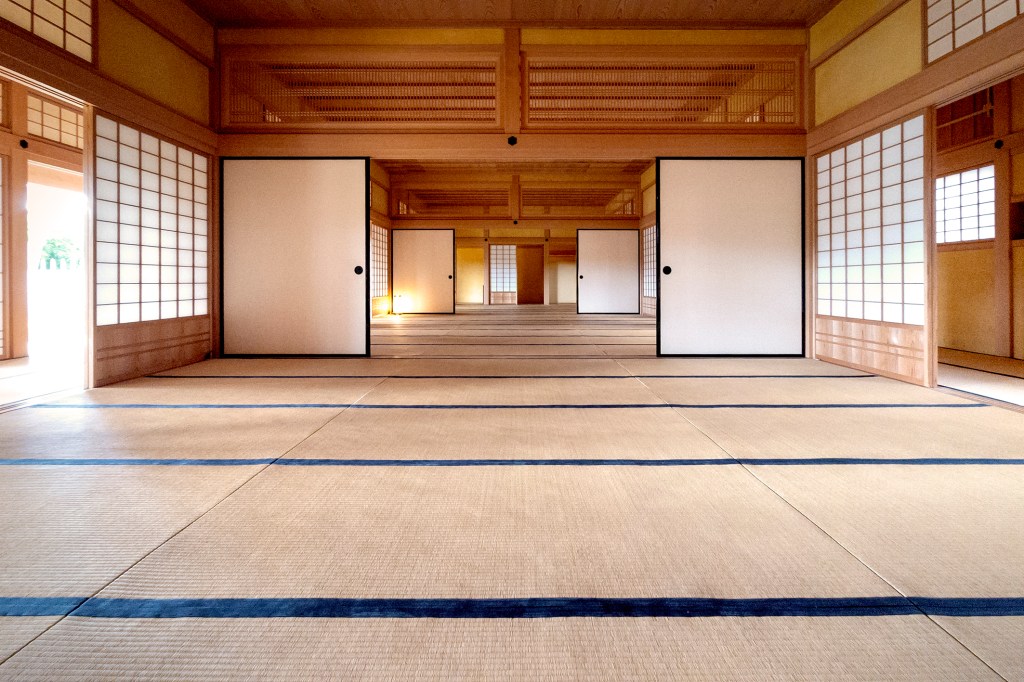
Visiting the old Bugyō’s house is worth it. For 600 yen, one can get a sense of a seat of shogunal power in the second half of the 19th century. Long abandoned, it was entirely rebuilt in 2010 using period techniques, especially the wooden pegging system, which is thoroughly explained. Rebuilding is a way to accept impermanence. Recreating it identically using past techniques gives the building a new level of meaning: it becomes exactly what it once was, and yet something else. A ruin holds no interest. Hisae, an architect, proudly told me about the meticulous and patient work done by the artisans.


The Motomachi district is a little over an hour’s walk from Goryōkaku—a stroll through a modern city that, like many in Japan, is a patchwork of very different styles, seemingly placed at random, with no apparent aesthetic logic. One constant: cables hanging from poles drawing a tangled sky, an electric web predating the digital one. I love walking in these streets with intermittent sidewalks, appearing and disappearing according to a logic I fail to grasp. Another constant: tactile paving for the visually impaired, absolutely everywhere—in the streets, underground, and even on upper floors.

Walking means discovering little things and making encounters. I spot a stadium with substantial bleachers, an athletics track encircling what seems to be a baseball field—the king of sports in Japan. I crossed a barrier, and an elderly man approached me. I expected to be asked to leave, but no—he kindly said there were no games today. But tomorrow, from 8 a.m., are the university baseball semifinals. He asked where I came from, thanked me for loving Japan, and told me 気を付けて, a common farewell.
気を付けて
Ki o tsukete – take care.
Near the station district, streets are lined with izakayas of all kinds that promise joy once it’s time to eat. At least one of them, which I discovered the night I arrived. I walked in and introduced myself properly: “Good evening, I’m alone.” The chef assessed me from his commanding position behind the counter, where he sliced fish and prepared sushi. He hesitated, but let me in, likely finding my approach polite enough. I had no regrets—the sashimi and sushi were exquisitely fresh, especially the squid, Hakodate’s specialty. It’s presented alive before being served sliced—hard to get fresher.
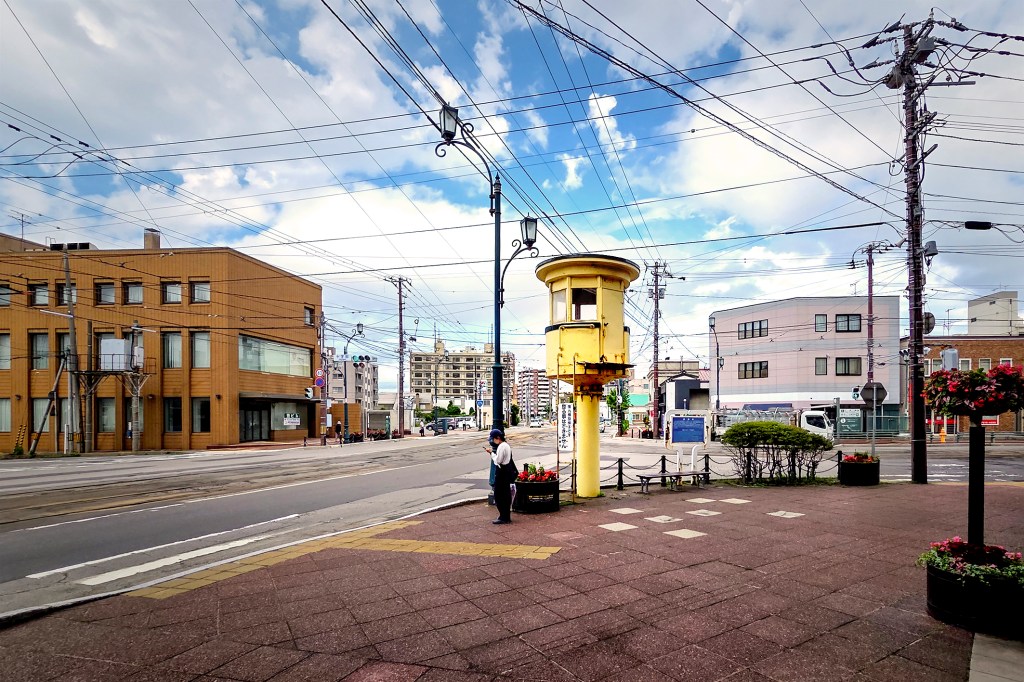
As I approached Motomachi, I saw a raised booth at a street corner, reminiscent of those where policemen once directed traffic, baton in hand, whistle in mouth. In fact, it’s a former tram switch control post. Hakodate was the first city to build a tram network back in 1913. It still exists, now modernized, but the post has been unused since the early ’80s. A little nostalgic charm that prompted a kind Japanese couple to offer to take my picture in front of this urban relic. I laughed and declined. We’d cross paths again several times in Motomachi.
This district, at the foot of Mount Hakodate, is surprising—it immediately reminded me of Nagasaki. It makes sense: Hakodate and Nagasaki were two of the three ports open to foreigners in the mid-19th century, the third being Yokohama. The architecture—reconstructed, once again—is mostly Western. This is where embassies, consulates, and foreign schools were first established. And naturally, Westerners built churches. At the end of the 19th century, they hoped to resume evangelizing Japan—a process halted at the end of the 16th century with the expulsion of foreign Christians and the forced conversion of Japanese Christians. It was a resounding failure: today, nearly 150 years later, fewer than 0.4% of Japanese are baptized.
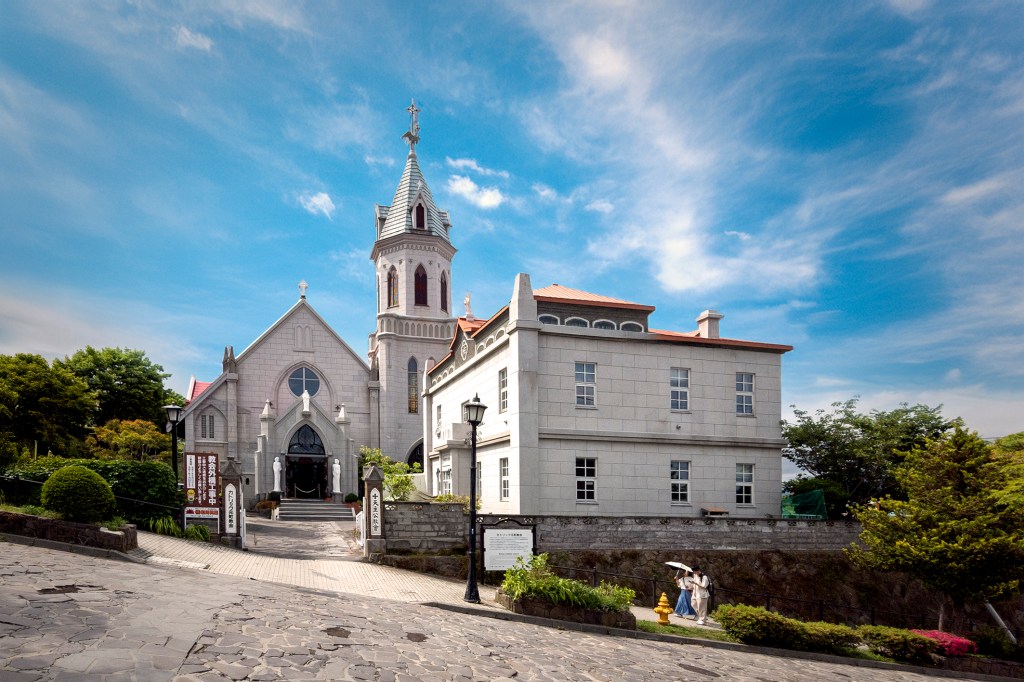

The churches bear witness to this attempt. They were destroyed and rebuilt multiple times. The two most spectacular in the landscape are the Catholic Church and the Russian Orthodox Church. There’s also an Anglican Episcopal church and a Protestant chapel dedicated to Methodist missionary M.C. Harris. He influenced several of his Japanese students at Sapporo Agricultural College, notably Inazō Nitobe, author of Bushido, the Soul of Japan, who would later become a diplomat at the League of Nations and marry the daughter of a prominent American Quaker.
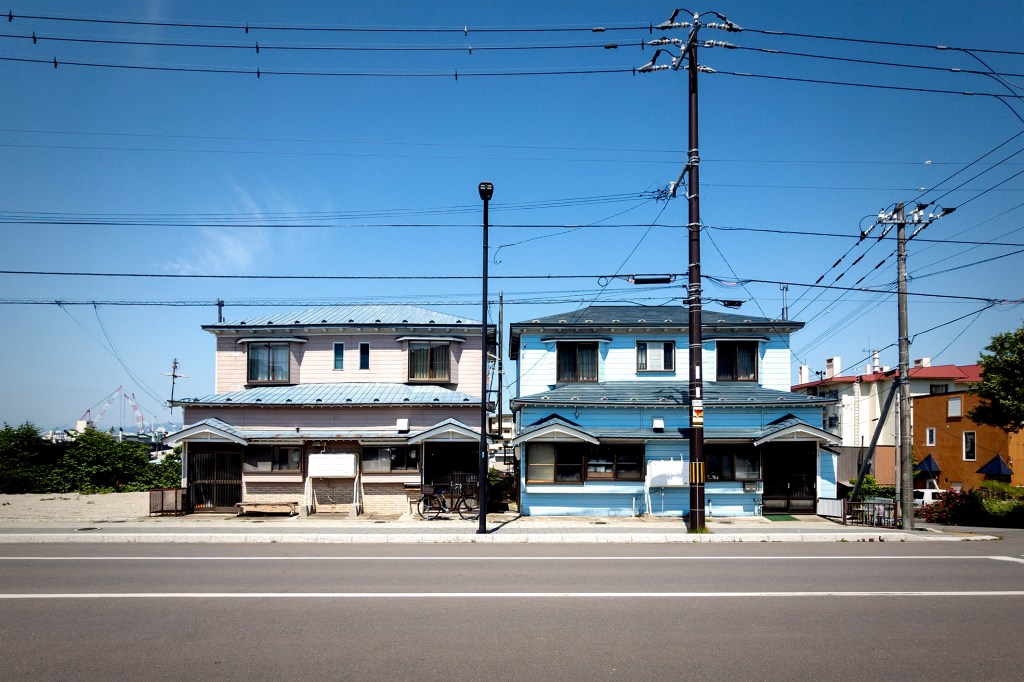
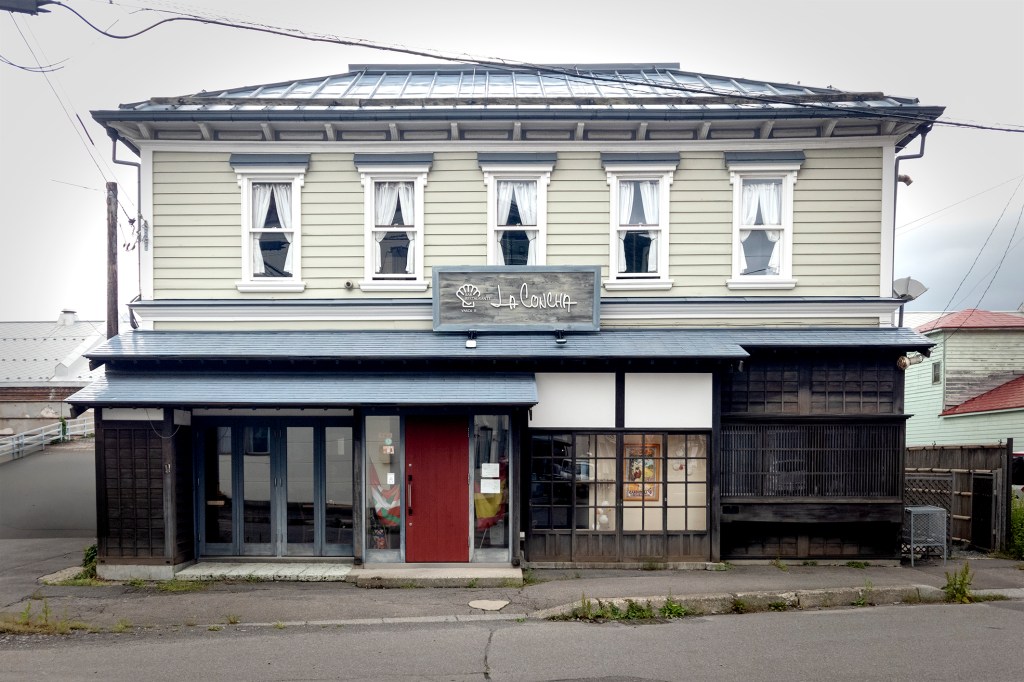
This blend of two vastly different cultures also influenced architecture. In Hakodate, there are curious houses—old and modern—that merge two completely distinct styles. The first floor (our ground floor) is clearly Japanese, while the second floor has a Western design. They’re very present in Motomachi but can also be seen elsewhere in the city. They have a unique charm that seems to ignore differences.

Mount Hakodate isn’t very tall—just over 300 meters—but offers a spectacular view over the sea-bound city. A cable car does the trip in three minutes, and lazily, I took it, refusing the five-kilometer walk to the observatory. I wasn’t the only one queueing: Americans were discussing breakfast, Québécoises chatted about their dogs, Spaniards were being noisy. See—and flee, as fast as possible.
Once I’d taken in the view, I walked down, disappointed not to find a forest path; you always have to look carefully. There are, in fact, trails in various directions, and I found one by chance descending via the road: the Kannon trail—named after the Buddhist goddess of compassion. Nothing can happen to me; the bears will avoid me. It’s a narrow, steep path still moist from yesterday’s rain but not slippery—just a bit damp. I tread carefully. In Japan, my balance is sometimes questionable.
Along the trail, at regular intervals, there are small statues of Kannon—not the thousand-armed version, but she takes many forms. They’re maybe 60 cm tall, with coins placed at their bases—offerings from hikers grateful for her tenderness and understanding toward those in distress, those who suffer. Planted among the trees, dressed and decorated by the plants, they softly say to passersby: don’t worry, I’m here.
The forest path crosses the road once more, then veers off. Signs announce a series of temples I can’t find online. Wonderful—getting a little lost is always a bit thrilling. What will I discover that the guide can’t? After a few statues, a clearing opens onto a temple that looks very old. Some Kannon figures sit outside on a small promontory accessible by six steps. At the center, an uncarved rock seems to be the object of worship. Rough, unshaped—its meaning, importance, and role elude me.

Lower down, I hear crows—I’m nearing the promised important temple. A few stones appear—they’re Buddhist graves. I’ve entered a cemetery. It seems small. Below, I glimpse the cobalt-blue sea shimmering under the sun, lazily basking in summer warmth and dazzling light. The crows have seen me—they caw in warning. In Japan, crows are to be taken seriously. Smart, they can become aggressive—even dangerous. One must respect their clear, loud signals.
Farther along, another small cemetery. I’m surprised they’re so high up, far from sea level. At the next bend, I understand. The view is stunning—the cemetery is vast, spread across several levels, overlooking Hakodate Bay, where a few bloated cargo ships lounge. I pass two older women visiting a grave—maybe a husband, a brother, a sister, parents. They carry a wooden bucket and a 柄杓 used to pour water on the tomb, a sign of respect and purification. It’s about refreshing the soul. On this warm northern summer day, they struggle up the steep steps under a cloudless sky. They smile and nod to me—I’m welcome in these sacred places.
柄杓
Hishaku – ladle.

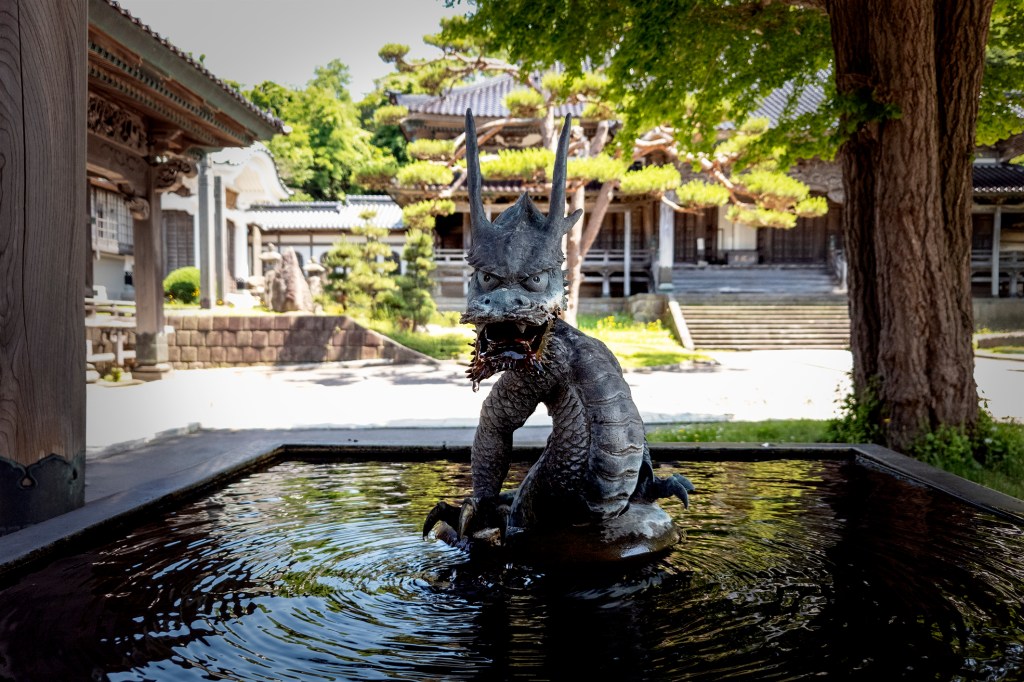
I find Kannon again in the courtyard of the temple whose cemetery I just crossed. She’s beautiful. No one’s around. A few boxy cars hint at monks or staff but don’t spoil the scene. The 手水舎, the purification pavilion where one washes hands before entering, features a dragon meant to be menacing but who looks rather comical. The temple is named Kōryū-ji—the Temple of the Fragrant Dragon. This is no superficiality—fragrance, associated with incense and pleasant aromas, symbolizes purity and spirituality. The dragon represents power—but also wisdom and spiritual elevation.
手水舎
Chōzuya – water pavilion for hands.
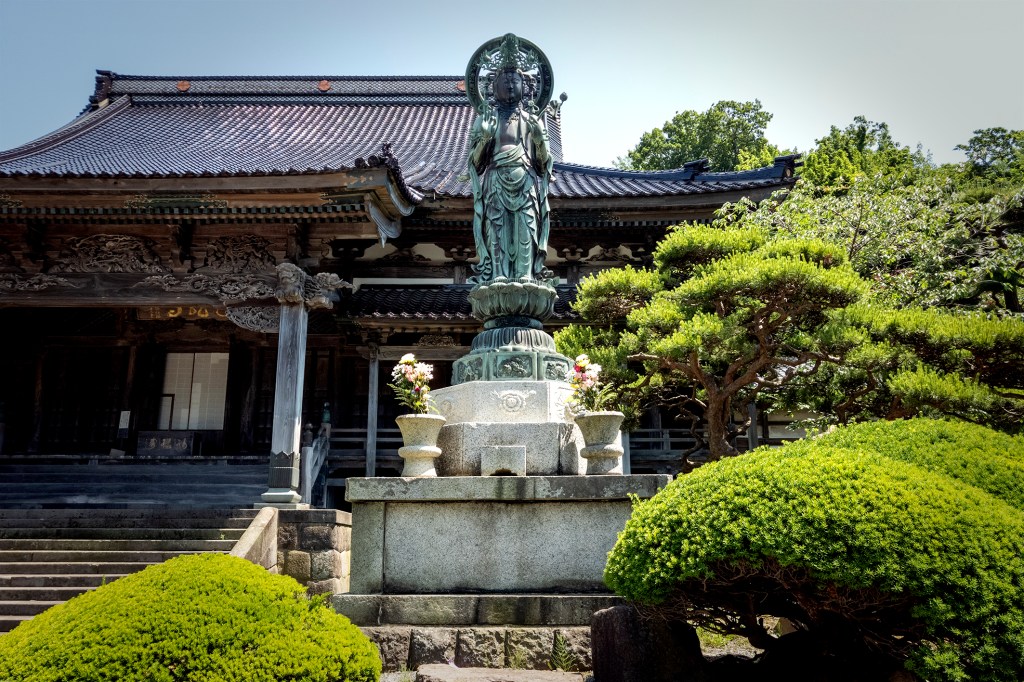

This temple evokes the last samurai. But who was he? Was it Enomoto Takeaki, who fought to the bitter end for the shogunate and admitted defeat only after the fall of Hakodate? Was it Hijikata Toshizō, the fearsome commander of the Shinsengumi—an armed militia defending the shogunate at all costs—who died at 34 from a bullet to the abdomen seven days before the final defeat? Or was it Takamatsu Ryōun—loyal to the shōgun to the end, but a samurai doctor who healed friend and foe alike, living long after defeat to offer his art to the poor?
I choose Takamatsu Ryōun. Beyond loyalty and war, he made peace—with others, and with himself. He devoted the rest of his life to healing others, until his death in 1916. Isn’t that the true samurai spirit? To give of oneself, without calculation or expectation, for the faintest chance of being someone good.
I love this country
Mata ne

