

Ohayou
June 19, 2025
Even in the rain, Kanazawa is beautiful — she will forever be my first love in Japan. A small snag in the fabric of impermanence. Perhaps first times are the kind of things that remain, in one way or another. That first time in Kanazawa was magical, almost unreal, as I’ve already told. Every time I return, walking through this one-of-a-kind city moves me just as much — if not more.
The rain has its advantages: it discourages many would-be wanderers. The streets open themselves up more freely, and it’s not unusual to find yourself alone in one of them, passing by a small temple without anyone there to interrupt a fleeting moment of meditation. Temples in Tōkyō or Kyōto are stormed by visitors, but that’s not the case in Kanazawa. It has no world-famous temples, but it has many. The rain washes away even the few people who usually come, except for a handful of Japanese quietly making wishes.


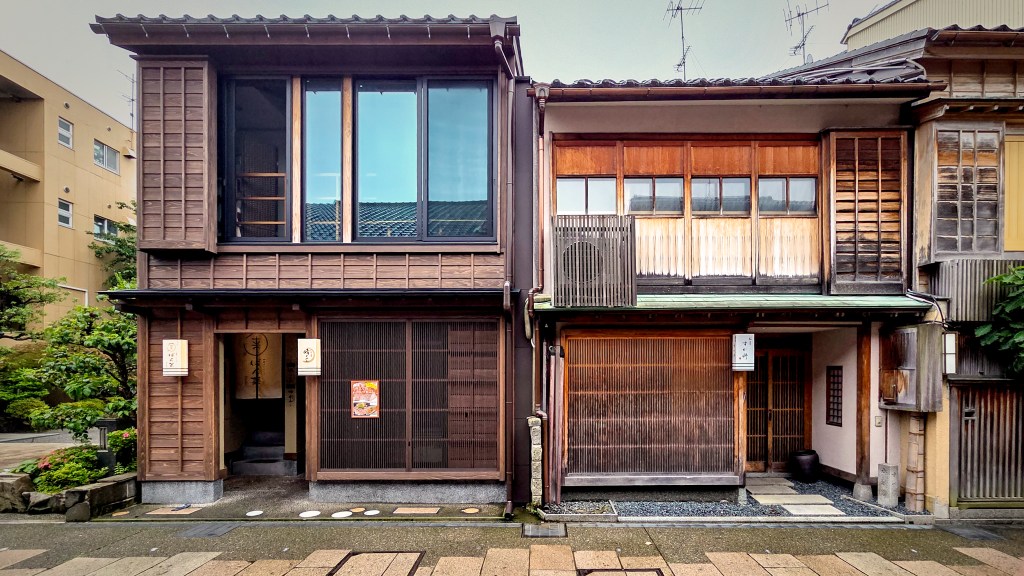
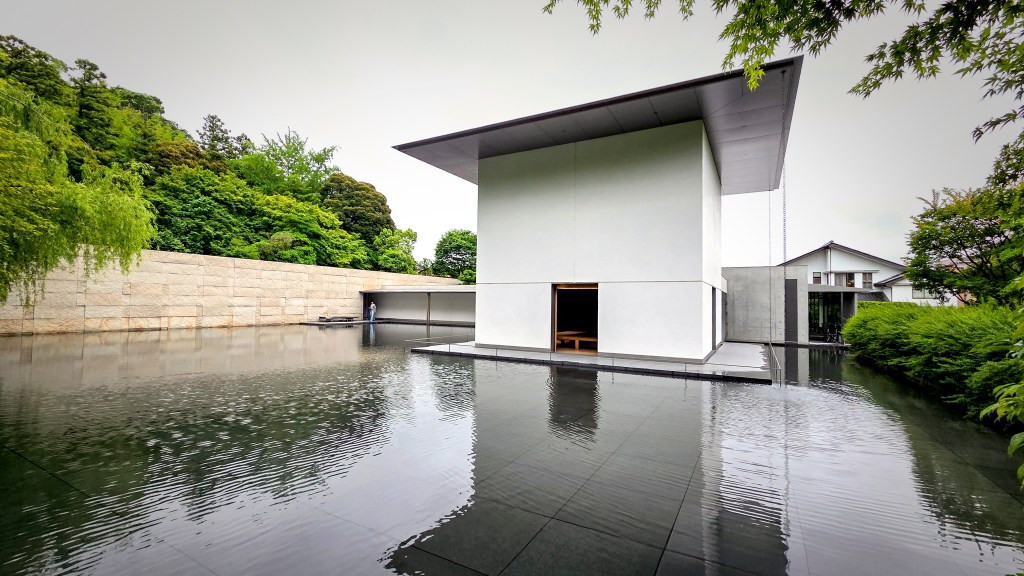
I began my wandering — joyful, and at times touched — the very day I arrived, starting in the Nishi Chaya district. It’s an old geisha quarter that borders the southern edge of Kenrokuen Garden, where many stunning wooden houses still stand, dating back to the Meiji or even Edo period. Strangely, one almost never sees tourists there, not even in good weather — except at the DT Suzuki House, all stone and concrete, now a museum that occasionally draws a few Western Zen enthusiasts. I pause for a while. It’s too late to go in, but the architecture, the soft undulation of the reflecting pool — it all inspires a respectful, almost mystical halt.
Schoolchildren are heading home, often carrying some item that marks their club activity in addition to the heavy randoseru backpacks on their backs: a bow, a racket, a stick, sketching gear, calligraphy or painting tools, musical instruments.
They’re alone or in small groups, often on bikes, always in uniform, chatting animatedly.
Japanese children are autonomous — they go to and from school on their own, no matter their age. Sometimes they look at me with curiosity — no doubt a sign they don’t often cross paths with foreigners on their way home.
I arrive at the small White Dragon shrine, perched at the upper-left corner of Kenrokuen, on the edge of the garden proper.
Its name is simply Kanazawa Shrine. It’s a Shintō shrine that held great significance for the Maeda clan, who ruled Kanazawa for centuries, before and during the Tokugawa era.
Three Japanese women bow and clap their hands to greet the deity, make a wish, and then buy what I assume are paper charms, which they let float on the purification basin where one rinses face and hands.
Depending on which way the paper drifts, they cry out loudly and laugh heartily.
金澤神社
Kanazawa Jinja

Kanazawa lends itself to being loved in gentle stages. I find her again, she finds me, and often it’s when turning down a forgotten street that the strongest emotion surges — when I see a place I’d almost forgotten. I leave the shrine and see that Kenrokuen, the garden of six elements, is still open. I go there to feast my eyes for the first time in ten months. I’ll return every day. Here too, the rain keeps people away, and the late hour means the place is nearly deserted. I find a photo to take: a tiny island lost in the middle of the pond, adorned with a few wildflowers reflected in the water. It’s rare — flowers aren’t typically part of a Japanese garden. Farther on, a heron stands perfectly still, ready to fish.

I leave my beloved garden, which I’ve seen so many times, and head to the majestic, gleaming castle, reconstructed in the early 2000s.
The interior is made of wood, held together entirely with joinery; the exterior is stone — all built to withstand the strongest earthquakes that regularly shake the archipelago. On the opposite side of Kenrokuen from the castle lies a massive construction site that’s been going on for over two years. The city of Kanazawa is rebuilding another section of the castle, but before it can rise, excavations must be done — Takashi will tell me that later.
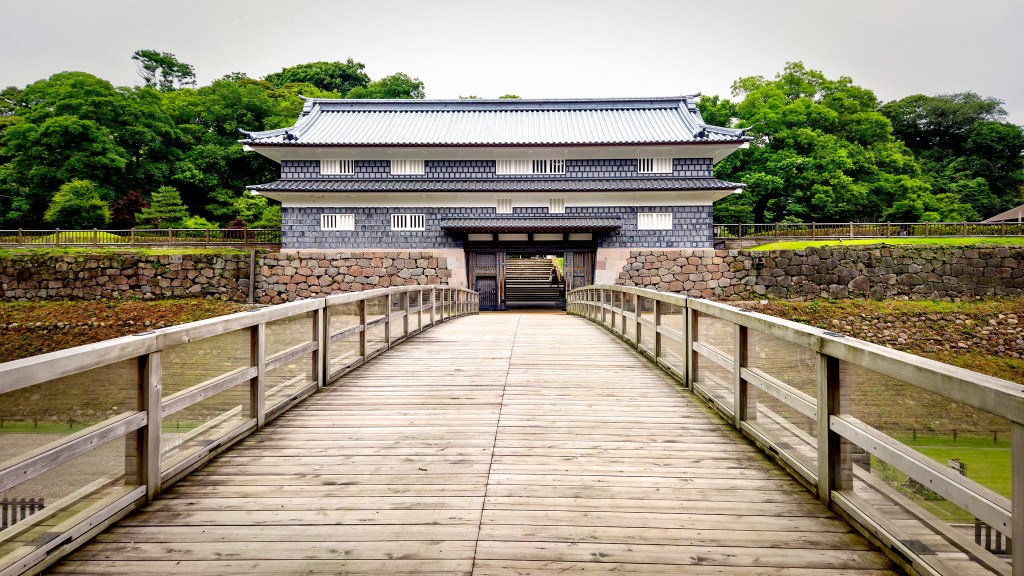
I walk down and around Gyokusen’inmaru, the other Japanese garden that borders the castle, to reach Nezumitamon, one of the restored gates of the outer wall. A bridge leads to Oyama Jinja and its small pond. This Shintō shrine has undeniable charm and mostly draws Japanese visitors making wishes. On the other side of the bridge, I gaze at the monumental gate my friend Hisae lit up to make it even more beautiful at night. She’s a lighting architect — the beauty of Kanazawa by night is her work.
The next day, it’s still raining. This time I wander along the Asano River.
It’s actually a river that flows into the Sea of Japan a few kilometers downstream, but in Japanese there’s no distinction — it’s all just 川.
On both banks of the Asano are geisha districts: one popular with tourists, the other much less so. The reason is simple: in the quieter one, the historic teahouses where geisha once performed haven’t been turned into shops. In Higashi Chaya, everything is gold — figurines and knickknacks covered in gold, ice cream sprinkled with gold, sake with gold flakes, sweets with golden sheen. Higashi Chaya never lets you forget that Kanazawa was — and still is, in part — the city of gold. The kanji for “gold” is the first character of its name. Kanazawa is where the gold leaf used to decorate temples is made.
川
Kawa – river, stream, body of water.
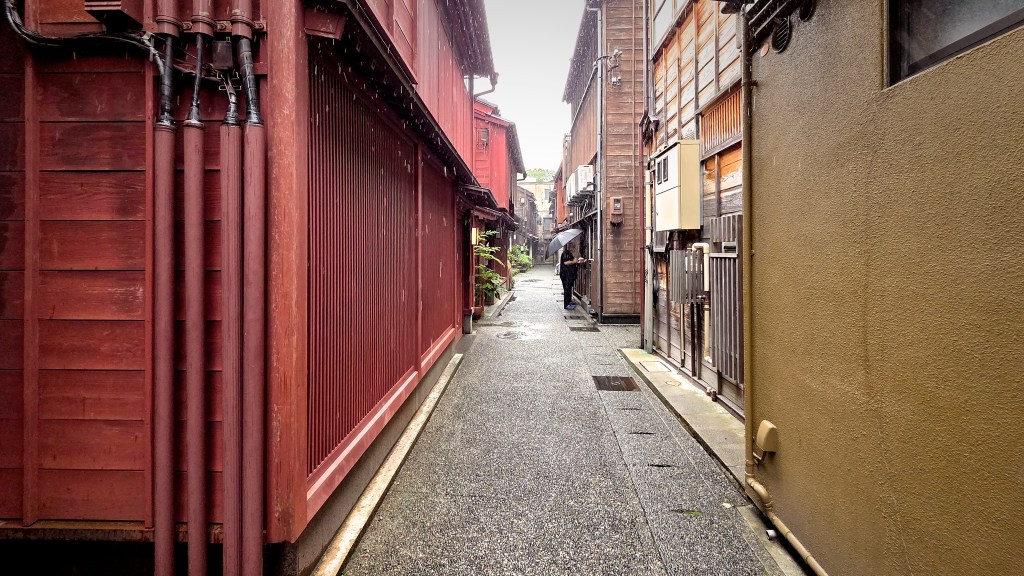
Kazuemachi Chaya, on the left bank of the Asano, is a quieter place, lined with wooden houses with no flashy windows or signs. Some are still homes; others are izakayas, cafés, or bars — where entry is nearly impossible without Japanese friends, and even more so without speaking Japanese. But in a few places, you can drink a coffee or tea with a sweet treat, if you’re lucky enough to find one that even tells you what it is. Usually, there’s just a Japanese name on the sign.

I love this neighborhood — its narrow alleys, just wide enough to shelter an open umbrella. I love the wooden bridge crossing the Asano to the right bank, the one Hisae lit with her art. I often feel that most foreigners never come here, or only rush through because there’s nothing to buy. But there is something: the joy of being, for a moment, in another time. Impermanence has done its work, yes — but the illusion remains. It feels even truer in the rain, which blurs your vision and sharpens the mirage.
Kanazawa, my beautiful — thank you for being what you are.
I loved you at first sight, even before meeting you, back when I was planning my first trip all those years ago. You have never disappointed me. You’ve always been there for me — tender, funny, unpredictable, a little mad. You’ve never allowed yourself to be sullied by fools whose words and actions could dull your grace. You ignore them.
It’s not your gold that seduces me — it’s the light and the madness of your nights, the languor of your sunlit days in streets where water runs through hidden canals, the freshness of your rain like a flower’s dew.
It’s your history, which makes you a delight both to the senses and the mind. It’s your gardens, rocking my steps and coloring my gaze.
I love your body — but even more, I am in love with your soul.
I adore this country.
Mata ne

