

Ohayou
June 6th 2025
European newspapers haven’t stopped reporting over the past few weeks on the crazy congestion at Narita Airport in Tokyo: endless queues, tourists losing it and lashing out at overwhelmed staff. Japan under the constant assault of rushed and disrespectful visitors. When I arrive, I expect the worst—but nothing happens. I barely have time to pull out my pre-filled declaration and clumsily hand over my passport to calm and smiling employees. In exactly ten minutes, I clear immigration, customs, and collect my luggage—a record!
I’ve returned to Japan almost without realizing it. In just a few minutes of rare smoothness, I find myself in the airport hall, sparsely populated, and I see Hisae walking toward me with a big smile; it’s the first time someone has come to pick me up—it’s moving. We take the train, and after a few kilometers, the city appears under a perfect blue sky, allowing the sun to reflect in thousands of windows. The light is beautiful, it’s warm, it’s 5 p.m., the sun is already beginning to set, and its angle on the horizon pushes the colors into a summer orange.
I get a message from Takashi—as always, the magician is back—he appears precisely as I head toward his city. The room I’ve rented is a 30-minute walk from his apartment, in the Meguro district, along the Tōyoko Line that connects Shibuya to Hiyoshi. It takes a good two hours to get there from the airport: train, subway with two different lines, and then a walk. Aki, the owner of the house where my room is located, asks me to wait a bit; check-in for new tenants doesn’t start until 7:30 p.m. It’s 7:29. The house is fairly large and looks Western from the outside, but inside it’s Japanese—old, with tatami mats and shōji doors. The house is over 100 years old.
畳
Tatami.障子
Shōji – sliding paper door.
Naturally, I have to relearn the rules I think I know but rarely follow properly: take off your shoes, step up, turn around and place them in the direction of departure to make leaving easy. Then step onto the upper level and slip into the slippers waiting for guests. I fumble through the whole process. People laugh and help me. Japan resists just a little, for show, with kindness but also seriousness. You’re expected to place any personal items you’ll bring into the room in a large white cloth bag. Heavy suitcases must stay at the entrance—the genkan, the space where you remove your shoes—because the tatami mats in the rooms are too delicate.
玄関
Genkan – main entrance.
Hisae takes me to eat at a small izakaya near the subway station. It’s perfect: a zinc counter, a few tables, little wooden plaques hanging from the walls announcing the joy of eating and drinking. I decipher the hiragana and the rarer katakana without too much trouble, and I guess at some kanji describing the endless types of fish available as sashimi, salt-grilled, simmered, or skewered. The sakes are countless. I choose a dry one (karakuchi) from Fukushima that pairs perfectly with the Asahi Super Dry and the raw fish and shellfish we order.
塩焼き
Shioyaki – salt-grilled.辛口
Karakuchi – dry taste.
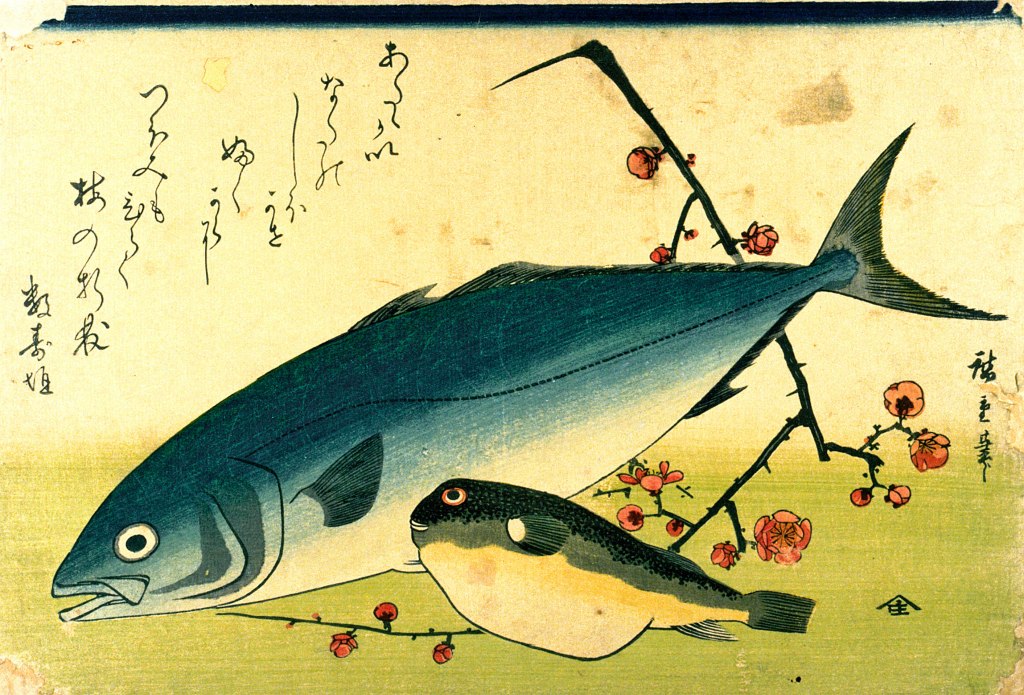
A Japanese yellowtail ends up on our menu again—just the salted, cooked head of this large Pacific fish, about a meter long. It’s called “buri,” and its tender white flesh melts delicately on the tongue, while just under the eyes is a narrow, deep cavity filled with even softer, slightly greyer flesh, whose briny flavor evokes the sea without being cloying. Chopsticks are the ideal tool for exploring a fish’s head: the pieces come off effortlessly—perfectly cooked.
On the way back to my Japanese room, another message from Takashi—it’s 11 p.m. He’s nearby, three subway stops away, a ten-minute ride to find him at the exit, wearing his usual Hawaiian shirt and his ever-so-slight smile. Ten months without seeing each other promises a long night.
We start in a little izakaya open until two in the morning, on the second floor of one of Tokyo’s many small buildings. The owner—turquoise sweater, shorts, and cap—greets Takashi warmly. Behind the bar, a young woman is busy grilling chicken liver yakitori and salted skewers, alongside a small sashimi of octopus and white shellfish. She’s the one choosing the music: The Clash, The Sex Pistols—punk rock and sake at midnight. Japan slowly opens up to me in a calm, festive atmosphere. Never rush things—they come on their own.
The owner also runs a karaoke bar we breeze through. The singers scream more than they sing; it’s impossible to talk, and we want to talk. In the street, people are scarce. It’s almost 3 a.m. We run into an acquaintance of Takashi, who stumbles a bit but politely greets me—it’s time for him to go home, but not for us. We pass by the Italian bar where we had a drink last year. The server is closing but comes out to greet us—he remembers me and even my name. Japanese people have incredible memories.
Takashi takes me into a little side street, just the kind I love. He leads me under an unimpressive porch and up a twisting staircase to a bar where Italian phrases are scrawled on the walls like graffiti—“arrivederci,” “tutto è a posto”… The bar is long and narrow, not Italian at all. As we walk in, the last two customers are leaving. The bartender welcomes us warmly—it’s a late-night bar that never closes… or maybe only when he gets tired of waiting for the night owls.
No sooner are we seated than new customers arrive: two salarymen and one salarywoman. They probably had dinner after a late shift and are ending the night talking—like us. Japanese nights are never frightening but always full of surprises, like when four more customers walk in and order food. The bartender doesn’t hesitate for a second and starts cooking while asking us over the counter if we’d like something to eat too.
He serves the newcomers a meat dish over a mound of rice I can’t identify, and yaki soba—fried noodles. Takashi tells me it’s a German dish, and I realize it’s sausage—big, fat wurst sausages half-buried in sauce and rice. Everyone loves sausage at 4 a.m.!
Outside, it’s broad daylight—the sun rises very early in summer in Japan. I hop on the first subway to return to my room and sleep for the first time in the Land of the Rising Sun. Takashi walked home. On the way, I pass three people—one is sleeping, either already or still. Did he wake early to go out? Or is he, like me, just now getting home after reuniting with a friend? I soon walk alone under a cloudless sky. It’s cool, no wind, and the residential streets where I now live are deserted. Occasionally, there’s music from a house, or the sound of an overhead train pulling into Toritsu-Daigaku Station. It’s five o’clock—Tokyo awakens. I’m home. I don’t feel like sleeping.
I love this country
Mata ne

