

Ohayou
December 2022
I arrived in Otaru one evening in July 2019. The weather was beautiful and warm, above 25 degrees Celsius. Like in Morioka, I had chosen a hotel near the small train station, equipped with a very nice onsen. After lounging in the hot baths to shake off my fatigue, as the Japanese like to say, I set out to explore this town about which I knew very little. I soon realized that many places were already closed. If you don’t know the city, you might get the impression that the locals go to sleep as soon as the sun sets, and that only the industrial canteens remain, invaded by noisy groups of Chinese tourists wandering the streets in boisterous hordes.
The good spots are hidden; they have to be earned. It takes a bit of luck and boldness to find them. I wandered, with no other goal than to find a small izakaya for dinner, heading toward the Otaru canal. It’s one of the city’s tourist attractions—the canal is famous for its warehouses with Western-style architecture, reminding visitors that the city was, at the beginning of the 20th century, the main port of northern Japan, intensively trading with nearby China. This explains the intense interest of Chinese tourists in the region, who visit in well-organized, neatly lined-up groups behind small flags waved by their guides.
In Otaru, there are many covered shopping arcades that allow you to cross blocks, as is common in Japan. I’ve seen them in Tokyo, Kobe, Osaka, and Kanazawa. In the North, they mainly protect from snow and cold winds that last nearly six months—from autumn to spring. In summer, they also shelter from the sun, which the Japanese generally fear. There are restaurants in these arcades, but they either close early, like the shops, around 7 or 8 p.m., or they are large, soulless places made for hurried customers or tourists. These are places I avoid.
Luck and a bit of daring—that’s what happened. In the covered arcade I had just entered, coming up from the canal, I saw an upright piano leaning against the wall. But looking more closely, I felt it was a bar, very narrow, like those I had seen in Tokyo or Kanazawa. I couldn’t find an entrance, but I made out many bottles inside—a good sign. Moving closer, I noticed a small, almost hidden alleyway barely wide enough for two people to pass. A half-closed gate marked the entrance. I sensed this was the place to go; instinct and the delicate, discreet smell of cooking drew me in. Above the gate were kanji I couldn’t read: レンガ横丁, but also “welcome” written in English, Japanese, Chinese, and Korean. I passed the threshold, curious and excited—happiness awaited, though I didn’t know it yet.
レンガ横丁
Renga yokochou – brick alley.
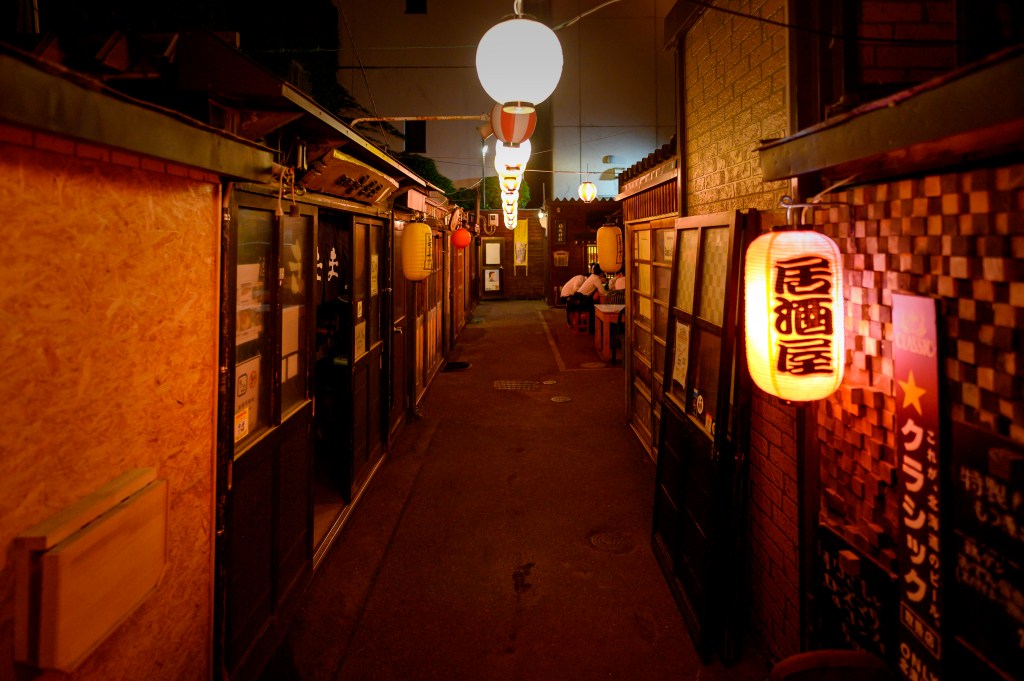
It was indeed a kind of alley with a small square at the end. Every five or six meters, there was a bar or an izakaya on each side. Each place could host between five and ten people. It was 9 p.m., and everything seemed full, as always in such places. In 2019, I knew barely a few words of Japanese—too little to be accepted where there was no chance of finding an English menu.
I passed an izakaya that wasn’t full—one seat remained. Six people sat around the counter, behind which the hostess chatted while serving drinks and simmering her recipes. She saw me and beckoned me to come in. I turned around to see which Japanese person she was calling, but no one was behind me—it was me she invited! That’s how I met my friend Makki, the owner of 酒楽屋 恵方.
酒楽屋 恵方
Sakuraya ehō – joyful bistro lucky direction.
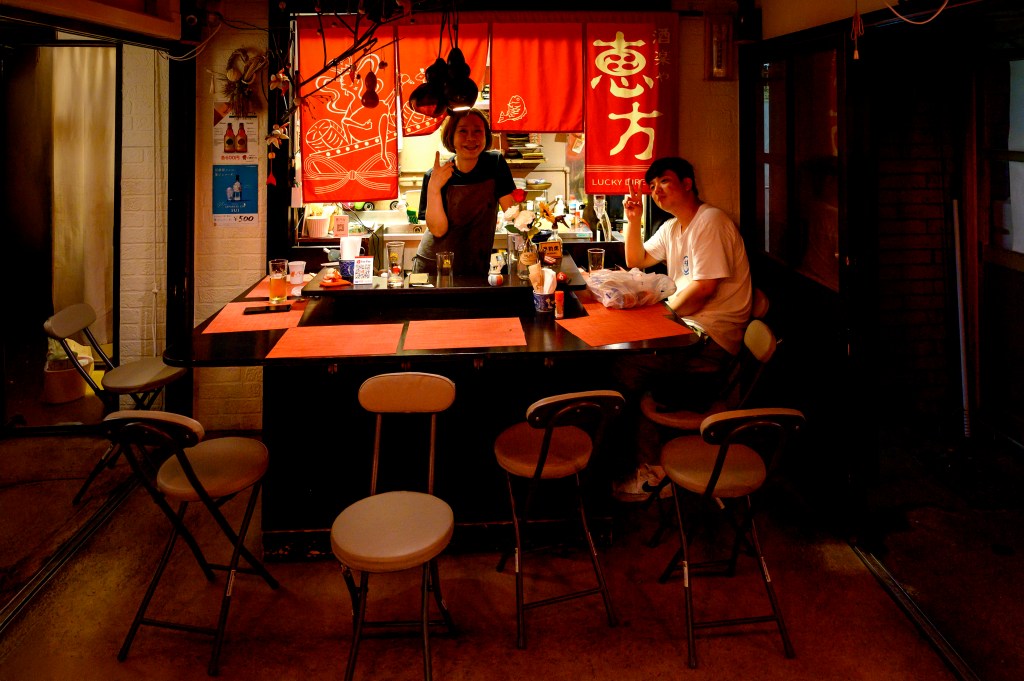
The name of the establishment, a bit strange when translated, deserves explanation, revealing nuances of the Japanese language. The first three kanji (酒楽屋) form a common phrase for izakayas, not a proper noun exactly but a commercial label. The first kanji 酒 (sake) means “alcohol,” the second 楽 (raku or tano) suggests being comfortable or having fun, and the third 屋 (ya) is a suffix meaning “shop of…”. So it literally means a place where people have fun and drink alcohol—a “joyful bistro.”
楽しい
Tanoshii – happy, cheerful, pleasant.
居酒屋
Izakaya – place to sit and drink alcohol.
The second part 恵方 (ehō) refers to a Japanese tradition from Chinese feng shui, where each year the lunar calendar calculates a lucky direction. One must face this lucky direction during Setsubun, around February 3rd. That evening in July 2019, I faced it too, and its influence has never faded since.
節分
Setsubun – last day of winter.
The seventh seat at the counter was partly hidden by a guest—it became my reserved spot every evening that summer. Every time I’ve returned to Otaru since, my seat at Makki’s izakaya awaits me. These moments are always fantastic and unique, full of meetings and reunions in this little town that surprisingly adopted me one evening when I doubted I could find a place to eat.
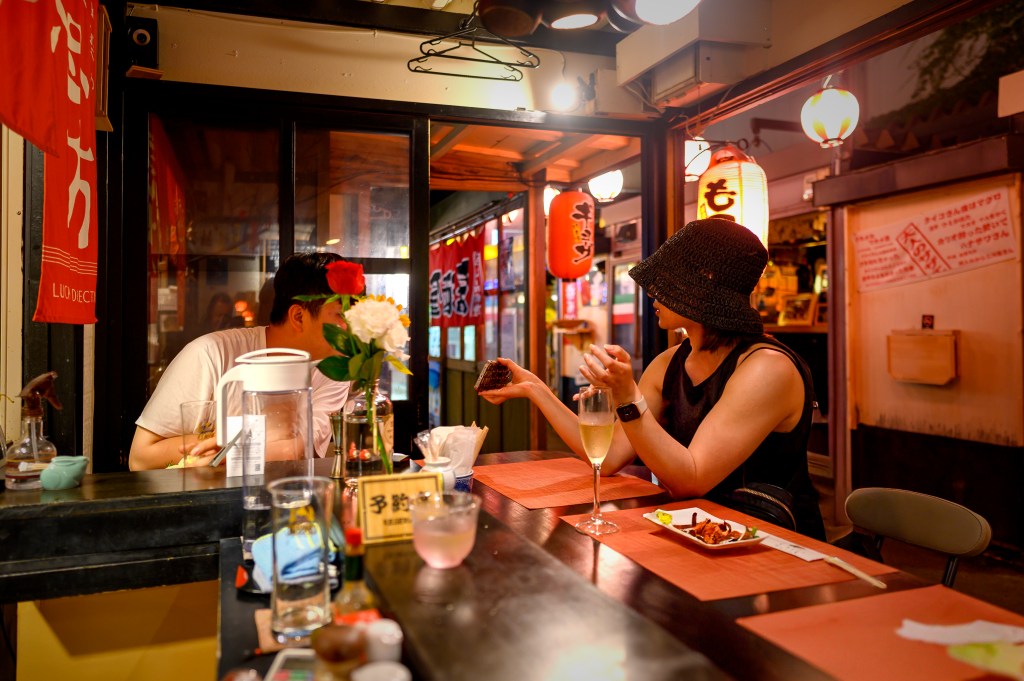
Makki is a ママ. In Japanese, this term means “hostess” or “proprietress” but also carries respect, friendship, and affection. It means much more than just serving food and drinks. Depending on the place, a ママ may run very different establishments, but the common thread is welcoming customers according to the place’s own codes.
ママ
Mama
Written in katakana, the word originates from the English “mama,” introduced to Japan in the late 19th century when the country opened to the West. This diminutive, popular among Westernized elites, did not replace the Japanese terms 母 and お母さん, which clearly mean one’s biological mother. Instead, starting in the early 20th century, ママ became the term for female owners of nightlife establishments. Using the foreign word preserves the warmth of the symbolic maternal role while clearly distinguishing it from the biological mother.
母
Haha – my mother.
お母さん
Okaasan – your mother.
A ママ is a maternal figure who welcomes her guests warmly. She embodies hospitality, emotional attachment, and natural authority in a place that exists thanks to her. She talks, listens, advises when needed, manages service, atmosphere, food, and drinks. She is the guardian of the place’s ambiance—a fundamental element of Japanese hospitality. Gentle yet firm, like a mother, she is the central, indispensable figure of this wonderful little theater that is a Japanese izakaya.
The term ママ is reserved for women, but there is a male equivalent: マスター. While it lacks the maternal connotation, it expresses authority, respect, and closeness, like the owner of an izakaya. The series *Shinya Shokudō* is a perfect example.
マスター
Masutā – maître.
Makki took care of me, asked where I came from, and introduced me to the Japanese guests who came throughout the evening, often staying only briefly—some just for a drink and a light meal while chatting, others bar-hopping from one izakaya to another in this hidden alley where everyone knows each other. I didn’t understand the conversations but purred with happiness, savoring the dishes and sake Makki served. Moments like these are why I travel.
Makki works in a kitchen barely two square meters in size—almost nothing, but as Raymond Devos said, “twice nothing is still something.” On her left, there’s a cast-iron *Staub* pot—a reference, I think—in which a devilish stew simmers. To my right, two gas burners handle last-minute preparations, grilling fish whose Japanese names are as surprising as their tastes.
Behind her is a tiny work table where some high-quality knives rest, waiting to slice, mince, peel, or finely chop some unknown vegetable. To her right stands a normal-sized fridge that must be magical, since it never seems to run out of wonderful ingredients that appear on demand. And, supreme luxury, right in front of the fridge, there is a beer tap pouring fresh Sapporo Classic, only available on Hokkaido island, perfectly matching the dishes served.
Thank you, Makki, for welcoming me so kindly, for showing me the gentle warmth of the Northern Japanese people, where it can be so bitterly cold. Thank you for being who you are and for making your dream come true by creating the izakaya of the lucky direction. In July 2019, I didn’t yet know I would have to wait more than three years to return because of COVID, but on December 14, 2022, I found Otaru again under the snow, following only one lucky direction.

