

Ohayou
April 2025
I made this apparently strange connection between Ryūichi Sakamoto and Dave Brubeck, and yet it is so obvious to me. This link is a small part of my story. It’s an innocuous story in itself for others, but so revealing of my own wandering to Japan.
I’m 16, listening to Koto Song for the first time and time stops to show me a space without limit. Dave Brubeck’s notes explore what I do not know, another world, another sound, they trace in a few moments a path that I can’t yet follow but which tells me: there is something out there somewhere. So I listen, I listen again and on me flows this music of an unheard beauty that comes from a world to find, to seek, to love discover.
The version I’m listening to is recorded at the Olympia in Paris in 1973. Dave Brubeck on piano, Paul Desmond on alto saxophone, Jack Six and Alan Dawson on bass and drums. Even today, I listen to this song repeatedly trying to understand why I feel so much emotion.
I don’t know why but this music reminds me of Harumi, the young student with whom I was put in touch by my English teacher and other students in the class to push us to write in that language. She is Japanese, she lives in Tōkyō, it’s pure chance, the couples were chosen by our teacher without consulting us. They are not all mixed, unlike our class of boys only. There is no internet at the time, we write real letters on paper.
I will never meet Harumi, who wrote to me for the first time on 27 March 1978 and sends me letters as beautiful as sheet music. These are notes, everyday notes: “In Japanese “Haru” has the meaning of your “spring” and “mi” means “beauty”. But I didn’t grow beautifully. In addition to her fine and regular writing, she makes small colorful drawings, she sends me photos of Japan, origami. It may have been at this time that I fell in love with Japan for the first time, discovering Harumi’s delicate kindness. After a few months we forgot to write to each other, it was too far, trot early, too difficult without doubt.
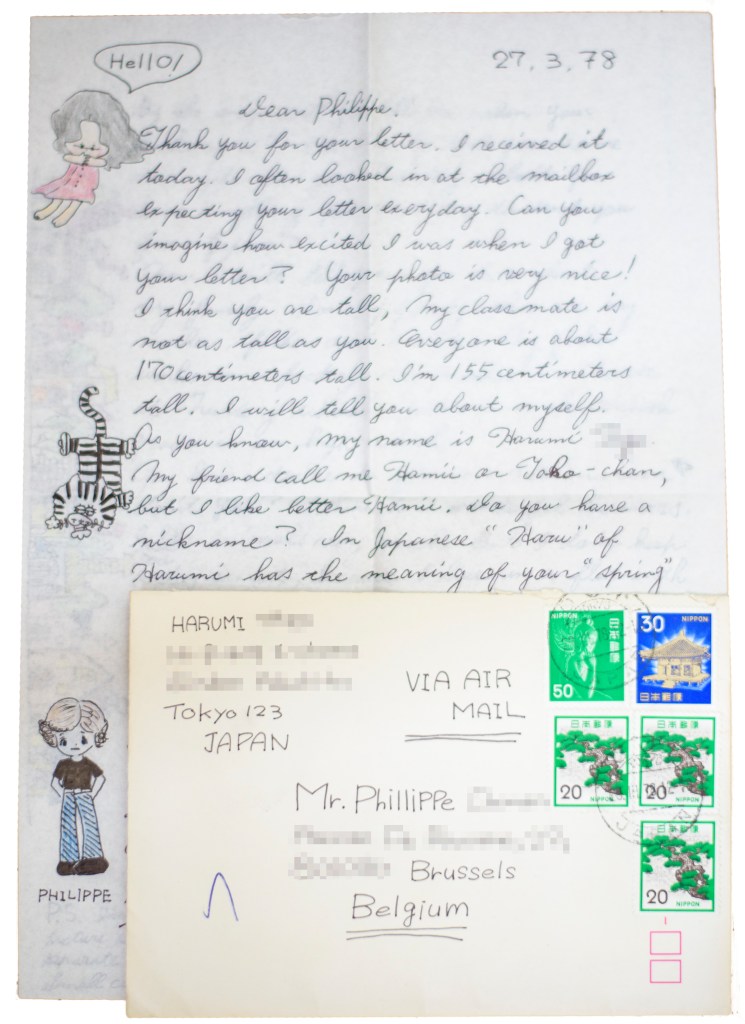
The koto is a traditional Japanese instrument I discovered it at this time by consulting the dictionary: “Long Japanese cithare, with silk strings and moving easels”. I understand why the music makes me think of Harumi, as in the letters of the girl, there is the delicate gentleness of Brubeck’s notes. I am simply amazed, invaded, stirred from top to bottom, I have the impression for the first time of perceiving as forbidden colors.
These new colors perceived and never seen before will soon bear a name, that of the androgynous spider of March which from orange to blond through black decorates his hair with unexpected hues that his sparse eyes underline strange ambiguous gleams. David Bowie discovered Japan in 1973 and brought back, if not forbidden colors, at least the original colors of fashion designer Kansai Yamamoto influenced by kabuki. They will be used for the Ziggy Stardust/ Aladdin Sane tour.
September 1980, first track of the album Scary Monsters, It’s No Game (No 1), actress Michi Hirota recites in Japanese the lyrics written by Bowie who yells at the edge of vomiting.
シルエットや影が革命を見ている
Shiruetto ya kage ga kakumei o mite iru
Silhouettes and shadows look at the revolution俺は現実から締め出され
Ore wa genjitsu kara shimedasare
I am excluded from reality何が起こっているのかわからない
Nani ga okotte iru no ka wakaranai
I don’t know what’s going on
On the cover, Bowie is a sad clown in pastel colors. A year later face colored makeup and sad look on the cover of Ryūichi Sakamoto’s third solo album, 左 腕 の 夢.
左腕 の 夢
Hidariude no yume – Dream of left arm.
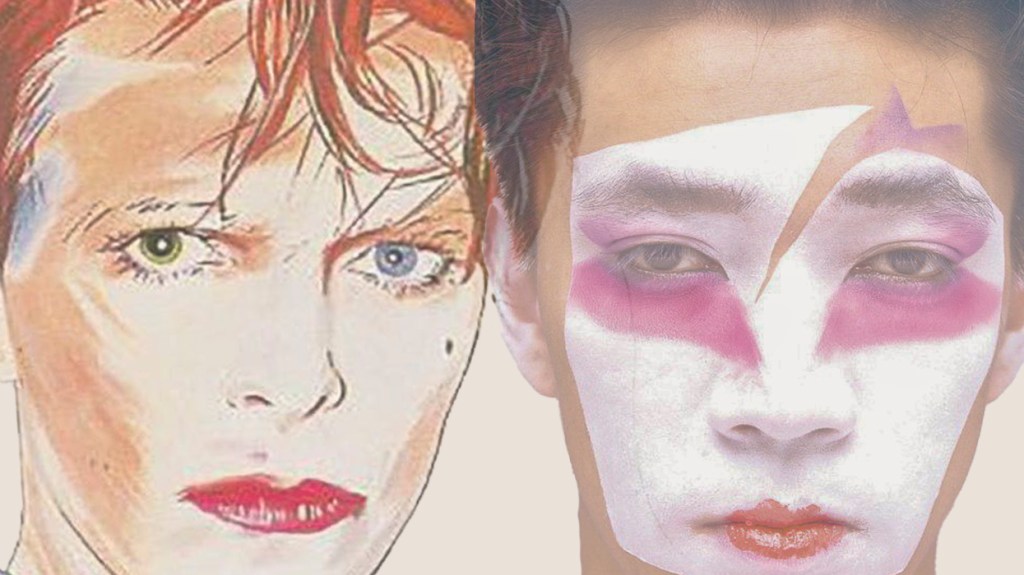
The cinema will bring them together, it was inevitable, this will be the only time!
In 1982, a film project was entrusted to Nagisa Oshima based on the novels of the former British soldier and writer of South African origin Laurens van der Post. The theme is the confrontation of Eastern and Western values in a prison camp in Indonesia during the Second World War.
The director offers the lead roles to Bowie and Sakamoto. The Japanese composer who has no experience as an actor unlike Bowie accepts on condition of being able to write the original soundtrack for the film. It will be released on May 1, 1983 under the title Merry Christmas Mr. Lawrence, a phrase that has become cult by Sergeant Hara, brilliantly performed by Takeshi Kitano. The same unforgettable melody opens and closes the album but in closing it is a version sung by David Sylvian, the former singer of the London band Japan who had split up a few months earlier. This sung version is called Forbidden Colors.
The title of the song is a direct reference to the novel written between 1950 and 1953 by Yukio Mishima, 禁 色 translated into French by Les Amours interdites. The kanji 禁 means “forbidden” and the kanji 色 means “color”, but it can also mean “sensual love”. This is a euphemism used by Mishima to refer to homosexuality which is the subject of his book as it was already the case for his first novel Confession of a Mask, which had been published by Sakamoto’s father. Oshima’s film deals with the cultural shock between West and East but also with repressed, forbidden desire and redemption embodied by the messianic figure of Major Jack Celliers played by Bowie.
禁色
Kinjiki – Forbidden colors.
The character played by Ryuichi Sakamoto, Captain Yonoi, torn between blind obedience to the discipline of the Japanese army during World War II and his homosexual attraction for his enemy, remains the Japanese composer’s defining role. But Merry Christmas Mr. Lawrence also marks the beginning of forty years of film music, the latest of which is the original soundtrack for Hirokazu Kore-Eda’s film, 怪 物, dedicated to the memory of Ryuichi Sakamoto who died a month and a half before the film was presented at Cannes in May 2023.
怪物
Kaibutsu – Monster.
From 1983 and after the success of Oshima’s film, Sakamoto worked intensively. He released five solo albums in four years and composed four film scores, including Bernardo Bertolucci’s The Last Emperor, which won him an Oscar in 1988. The time of the Yellow Magic Orchestra has passed, the group split in 1983, the Japanese composer will reach maturity through very diverse works that testify to his extraordinary ability to innovate but also to feed on all music, wherever they come from.
Coda was released in December 1983 and is based on the success of Merry Christmas by M. Lawrence, some of which Sakamoto explores on solo piano. It is a return to neo-classical music, to its models Claude Debussy and Erik Satie, but it is also an exploration of minimalist music. The melodic richness of his piano compositions is often mirrored with a sound texture that recalls his interest in electronic music. It reappears in the last two tracks of the album Japan and Coda, the first being for sure one of the compositions that led Bertolucci to call him on for his film.
One year later released 音 楽 図 鑑 the fourth solo album of Ryuichi Sakamoto, it was then republished in 1986 under the title English Illustrated Musical Encyclopedia. This is a major album that places the composer among the most innovative of the time and will influence musicians as brilliant as Brian Eno or David Byrne. Today the album is still considered a very modern work exploring the richness of world music while looking for new sounds from the possibilities of electronics. Everything is innovative and yet the richness of sound and melody is immediately accessible.
In 1985, Sakamoto regains the taste for experimental with a very surprising album, Esperanto, which he composed for a Japanese contemporary dance troupe. It’s minimalist, industrial music, but the rhythms are fascinating and the use of sampling and electronic manipulation around rhythms from Africa and Asia make this recording the most experimental album of the author.
Two less innovative albums were released in 1986 and 1987, Futurista and Neo Geo on which they found a song sung by Iggy Pop, Risky. The reason for these less innovative compositions is perhaps that Sakamoto was contacted by Bernardo Bertolucci who asked him to compose the soundtrack of his next film: The Last Emperor. It is a major project for the Italian director, a historical fresco as ambitious as 1900 that he had made in 1975. Sakamoto is working on this soundtrack with David Byrne, who has gradually distanced himself from the band he created Talking Heads, and with the Chinese composer Cong Su.
During filming, Bertolucci asks Sakamoto to play the role of Masahiko Amakasu, a key character who appears in the second part of the film when Puyi, the last Chinese emperor, is used by the Japanese as the puppet emperor of Manchuria. The Italian director likes the powerful look of the Japanese composer who was already strong in Furyo. In 1988, this film became legendary since then won nine Oscars including the one for best music won collectively by Sakamoto, Byrne and Cong Su.
The theme composed by the three men is unforgettable and so much a part of the film’s story that it can hardly be dissociated from it. For Ryuichi Sakamoto, this new consecration crowns ten years of intense work in all musical universes and with music from all over the world. He continued in this vein throughout the 1990s, which were nonetheless years of transition that gradually brought him back to his favourite universe, the one in which he excelled: melody and classical piano. In the meantime, he toured the world at the end of the 80s.
To be continued…

