

Ohayou
March 2025
The Japanese and music is a love story. They learn it very early in school and often play an instrument and just sing. What a pleasure for the karaoke whose popularity in Japan is naturally explained by the love and knowledge of music.
In restaurants, bars, Izakayas, there is usually music and very often jazz or classical music. Bars and night restaurants are a bit different, more rock or pop, but the music is still there. At night when we go from one bar to another, from an Izakaya to a ramen restaurant, we also go from one music to another. And the nights are long.
In 1964, Dave Brubeck and his Quartet toured Japan in the run-up to the Tokyo Olympic Games and as part of American Cold War cultural diplomacy. The great pianist that he was, famous author of Take Five and Blue Rondo a la Turk, meets a Japan in full modernization, open to the West, where jazz is extremely popular. Fascinated by the country he discovers, by the passion of the Japanese for music, Brubeck takes notes throughout his journey and designs a splendid album: Jazz impressions of Japan.
This album, too little known, has a magical charm that any amateur of Japan will appreciate. It reflects Brubeck’s respect for Japanese culture and his ability to incorporate foreign influences into his music. He was the forerunner of what would become World Music 20 years later in the wake of David Byrne, Ali Farka Touré, Peter Gabriel or Nusrat Fateh Ali Kan to name a few.
When the album was released in 1964, Ryūichi Sakamoto was only 12 years old but he had already been playing the piano for several years. He discovered very early the music of Claude Debussy which will remain a major influence of his work, he is also interested in jazz and traditional Japanese music. He has never publicly mentioned the album of Dave Brubeck, but it is impossible that he did not listen to it and appreciated so much this one is like a premise of his own musical career made of so many tasty or great mixes.
Ryūichi Sakamoto is the son of a fashion designer, Keiko Shimomura and a famous publisher, Kazuki Sakamoto, who published notably Yukio Mishima’s first novel Confession of a Mask. Raised in a rich cultural environment, his passion for music led him to join the prestigious Tokyo University of the Arts in 1970 where he studied electronic music and ethnomusicology.
His interest is in traditional Asian and African music but he also explores minimalism and experimental music. He obtained a master’s degree in electronic music in 1975 and began his career as a studio musician. Very quickly he becomes arranger and composer.
Three years later, after several collaborations, Ryūichi Sakamoto became an international star in the company of Haruomi Hosono and Yukihiro Takahashi with whom he created the group Yellow Magic Orchestra (YMO). The eponymous album was released in November 1978 in Japan and in May 1979 in the United States in a slightly different version in terms of mixing.
Success is unexpected! The single Computer Game/ Fire Cracker sold more than 400,000 copies in the US and the song entered the Top 20 in the UK. An unimaginable performance for a Japanese band at the time. Synthpop has just been born and YMO is in the footsteps of German Krautrock from Kraftwerk and Tangerine Dream, electronic music from Italian Georgio Moroder and Berlin albums by David Bowie Low and Heroes.
The single is actually the sequence of the first two tracks of the album and listening to the first part, Computer Game, we understand how YMO was precursor. These sounds, whether you were born before or after 1978, we all know them, they have become the very symbols of the advent of electronics and computers.
Parallel to YMO’s debut album, Ryūichi Sakamoto released his first solo album a month earlier, in October 1978, 千 の ナ イ フ. The title is inspired by the description given by Henri Michaux, the surrealist poet of Belgian origin, of his experience with mescaline in Misérable Miracle published in 1956.
千のナイフ
Sen no naifu – Thousand knifes.
The title of the album is also the title of the first song that begins with the reading to the vocoder of a poem written by Mao Zedong in 1928 which relates his first experience of guerrilla warfare. It is difficult to understand the intention of Sakamoto who studied while the cultural revolution initiated by Mao cost the lives of millions of Chinese. Perhaps it is a revolutionary intention specific to the sixties and seventies in reaction to the westernization of Japan by the United States, but in no way an adherence to the terror and massacres engendered by the Chinese communist regime.
Ryūichi Sakamoto is an artist aware of his time, the space in which he lives and his music reflects that. His first album is a statement of intent as a musician, it includes the barbarity of his time, references to the past and opening up to a new, globalized space that directly influences music, his music.
The song Island of Woods evokes nature, forests and islands through the discovery of electronic instruments. Grasshoppers juxtaposes the well-tempered piano of Johann Sebastian Bach with popular Japanese melodies in a mirror-like harmony. Das Neue Japanische Elektronische Volkslied is a direct tribute to the cradle of electronic music, Germany, where indistinct vocals worked on the vocoder and directly inspired by Kraftwerk are supported by a traditional Asian melody played on the electronic keyboard. Plastic Bamboo is the synth pop manifesto and announcement YMO. The end of Asia, the last song on the album, is a new allusion to the political situation of the time since the melody is taken from «East is Red», the Chinese national anthem of the period of the cultural revolution.
Starting with Thousand Knives and in parallel to his access to fame through the Yellow Magic Orchestra, Ryūichi Sakamoto lays the foundations of a musical universe made of discoveries, innovations, mixtures of cultures and genres. He discovers Europe during the world tour of YMO which starts in London on October 16, 1979, it allows him to measure the impact that his music already has on the international musical scene. After London, Paris, New York and Washington, the tour ends in Boston in early November.
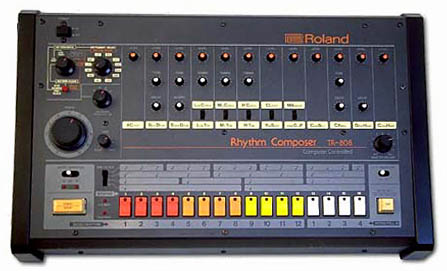
Ryūichi Sakamoto is at the heart of electronic innovation and the Japanese company Roland founded in Osaka in 1972 by Ikutario Kakeashi gives him the opportunity to use the new TR-808 drum machine, which was officially released during 1980. In 1982 the TR-808 was used by Afriika Bambaata for Planet Rock and by Marvin Gaye for Sexual Healing. Two pieces that have marked their era.
Ryūichi Sakamoto is working on the production of his second solo album in early 1980 at the Kraftwerk studios in Berlin; B-2 unit will be released on 21 September just before the second world tour of YMO which starts in London in the legendary hall of the Hammersmith Odeon, temple of music at the time. It was also in London that he recorded the single from his album Riot in Lagos at the brand new studio of dub reggae producer Dennis Bovell.
Dennis Bovell is a reggae musician and producer famous for his collaboration with the reggae poet and singer Linton Kwesi Johnson. He has produced bands such as Madness, Fela Kuti, The Slits and Thompson Twins.
Sakamoto’s second solo album will exert a major influence on the electro scene that is being born, including Riot in Lagos. This piece is considered today as the one that anticipated techno and hip hop sounds and such essential producers as Lance Taylor (Afrika Bambaata) and Kurtis el Khaleel (Kurtis Mantronik) who are among the founders of hip hop. They cite B-2 unit as a major influence.
Ryūichi Sakamoto entered the world of international music through the big door and immediately had a decisive influence on the time and space of emerging music. His time of rhythm, electronics, but also and always melody, his space on the scale of the world and the history of music make him a unique artist whose universe will develop without limit, touching all genres, exploring all the possibilities of a musical phrase, a tempo, a simple sound.
To be continued…

