

Ohayou
December 2022

When the sky is clear, which is not often the case at the moment, you can see clearly from Otaru the snow-covered and bright white Mount Tengu. It is a small summit, barely 532 meters, which is very popular with the inhabitants of Otaru and tourists, you can reach the summit by a cable car that flies over snowy landscapes with magical looks. You can go hiking, climbing and of course skiing in winter. It is also at the bottom of its slope that this unfolds the annual winter fireworks display that attracts a colorful and cheerful crowd. When I reach the summit, the sky clears and Otaru under the snow appears in all its beauty. The ocean far away seems to emerge from the clouds.
天狗山
Tenguyama – Tengu mount.

You may have noticed that we pronounce Tenguyama and not Tengusan as we should pronounce Fujisan and not Fujiyama – many foreigners say it and write it incorrectly. In the case of Tenguyama we use the pure Japanese pronunciation of kanji 山, namely yama, while in the case of Fujisan we use the Sino-Japanese pronunciation of kanji 山, namely san.
富士山
Fujisan – Fuji mount.
The kanji have almost both (at least) very different pronunciations. The explanation of this complexity specific to Japanese is historical. Before the 5th century AD, Japan did not have its own writing system and had only an oral tradition. The Japanese have adopted from this time the Chinese writing system, ideograms, which are called kanji in Japan and which are originally the same as the Chinese.
The subtlety is that the Japanese have kept both pronunciations. The Sino-Japanese pronunciation of a kanji is called on’yomi while the Japanese pronunciation of a kanji is called kunyomi. The first one is mostly used for compound kanji, the second one is mainly used for kanji alone. I recognize that this does not simplify things. Here are examples from the Kanji to kana, reference if it is learning Japanese.
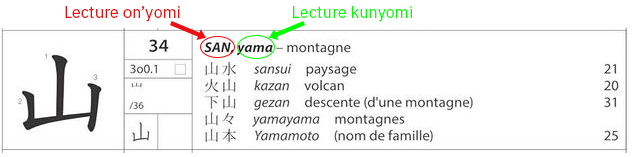

We see that when a word is clearly the combination of two kanji, the pronunciation is on’yomi, Sino-Japanese. Sansui, landscape, kazan, volcano, suiden, rice field (flooded). However, when it is a proper noun, the pronunciation is kunyomi, Japanese. This is logical since names like Tanaka (in the rice field), Yamada (mountain rice field) or Yamamoto (origin of the mountain) existed before the arrival of the Chinese script.
山水
Sansui – 山 (yama, mountain) et 水 (mizu, water).火山
Kazan – 火 (hi, fire) et 山 (yama, mountain).
水田
Suiden – 水 (mizu, mizu) et 田 (da, rice field).
In the case of Tenguyama, the exception may be due to the fact that Tengu is the name of one of many creatures in Shinto Japanese mythology. The 天 狗 is a very well-known character, even outside of Japan, it is the one depicted with a very long nose. Nothing to do with Pinocchio or Cyrano de Bergerac, this goblin is arrogant and having a long nose in Japan is a sign of pretension. It is said in Japanese 天 狗 に な る which means to become arrogant, vain.
天狗
Tengu – heavenly dog.天狗になる
Tengu ni naru – become a Tengu.

The Tengu is a very old demon that probably comes from China, in Japan we find the written trace in the eighth century, but it is already represented on paintings on Japanese rolls a century before. Its appearance has evolved over time. His name is composed of the kanji of sky 天 (ten) and dog 狗 (gu), so it is at first a celestial dog but he evolved into man bird, perhaps in the manner of a Pokémon.
The long nose of the Tengu is a beak that changed at the same time as the Tengu took human form while retaining wings. This is one of its important features, the Tengu can fly. The Tengu is not a single demon, the Tengus are countless and also have several stages of evolution, there are small and large Tengus. The former, unfriendly and not very nice are more birds than men, the latter are wise, intelligent, closer to humans.
It is also obvious that the Tengus exist and can be encountered, like all other demons of Japan. All the Japanese are aware of the existence of another world that remains discreet but which is not less real where all these demons and gods live in parallel to the human world. Encounters between the two worlds are common and pace Japanese life.
The Tengus are 妖 怪, they are spirits, ghosts, demons, or strange appearances. The first kanji 妖 (Yō) means attractive, bewitching or calamity, the second kanji 怪 (kai) appearance, mystery, suspicious.
妖怪
Yōkai.
Let’s go back to the Tengus. They are at the origin of the pretentious demons, I said it, but mostly ill-intentioned. They are initially associated with Shintoism, the animist and ancient religion of Japan, present long before Buddhism which is brought by the Chinese at the same time as writing. The Emperor of Japan is a descendant of the Shinto gods, even if during the defeat of the second world war Hiro Hito officially recognized that this divine ancestry was a myth.
Buddhism wanted to gain political importance very quickly in Japan and it succeeded in doing so at the expense of Shintoism. It is the samurai, the saimyos, the shoguns who have power and they became Buddhists. The Samurai have mostly adopted Zen Buddhism. The Tengus from Shintoism are therefore from the eighth to the eleventh century harmful spirits who attack Buddhist temples, kidnap priests, resist the power in place that has replaced Shintoism.
In the 12th and 13th centuries, the Tengus became ghosts of angry priests, heretical priests or Shinto priests who continued to attack Buddhism in all its forms. They may also want to take revenge on the nobles, or even on the Emperor after falling into the world of the Tengus. A fallen emperor himself became a Tengu in the 13th century. All this is perfectly documented of course.
Gradually, even among Buddhist priests, the Tengus will evolve in reputation. We will distinguish the good and the bad Tengus, the intelligent and the stupid. In different regions of Japan, the Tengus will become benevolent beings and Tengus-related cults will be born.
Today, the Tengus are still there, and if from time to time one or the other allows itself a pendable tour but without great wickedness, most lead a quiet life and have more at heart to serve men rather than spending their time tormenting them.
They are always proud, even pretentious, but they have learned to live in good harmony with the Japanese who now pay tribute to them in many festivals where they are thanked for their benefits. This is not the case for all Japanese demons. But the list of these is far too long to talk about here, gods and demons are legion in Japan, and it is not always appropriate to talk about them. But for the Tengu, it’s okay, I’m safe.
I went to the top of the mountain where lives the Tengu of Otaru, I did not see it but I felt its beneficial presence. The Tengu did not even think to scare me, he just shook a little trees covered with snow to make it fall on me, I heard him laugh, it’s not very bad and it is very beautiful.

If you meet a Tengu, be respectful and polite, don’t look him straight in the eye, smile at him, he will be grateful. And who knows, maybe it will help you to better understand Japan and the Japanese.

