

Ohayou
January 2023
Although largely ignored in the West, Japanese cinema is still one of the most important in the world in terms of films produced. In some years, Japan outstrips the United States!
From the end of the 19th century, having barely opened up to the West, Japan was eager for technology, and the first screenings by the Lumière brothers’ technicians were held in Kobe in 1896 and Osaka in 1897.
Shirō Asano (1877 – 1955) imported the first Gaumont camera in 1897 and shot street scenes and geisha scenes. The screening of his films in Tokyo in 1899 was a success, and cinema was launched in Japan. The first successful film genre was 時代劇, featuring sword fights that were to become extremely popular.
時代劇
Jidaigeki – historical drama.
Almost all this silent film production, which lasted about thirty years, has unfortunately almost completely disappeared. Things are ephemeral in Japan, we do not try to keep them. The genre has nevertheless persisted in talking cinema and it will become the very symbol of Japanese cinema through the works of Akira Kurosawa or Masaki Kobayashi among many others.
However, the Japanese cinema was totally ignored by the rest of the world for more than 50 years, it will be necessary to wait for the Venice Film Festival in 1951 for the West to become aware of the existence of Japanese cinema. But it remains in the shadows for the general public as shown by the story of Yasujirō Ozu, considered today as one of the most important directors in the history of world cinema.
On the 12th of December 1963, Ozu dies on his 60th birthday, he pays a last discreet tribute to the subtle precision that characterizes his cinema. In Japan, it is famous, recognized, but often considered as very little Japanese. The New Wave of Japanese cinema, which is making its debut, considers him a bourgeois filmmaker.
In the West, it is almost unknown. In the year of his death, the Berlin Film Festival presented some of his 54 films, but it was not until 1978 that 東 京 物 語, literally, “Histoire de Tokyo”, saw a national release in France under the title “Voyage à Tōkyō”.
東京物語
Tōkyō monogatari – Tōkyō story.

Public domain, via Wikimedia Commons
This 1953 film is considered today as one of the greatest films in cinema history. To see it, to appreciate it, to remember the emotion that it provides, has entered through a small backdoor into the universe of Japan, a universe that is nothing like ours and at the same time so much like it.
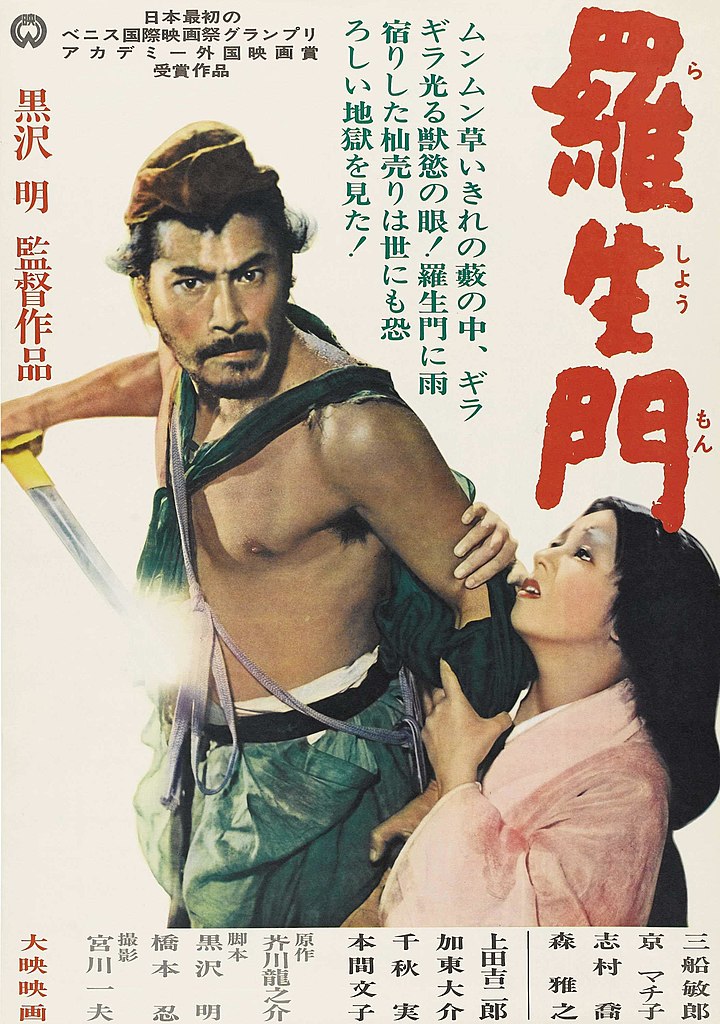
The first name of Japanese cinema, the first reference for Westerners, is not Yasujirō Ozu but Akira Kurosawa. In 1951, he won the Golden Lion at the Venice Film Festival for his film Rashōmon. Kurosawa is 41 years old, this is his tenth film and for the first time in more than fifty years of existence, Japanese cinema receives international recognition.
Rashōmon is the story of the murder of a samurai and the rape of his wife told in four very different ways, including by the dead himself through a medium. This is the Japan of the Heian era, between the 8th and 12th centuries, there are the bandit, the samurai, the miserable, the femme fatale, all the archetypal ingredients are there.
Public domain, via Wikimedia Commons
This film of unprecedented power is served by an extraordinary actor, Toshirō Mifune, it is the fifth of fifteen films he shoots with Kurosawa, most have become classics. I think it was by watching this film that I understood how much cinema allows us to see the world differently, just as literature allows us to think of the world differently.
It is from this time that Japanese cinema will make popular in the West the character of the fearless, inflexible, extraordinarily skilled samurai and at the same time counteract the extremely negative image of the Japanese resulting from the second world war.
Yesterday I was revisiting another Kurosawa film that is also emblematic of this aspect of things, Yōjimbō (The Bodyguard) which dates from 1961. It is a huge success at the Japanese box office, it earns more money than all previous films. It is also the one who launches a new era for 残 酷 時 代 劇.
残酷時代劇
Zankoku jidaigeki – cruel historical drama.
But not only. Sergio Leone, then largely unknown to the general public, plagiarizes without embarrassment not only the scenario, but also the techniques, the plans of Kurosawa. These famous tight shots, of patibular cheeks, sadistic moustaches, perverts, badly shaved faces, dirt on all parts of the body and music that rhythms the shots. Duel scenes in the main street of the village, with wind, dust etc.
Sergio Leone took everything from Kurosawa – he anticipated in this Tarantino who also plunders the Asian cinema without reserve – and he did it For a handful of dollars with Clint Eastwood that comes out in 1964 and launches his career. This is the exact copy of Yōjimbō. Leone will lose the lawsuit filed by Kurosawa for plagiarism, but in the West they prefer to forget it.
Il y a aussi un réalisateur dont le nom est associé aux Geishas, Kenji Mizoguchi Kenji. Il est né en 1898, son père se voit ruiné dans son entreprise de fournir des pardessus à l’armée japonaise lorsque le guerre russo-japonaise s’arrête en 1905. Il vend sa fille aînée à une maison de Geisha ce qui traumatise le jeune Kenji. Il fera des Geishas, des prostituées, des femmes en souffrance, la thématique récurrente de son cinéma qui a l’ampleur et la qualité de celui d’Ozu, de Kurosawa ou d’Imamura dont je parlerai dans une autre chronique.
« Les musiciens de Gion », raconte l’histoire d’une jeune fille qui devient Maiko après la mort de sa mère qui était une Geisha. « Les sœurs de Gion » se passe dans le quartier des Geishas de Kyoto. « La rue de la honte », son dernier film en 1956, raconte la résistance d’une maison de passe face à l’interdiction de la prostitution.
879 / 2000
There is also a director whose name is associated with the Geishas, Kenji Mizoguchi Kenji. Born in 1898, his father was ruined in his business of supplying overcoats to the Japanese army when the Russo-Japanese war ended in 1905. He sells his eldest daughter to a house of Geisha which traumatizes the young Kenji. He will make Geishas, prostitutes, suffering women, the recurring theme of his cinema that has the magnitude and quality of that of Ozu, Kurosawa or Imamura I’ll talk about in another chronicle.
«The musicians of Gion», tells the story of a young girl who becomes Maiko after the death of her mother who was a geisha. «Gion’s Sisters» takes place in the Geishas district of Kyoto. «La rue de la honte», his last film in 1956, tells the story of a brothel resisting the ban on prostitution.
Japanese cinema is probably one of the best ways with literature to discover Japan, its past, its history, its culture, having a chance to grasp all the difference with the Western world and all the difficulty in appreciating and understanding it.


