

Ohayou
June 2024
One last evening in Kanazawa with Mari and I leave the next day for the North, Hokkaidō, Otaru, this small town where I love not doing anything but walking, writing, drinking coffee, talking, eating, seeing friends, drinking beer and sake, learning more about the Japanese. It’s not really nothing.
Mari gave me a meeting in her wine bar, the ラ ン プ, at 10:30 pm, before that she has to work and welcome two important clients in her bar. I take the opportunity to return to an Izakaya where I have not returned for six years, I had eaten my first 河 豚. The place has not changed but I no longer see the sushi master that I met there. He spoke perfect English having lived several years in New York. He had returned to Japan combining a job as sushi master with that of psychologist.
ランプ
Ranpu – lamp.河豚 (ふぐ)
Fugu – pufferfish.
Something has changed anyway, we can have access to the menu with a QR code, a way to show that tourists are welcome. I prefer the menus in Japanese and I order what I can understand which does not impress the waitress who with a radiant smile starts to speak to me Japanese as if I spoke fluently. I don’t understand anything and I laugh. ゆ っ く り く だ さ い. I ask her 今 日 の お す す す め な に で す か?
ゆっくりください
Yukkuri kudasai – slowly please.今日のおすすめなにですか
Osusume nani desuka – what is the recommendation of the day?
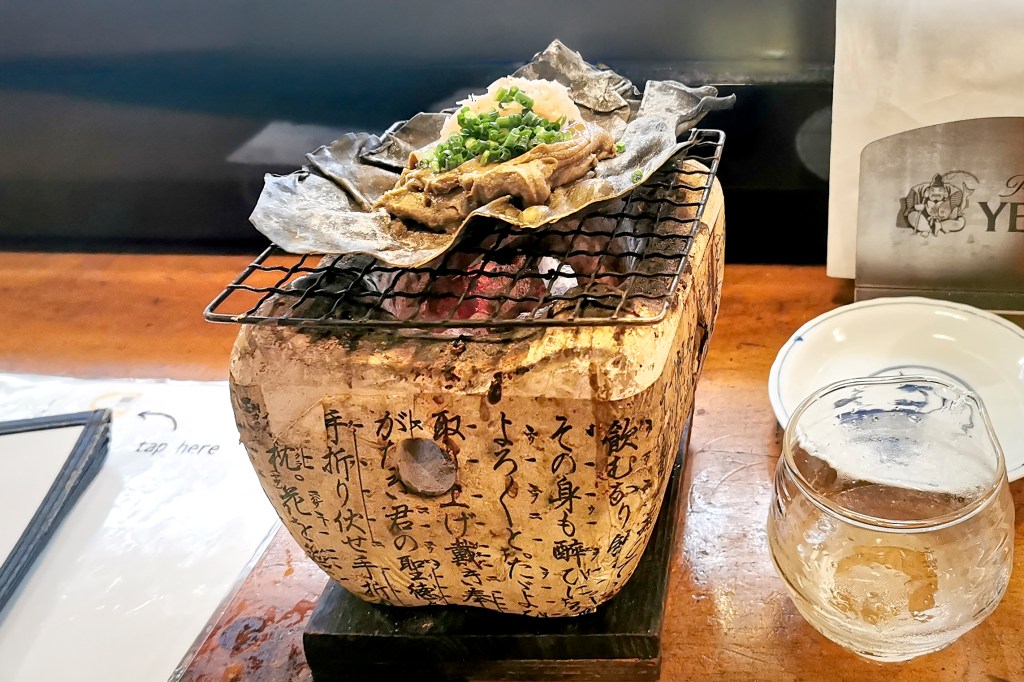
The waitress looks at me a little surprised but she points out several dishes on the menu. She doesn’t know my tastes, so she hesitates a bit. But I am a client, a foreign client either, but a client and I must therefore be treated as such. She advises me in particular what will turn out to be a small portable campfire on which are pieces of crab in a hollow, curved receptacle resting on a kind of lumpy brown paste made of miso and something else that I cannot define. It looks a bit like tentacles given the layout but it’s not. It’s really delicious. I receive this dish together with the 味 噌 汁 and seafood that I also ordered.
焼きカニ
Yaki kani – grilled crab.味噌汁
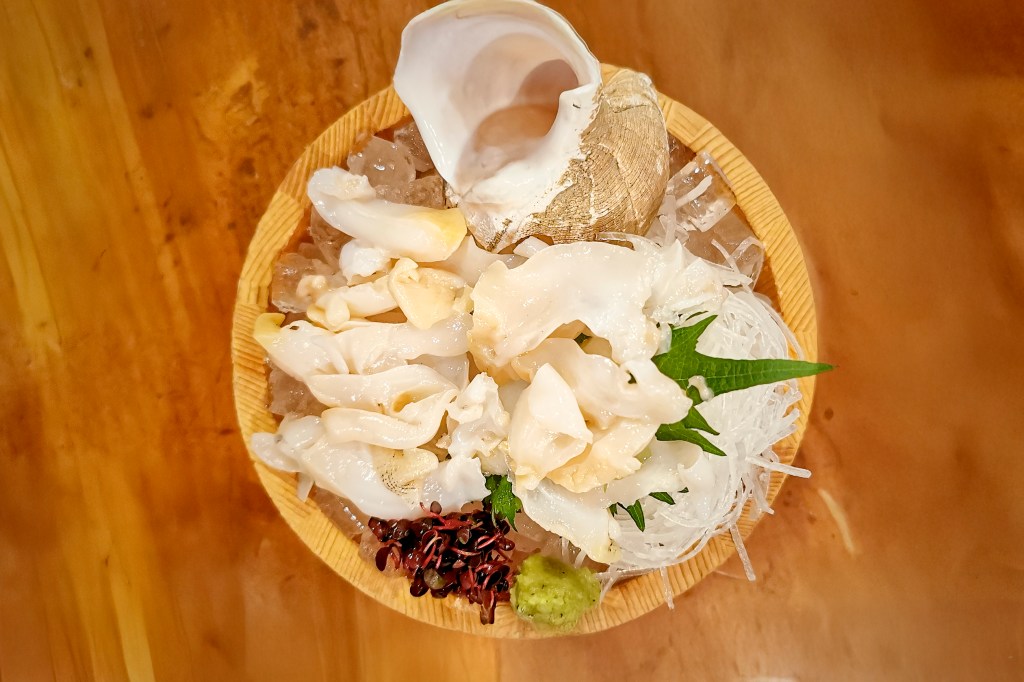
Misoshiru – miso soup.つぶ貝
Tsubugai – whelks.イカの塩焼き
Ika no shioyaki – grilled calamari with salt.


When I join Mari at the Lamp, her wine bar, she is at her boss table in the back with the two clients she told me about. I know them, at least I have seen them before and they recognize me too. It was five years ago, still this amazing memory of the Japanese. They are salary men, probably executives of their company, even directors, they are in classic suit and they came to drink with Mari discussing business and investments.
I am not an inconvenience, I arrive at the agreed time and their discussion has already progressed as well as their consumption of wines that are served in the bar. The dikes of the proverbial reserve of the Japanese are crossed, the evening promises to be interesting and fun. Mari summarizes to her guests my last five years of relations with Japan, she specifies that I have progressed in Japanese and she adds that when I come to Japan, I always come to see her in Kanazawa. I confirm with a smile.

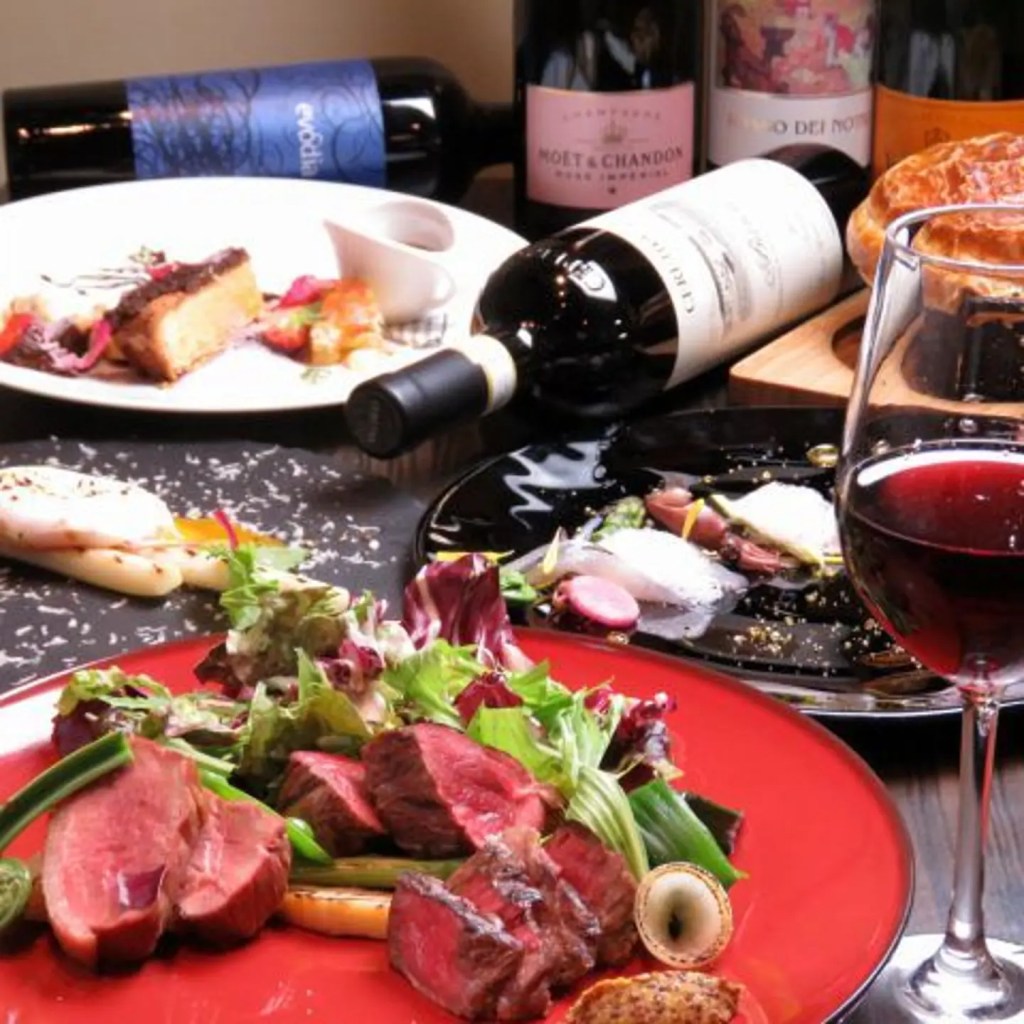
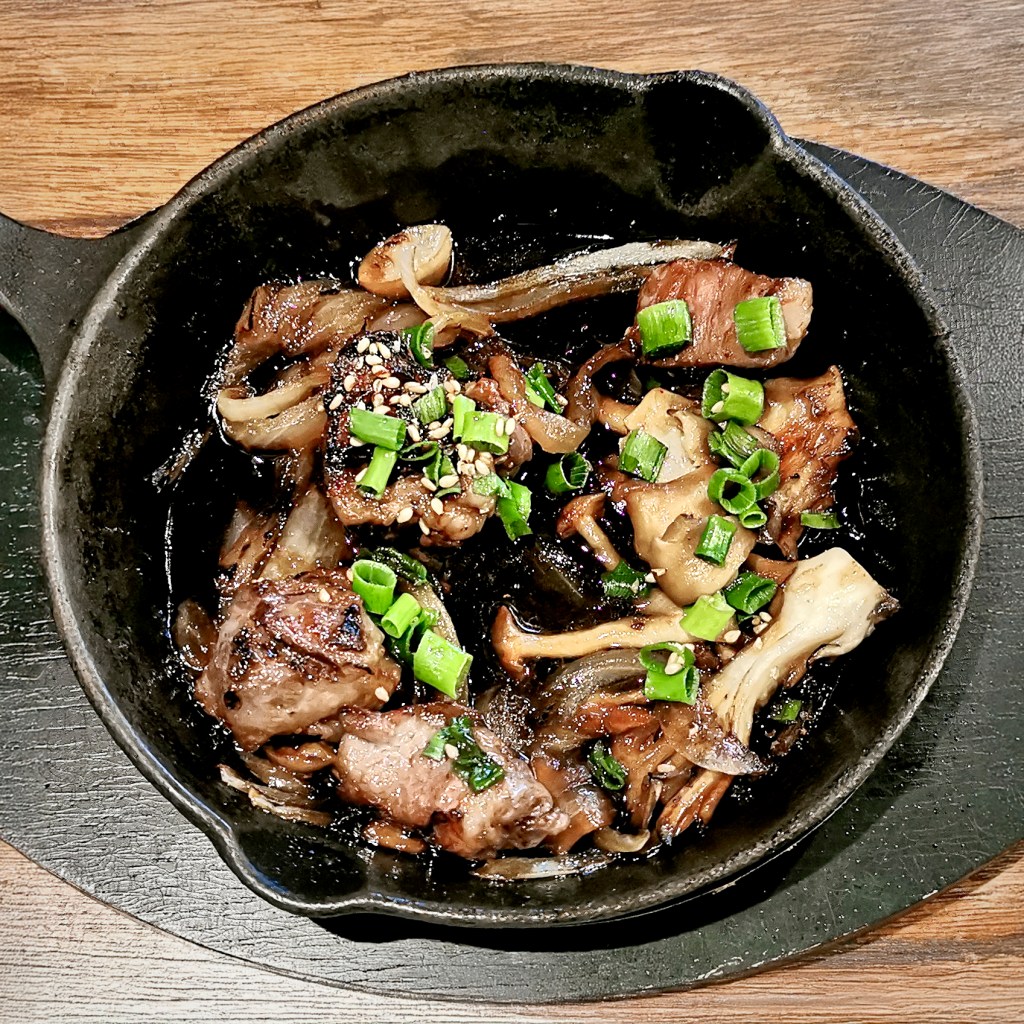
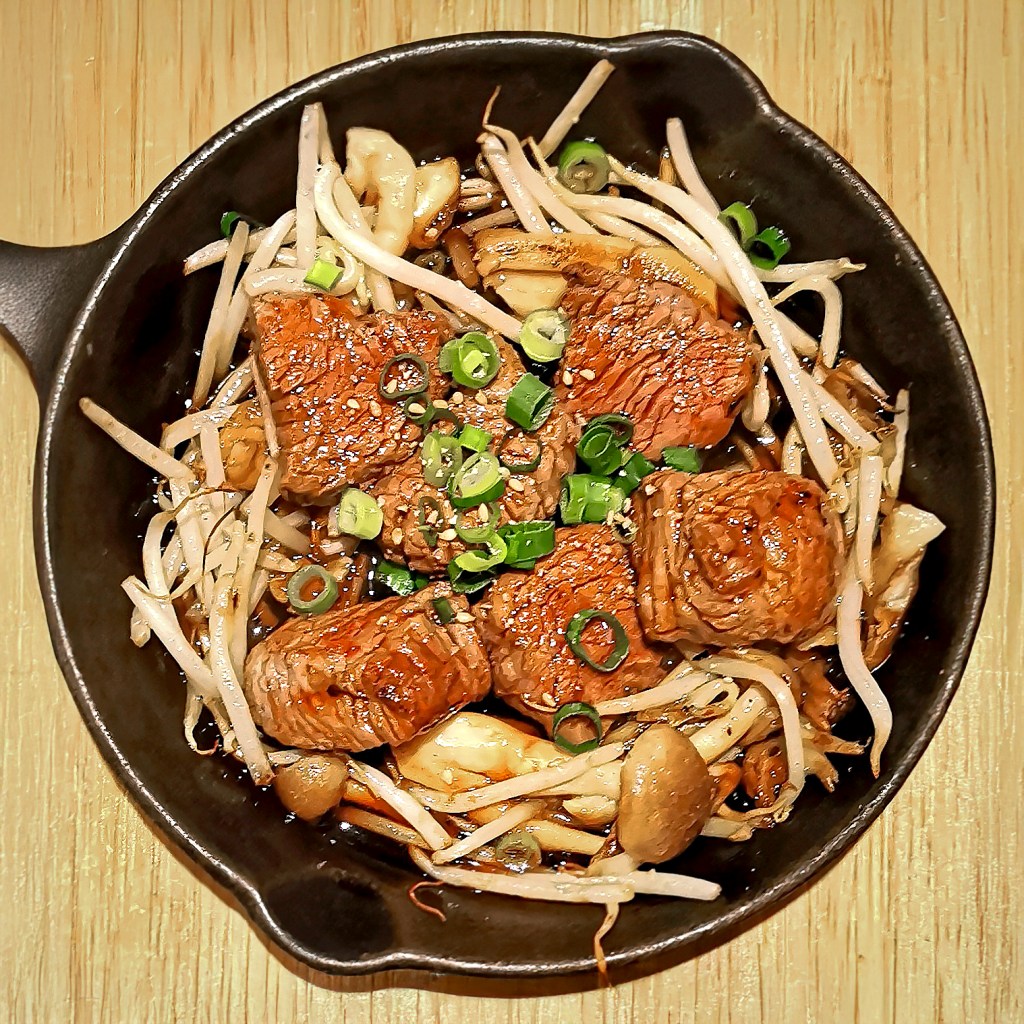
Mari’s wine bar is also an Izakaya and it eats very well, the chef, Tako, in his thirties, handsome guy, very reserved, is an excellent cook. Everything is neat, fine, well presented, original too. When I came in 2019, Mari had opened another restaurant, smaller, in a place that includes restaurants with a gastronomic vocation. She even opened a third one afterwards, but the Corona arrived and she had to give up the two new ones to keep only the bigger and more efficient one, the Lamp.




The first thing that Mari showed me when I met her, even before introducing me to Takashi, was a picture of her violin she ordered, in Europe, in Belgium more precisely. I remember his smartphone ringing that night, the second piano concerto of Sergei Rachmaninov, one of his favourite composers, was our first common ground.
The Japanese and music is a love story. They learn it at a young age in school and most of them play an instrument and just sing, what a pleasure for the カ ラ オ ケ whose popularity in Japan is immense. In every restaurant, in every bar, in every Izakaya there is music, almost always jazz or classical music. The bars and night-clubs are a bit different, more rock or pop, but the music is still there.
カラオケ
Karaoke – composed of kara (空), “empty”, and oke, orchestra abbreviation (オーケストラ).
So, at night when we go from one bar to another, from an Izakaya to a ramen restaurant, we also go from one music to another. And the nights are long with Takashi and Mari, nights that all three of us want to live as long as possible because they are too rare and we do not know when the next one will be. And sometimes, in those nights when we walk in three-sided Saké, Takashi as a free electron as it should be for a scientist, we move without looking at each other and a new sun shines in our eyes in the land of the rising sun.
Tonight at the Lamp, Mari’s guests are close to the start, the alcohol level after the work day has passed the stage of carelessly untied ties, the stage of sitting down is near. It’s time to exchange the 名 刺 , I sign mine with the 判 子 that Makki gave me in Otaru and on which is my Japanese kanji name that Mari created five years ago. This arouses the interest of one of the guests while the other slowly fades by leaning on the bench to sleep.
名刺
Meishi – business card.判子
Hanko – seal used for signatures in Japan.
Mari being the author of the kanji that make up my Japanese name, she explains the design to the still awake guest. The difficulty is to find kanji whose pronunciation allows you to read the name as it is actually pronounced. With sounds that exist in Japanese and are not always the same as in other languages such as French or English. Normally a foreign name or surname is written in katakana, the Japanese syllabary used for foreign words.
マルセル・プルースト
Maruseru purūsuto – Marcel Proust.デヴィッド・ボウイ
Devuiddo bōi – David Bowie.
It is also possible to create a Japanese kanji form of a foreign name by respecting the pronunciation of the same using kanji. The choice is vast because there are several thousand kanji and many pronounce in the same way. But that’s not all, it is also necessary that these kanji reflect the meaning of the name and first name as far as possible. It is not necessarily obvious to us, we have generally forgotten that our names and surnames originally mean something and we no longer name our children because of this meaning. This is not the case of the Japanese, the kanji that form the name of Mari and who pronounce themselves in this way mean for example “the truth”.
Mari accompanies her guests on the street as it is done in Japan, it’s お 見 送 り. There are three reasons for doing this. First, thank the customer for coming, then wish that the customer will return home safely, and finally wish that they are healthy the next day. It is being 一 期 一 会, doing things as if it was the last time in your life. Act like it’s the last time you see him or her, even if he or she is someone you see very regularly. It is deeply rooted in the hearts of all Japanese, and has been part of their education since their earliest years. They cherish every moment fully with the permanent awareness of the ephemerality of the thing of which the cherry tree is the most obvious and known symbol.
お見送り
Omiokuri – to accompany and say goodbye.一期一会
Ichigo ichie – a moment, a meeting.
You have to stay on the street, say ま た ね, 気 ぞ 付 け て and make hand signals while the customer is visible. Mari does this perfectly and I do not doubt for a moment her sincerity when she does it.
またね
Mata ne – see you soon.気を付けて
ki ho tsukete – take care.

