Public domain, via Wikimedia Commons
Ohayou
June 2024
Finding your way is a game I love in Japan, doing what others do not, knowing the logic of the enemy to better counter it. Sun Tzu’s Art of War teaches us these things. We must read this book, which is not a book of bloody battles. There are many wars to be waged and the astute and effective principles of the Chinese author who lived six centuries before our era also apply to avoiding tourists.
It’s nice and warm, since my arrival in Japan I’m really lucky, sun is there almost every day when the 梅 雨 is supposed to have started. Walking is a bit complicated, it’s hot and humid and I’m not used to it yet, I drip quickly. On the other hand I keep in shape, I feel light and I accumulate the kilometers on foot that only wear shoes.
梅雨
Tsuyu – rainy season.
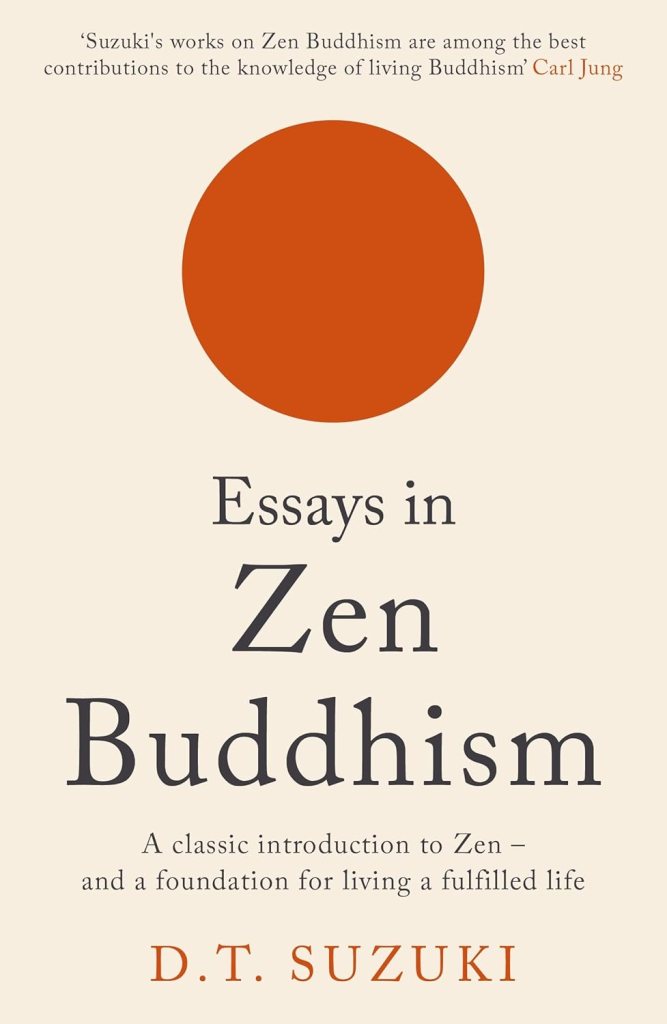
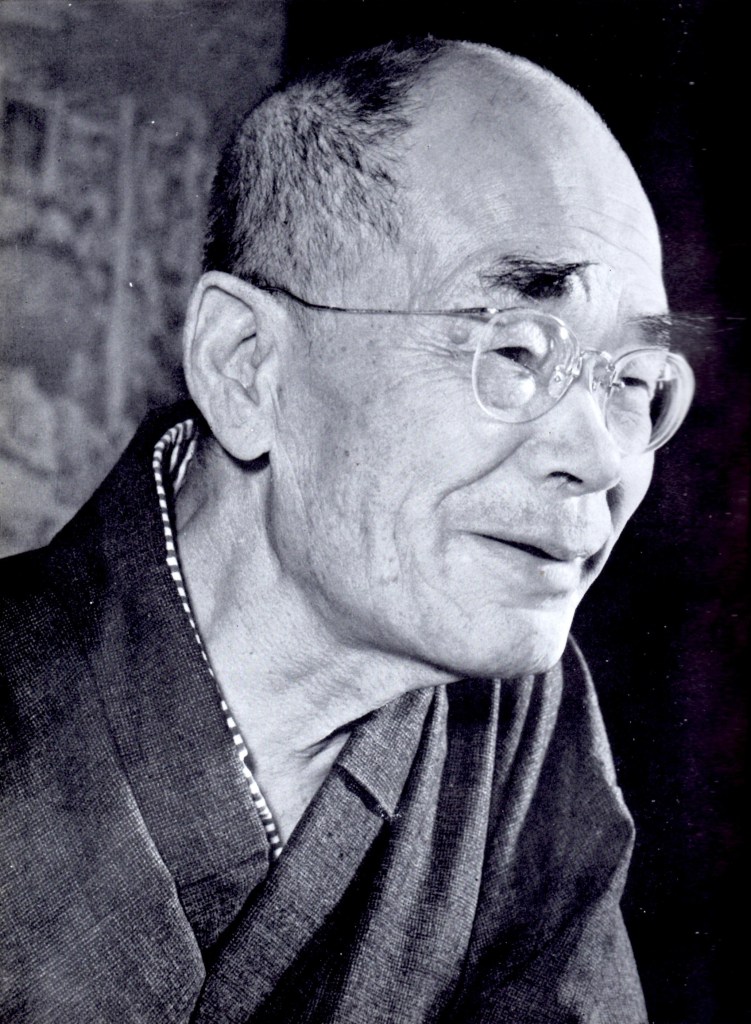
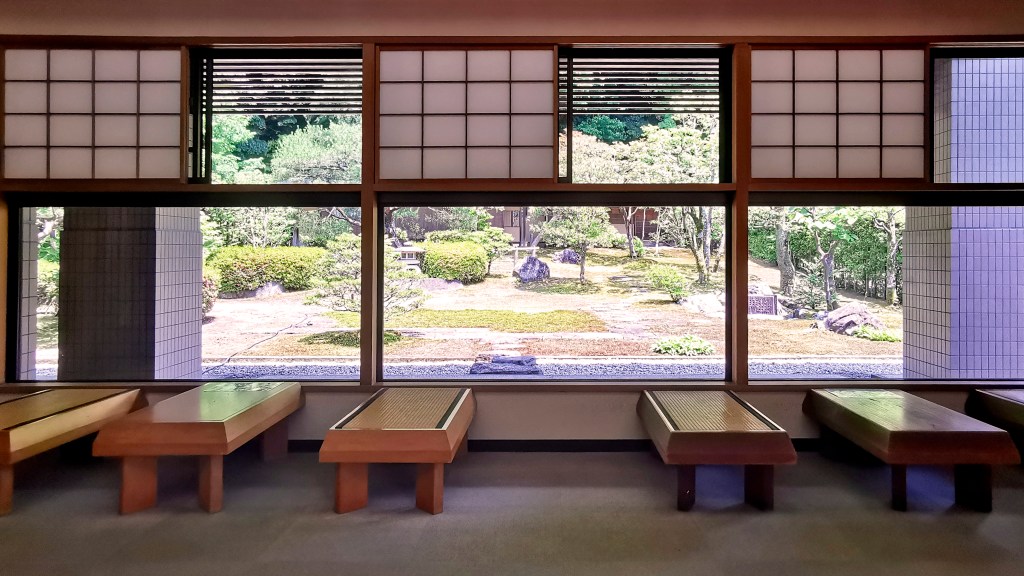
The focus of the day is the home of Daisetz Taitaro Suzuki (1870-1966), a Zen scholar and philosopher who was born and died in Kanazawa and studied Zen at the Engaku-ji in Kamakura where the filmmaker Ozu is buried. How my interests intersect and complement each other, Kamakura, Kanazawa, the Zen, Ozu, Suzuki. The house has become a small museum in which you can learn a lot about D. T. Suzuki’s thought but where there is not much to see outside of the houseWhich is a true happiness of serenity with a body of water that serves as a mirror to the extremely simple architecture of the place. Everything is harmonious.
Being Zen does not mean to withdraw from the world and only spend time meditating; it is also not cool as the use of the word in everyday language might make you think. Zen is a very important school of Mahayana Buddhism in Japan, it was notably the one of the Samurai. He particularly emphasizes the importance of finding the awakening dear to Buddhism in everyday life by transforming its worldview.
The important elements of Zen are the non-duality between self and world, between mind and matter; the rejection of complex doctrines in favor of an intuitive discovery of reality; Zen emphasizes the importance of living and feeling reality, daily life, eating, walking, loving are paths of awakening; things have no importance in themselves, it is emptiness; the “I” is an illusion; everything is transient, impermanent.
One does not become Zen by being calm and kind, one becomes Zen by losing all desire, in integral that the desire and the satisfaction of desire are vain, devoid of meaning. This does not prevent at all from being a good living, from drinking food, laughing, making love; one must let things come to oneself and not desire them, as it is necessary that the way of the bow comes from harmony and not from aiming.
I like a quote from D. T. Suzuki: “The truth of Zen is the truth of life, and life means to live, to move, to act, not merely to reflect”.
My journey that day goes through the 兼 六 園, the wonderful Japanese garden of Kanazawa, but I do not stop there, I went the day before and I found with happiness that it is not at all crowded by tourists. Understand who can, I probably had luck, I will see well the next time because necessarily I will return. Of course I pass by the castle still as imposing, there too it is rather quiet; are they all gone, mystery.
兼六園
Kenrokuen – garden of six attributes.
I arrive in the park that precedes the house of D.T. Suzuki and at the entrance there is a small museum dedicated to the objects that serve in Japanese ceremonies, the tea ceremony for example. I have never visited it and this is the opportunity to go in a place where there is absolutely no chance of seeing a tourist.
I’m walking with a couple of old Japanese, only visitors to the place. Surprisingly, a lot of descriptions of the exhibits are translated into English, not necessarily completely, but still, it is useful. There are cups, vases, urns, bowls, I stay in the old times and it’s nice.
At the entrance I took an additional ticket for the tasting of macha tea that is offered. I’m alone for this one and I can choose the bowl in which I want to drink my tea in a showcase that offers very different containers. I choose the simplest, the one without decorations, I know that the most precious cuts are the simplest and I see in the look of the one who offers me the choice an interested flash. She understands that I know. An anecdote which reminds me of a certain adventurer whose hat I have but not the whip.
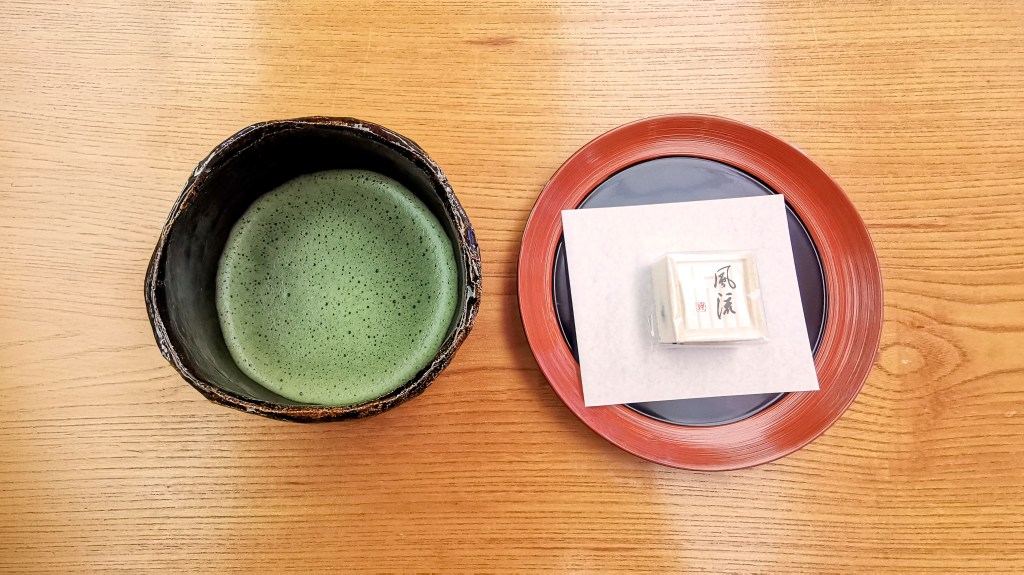
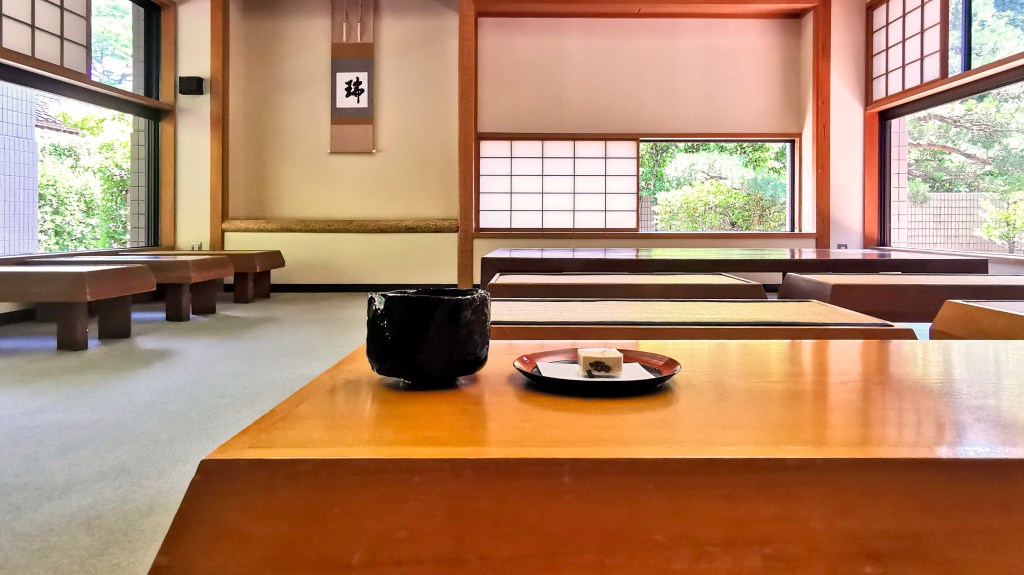
It’s not a real tea ceremony but I try to drink the masha as it should. First eat the pastry that is served with the tea, cut it into smaller pieces if it is accompanied by a utensil for this purpose. Take the bowl with your right hand and place it in the palm of your left hand. Turn the bowl twice a quarter turn with your right hand so you don’t drink from the side where the bowl was presented to you. Drink gently the green liquid a little frothy that looks like a pastry because it seems solid; it is slightly bitter, the temperature is perfect. After drinking, turn the bowl twice in the opposite direction and gently place it on the wooden table.
Everything is simple, harmonious, you can look at the beautiful garden while enjoying tea, be Zen, do not think about anything or rather as the council the Zen, let pass thoughts without sticking to it. Simply savor what you see, feel and hear, that is to say nothing. Nothing to be desired in such moments, everything is there, you have to be 一 期 一 会, live the moment as if it would never happen again, as if it was the last moment of his life. I think that in the West we say a lot of nonsense about this very simple and so difficult to grasp principle in the manner of a Japanese.
一期一会
Ichigo ichie – a moment, a meeting.
The afternoon heat is even stronger, I walk slowly towards the house of D.T. Suzuki thinking that for once I will see it under a radiant sun. Students in uniform come out of the house, they do not seem to be accompanied by a teacher, they came alone apparently. Maybe that’s what they were asked at school, maybe they like it here too.
They are young students, the girls wear the セ ー ラ ー 服, square sailor collar at the back, pleated skirt above the knee, long white socks. Boys wear the 学 ラ ン, which is inspired by Prussian uniforms, it dates from the 1890s while girls’ uniforms appeared around 1920 and were designed from the Royal Navy uniform.
セーラー服
Sērā-fuku – marine clothing.学ラン
Gakuran – uniform for boys.
In the house of D.T. Suzuki there are no more students, only a few visitors. I have the opportunity to watch the silence reflected in the water, to listen to the house say nothing, to play with filming two lovers whose silhouette is cut into Chinese shadow in one of the four openings of the reflection room. But is it a room to think about or a room to see the reflections in the water? I think both. But do I really think or am I someone who thinks he does? I don’t know, I’m not a Buddhist.