

Ohayou
December 2022
I cried today. Sometimes you have to cry because it’s so beautiful.
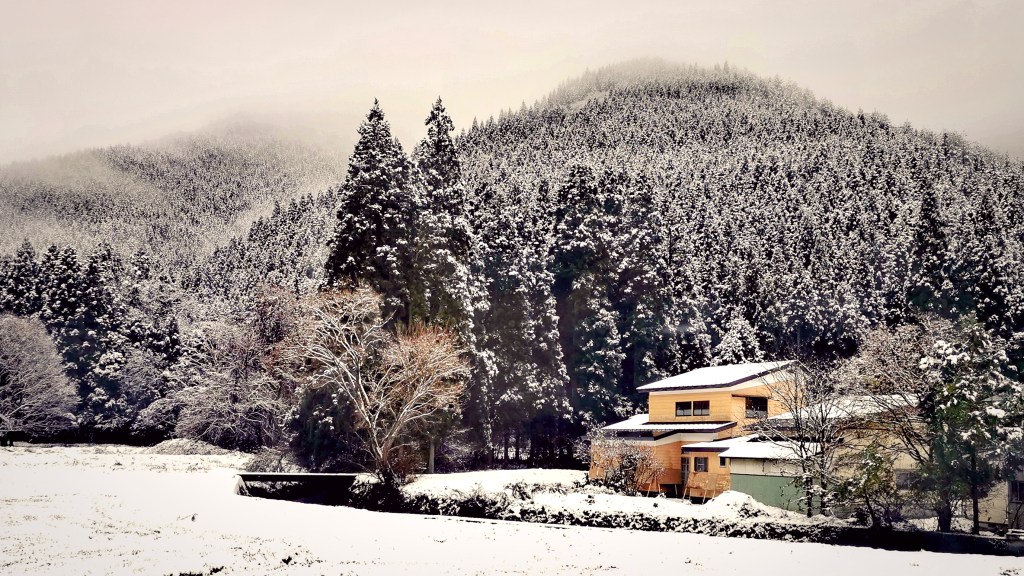
From Morioka, I set off for Akita on the west coast, with no particular goal in mind, to cross the snow-covered landscapes on the Shinkansen and discover their beauty, to take a photo of myself in Akita and send it to a Japanese friend in Kanazawa who was born there. Pleasing someone you love is a goal in itself.
On this grey day, I took a few photos and visited a museum built by the architect Tadao Andō, whom I had discovered four years ago on the island of Naoshima thanks to the advice of a long-lost friend.

It was on the way back that the event that motivated this story happened.
As I leave Morioka station, I see a school on a trip. Japanese schoolchildren will soon be having winter holidays, and it seems that this is an opportunity for them to go on school trips.
There they are, coming out of the station, in a column of four, with the teachers in front of them, looking like officers reviewing their troops. They thanked each other in Japanese, and shouted with satisfaction that the trip had been a success. The schoolchildren, like children at Hogwarts, play along and cheer.
What struck me was not the order and discipline of the school gang, I’m used to that in Japan, but the fact that, despite the sub-zero temperatures, the girls, dressed in their proper uniforms, were bare-legged.
According to my friend Takashi, they’re cold, but it’s much more important for them to show off their legs in order to look 可愛い. In this case, he wasn’t talking about schoolgirls, but about those young women you come across at three o’clock in the morning, bare-legged and freezing. It’s not rare, it’s the norm.
可愛い
Kawaii – cute.

It is quite extraordinary to be faced with such a situation, the standards and respect that dress his moments are alien to us. I climb up the line of students and receive a greeting from a young girl who plants her eyes in mine and then slightly bows her head with respect. I can only answer in the same way.
In Japan it is like that. A Westerner sees it as an invitation, in fact, it’s curiosity. It’s a lesson to learn for those who want to travel to Japan, the Japanese are shy, but in reality they want to know us.
When I’m in an Izakaya and ask Takashi what our neighbors eat, he says: “Ask them, they want to talk with you”; he is totally right.
But the subject of my chronicle today is not that, not quite.
In the Morioka station, I want to cross the tracks to go to the other side of the station where there is an electronics store where I want to buy a cable that I need. But the stations in Japan have several levels, consisting of stores of all kinds.
I am therefore a little lost and I go around in three dimensions, up down, left right, escalators, corridors, dead ends, etc.
I pass a young student in uniform who buys a flower probably to offer a gift. I hesitate about the direction, it exceeds me, and I choose to go in the same direction, by chance.
So I unintentionally start to follow her. After a while she turns around and I start to worry that she will take me for a satyr and start yelling 止 め て.
止めて
Yamete – stop.
I don’t really know where to go and at the same time I have no choice but to keep going or turn back, I’m still walking in the same direction as her.
She stops and turns towards me.
In the kind of soft voice you’d like to wake up to in the morning when you’ve got the time, she says to me in slightly hesitant English: “You’re lost, do you want me to help you”?
I know that’s how it is, the Japanese are people of a courtesy and attentiveness that only exists there. Helping someone, especially a foreigner, is normal, it’s obvious. But every time, I’m flabbergasted.
I explain to her where I want to go and she takes charge of me, looks after me, guides me. She’ll accompany me for fifteen minutes to get out of the station and take me to the shop I want to go to.
When I asked her in Japanese if this was the way she wanted to go, she didn’t answer – Japanese people are like that, they ignore questions they don’t want to answer. It’s obviously not her way.
Her name is Yuzuka, she’s 高校生, she wants to know where I come from and she wants to do me a favour because in her upbringing, in her culture, it’s not an obligation, something imposed, it’s a way of seeing the world.
高校生
Kōkōsei – high school student.
“You’ve been kind enough to come to my country, and my upbringing has taught me that it’s only right to thank you”, says Yuzuka with a disarming smile. The snow starts to fall again in large flakes, giving the scene a cinematic feel.
As soon as she sees the shop sign, she says ‘Here it is’ and greets me, saying またね.
またね
Mata ne – see you soon.
The emotion rose and I cried; it was so beautiful that I cried.


