

Ohayou
June 2024
In the train I am nostalgic and happy. Nostalgic because I leave my friends in Kanazawa, happy because I will meet those from Otaru on the island of Hokkaidō in the north. It’s a long drive, it would take 18 hours to drive the 1200 kilometers. In Japan you do not drive fast, unless otherwise indicated the speed is limited everywhere to 60 km/ h with a maximum of 100 km/ h on some highways, most of them allowing 70 or 80 km/ h. In addition, to make this route you must take a ferry between the island of Honshū and that of Hokkaidō.
By train it takes a little more than 11 hours, it varies a bit depending on the connections between the four trains that have to be taken, but the wait between each of them is rarely more than 10 minutes. I love this ride. From Kanazawa to Omiya, first Shinkansen, 7 minutes to change platform and take another Shinkansen that goes from Omiya to Hakodate. It passes under the Sea of Japan at a maximum depth of 240 meters for about fifty kilometers to reach the island of Hokkaidō.
In Hakodate, it takes 15 minutes to change platforms and take the Hokuto limited express which is not a high-speed train like the Shinkansen, its speed is limited to 100 km/h while the Shinkansen runs at more than 300 km/h. Three and a half hours to get to Sapporo. Then last local train from Sapporo to Otaru. In 2030, the Shinkansen will go to Sapporo which should shorten the journey by a good two hours.
I arrive in Otaru shortly before 8pm, the flat I’m renting isn’t far, a twenty-minute walk, and I pick up the keys at the Makki Izakaya. On the way I bump into several people, some whose names I know, others not. The owner of the Last Drink bar, where you can play the piano at any time of day, the Makki customers who wave to me in the street, the neighbours who live opposite my flat. I’m back home.
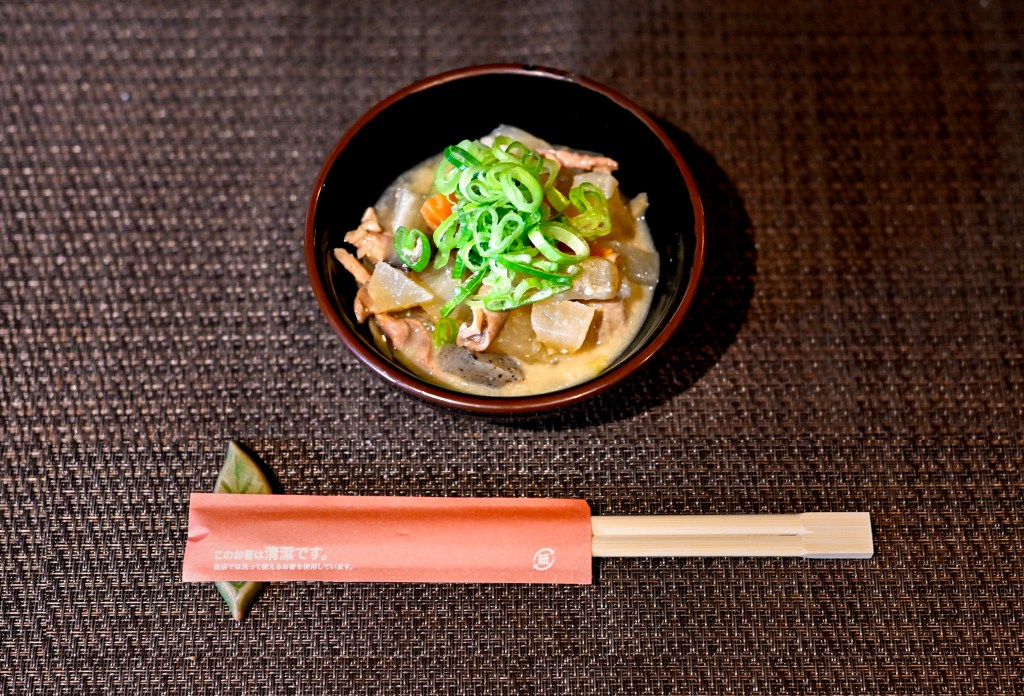
As soon as I’ve dropped off my luggage, I head back to Makki’s Izakaya for dinner. On the menu this evening is a bowl of the inescapable もつ, cow’s stomach in carbonnades over which I enviously pour hot chilli, which young raw onions placed on the hot offal welcome. Next comes some 生氷いか which takes a little getting used to, the taste and smell are very strong. A few sips of Sake help to accept the surprising strength of the flavour and aroma. We’re in the North where life is hard in winter, sometimes very hard, and that forges your character and your taste buds.
もつ
Motsu – tripe.生氷いか
Nama koori ika – frozen raw squid.
I’m served small bowls of mixed vegetables in various delicate and sensual salads that balance the sensations; the North can be tender too when the southern wind begins to blow. Eating all these slightly intricate dishes—not in their preparation, but in their sometimes striking simplicity—makes you the subject of interest among the Japanese. In a way, if you can eat what they eat, perhaps you can begin to understand who they are.
It’s time to let Makki tidy up and clean her little izakaya while I head to the bar just three and a half meters away, where she will join me later. I have to be careful as I enter; the ceiling reaches less than 190 centimeters at its highest point, and even lower beneath the imposing beams that hold up the roof. Everything in this small alley of restaurants and bars seems improvisational, even precarious, but it’s a place of constant human warmth that’s hard to leave.
As I greet the owner and exchange some news, I spot my friend Fumiko and her daughter walking past the bar. They wave warmly and sit next to me. Fumiko is the elegant owner of La Salle de F—in French, no less—a bar where a bottle of Nikka single malt whisky has been waiting for me for several months, adorned with a small tag bearing my name.
Fumiko exudes class, grace, and elegance. When she laughs, it’s a contagious sound that she partially conceals with a hand gently raised in front of her mouth, as many Japanese women do. That’s how she is with her friends, but also how she welcomes her customers, always with elegance and a smile.
Fumiko’s bar is a cozy little gem, decorated with ikebana flower arrangements, where men mostly gather, either after work or after dinner. Here, you sip wine or quality spirits while chatting and laughing loudly. Fumiko plays her role perfectly, moving from table to table to ensure everyone is satisfied, enthusiastically and humorously joining various conversations. The philosophy is simple: whether it’s Fumiko, Makki, or anyone else in Japan, the customer must leave happier than when they arrived.
生け花
Ikebana – flower arrangement.
But tonight Fumiko has finished work and we have a drink together, laughing a lot. We haven’t seen each other for almost a year, but we talk as if we’d parted the day before. In these moments, time, durations disappear and only the present moment counts. 一期一会, this concept dear to the Japanese advises us to live every moment we enjoy as if it were our last. That’s what I try to do when I’m in Japan, not to think about tomorrow, not to calculate, not to fear regrets and always to live the moments without restraint.
一期一会
Ichigo Ichie – a moment, an encounter.
The next day I go to Sankuro, an Izakaya where they make excellent 焼き鳥 for ridiculously low prices. The Japanese word literally means ‘grilled bird’, but anything can be grilled on these little wooden sticks. All parts of the chicken of course, including giblets, skin and even cartilage, but also all versions of pork, many vegetables and quail eggs.
焼き鳥
Yakitori – meat skewers.
I joined my downstairs neighbor, the father of the owner of the apartment I occupy. He has his habits at Sankuro on Friday and Monday, when I arrived he offered to come and eat there one evening when I had time. I already ate at Sankuro with him last November and when I arrive I’m in a known country, they install me directly next to my neighbor below who was not really expecting me but is very happy to see me. He is with his girlfriend who must go towards 80 years as him.
I know what will happen, he will push me to order the yakitori prepared by the boss’ son whose other passion are cats, propose me a savory onigiri with salmon, specialty of the boss. This one will be a size above normal and he will order me a beer when mine is over. Of course I will not pay anything, I am his guest and a little bit the attraction of the evening.
I ate very well, drank a third great Sapporo pressure offered by an unknown customer at the time of his departure. I also watched with my companions television games where young women must recognize kanji disguised as very short dressed students and programs on nonsense, the games and interactions of the cats that the boss’ son selects on YouTube and broadcasts on his big TV.
These tasty moments I live them as they are, with simplicity. They reflect the pleasure of a lonely traveller who is welcomed somewhere.

