

Ohayou
June 2024
At 6:30 in the morning my phone literally explodes. He starts to vibrate like I’ve never seen him vibrate while making a loud and repeated scream: “Earthquake, Earthquake, Earthquake…”. This is my eighth trip to Japan and it’s the first time that I’ve ever been there. Of course there have been earthquakes in the country while I was there, but I was still elsewhere at the time of the earthquake. I avoided a little on my first trip; at the last minute, I changed my itinerary and postponed my stay in Osaka by three days. The next day, the earth was shaking in the city, killing three people and causing a lot of damage.
This time I’m there, the alarm has sounded on all phones and I hear in the corridor people who have gone out. It is probably the hotel employees who are about to start their work. They speak Japanese, calmly, I hear no anxiety in their voices. I came home at three in the morning, I was sleeping soundly, I began to realize what can happen from one moment to another.
I think of the Big one, the one that is to come in the next 15 years with a probability of 90%. Nobody knows when the Nankai fault near Tokyo will move like on May 19, 1924, during the great earthquake of Canto which had caused 120,000 deaths. When that happens, and it will happen, the Japanese authorities estimate that through prevention and education of all Japanese people to prepare for this disaster, the death toll should be limited to 200,000. But how can such a figure be guaranteed in an area where 42 million people live?

I know that in the event of an earthquake, you should stay inside if you’re in a modern building, as they are designed in Japan with cutting-edge seismic technologies. However, if you’re in an older structure, you need to get out as quickly as possible and move far away from surrounding buildings. If that’s not feasible, you should try to position yourself in an area less exposed to falling debris.
I stay lying in bed, staring at the ceiling, waiting for the tremor. Nothing! On my phone screen, a message in Japanese appears. I don’t even think to copy and translate it; I just tell myself I can’t read it. Still nothing! I’m almost disappointed not to experience the sensation described to me as terrifying during earthquakes of magnitude 5 or higher on Japan’s Shindo scale, which goes up to 7. But I think about the victims and the damage, about my friends, and I silently hope nothing happens.
I hear cheerful voices in the hallway. They’re checking the news and must have learned it was a false alarm or that we’re simply too far from the epicenter to feel anything. I realize nothing will happen and drift back to sleep.
The next day, I assume I must have dreamed it, but when I check my phone, I immediately see the news alert from The Japan Times: “Powerful Magnitude 5 Earthquake in Northern Noto Peninsula.” That’s 300 kilometers west of Tokyo, north of Kanazawa, where I’ll be heading later this week. It’s also the region where a magnitude 6+ earthquake killed over 200 people on January 1st this year. Thousands of people are still living in fairly precarious shelters five months later, leading to harsh criticism of the Japanese government. Many feel there’s insufficient support for those affected, while too many resources are being allocated to preparing for next year’s World Expo in Osaka.
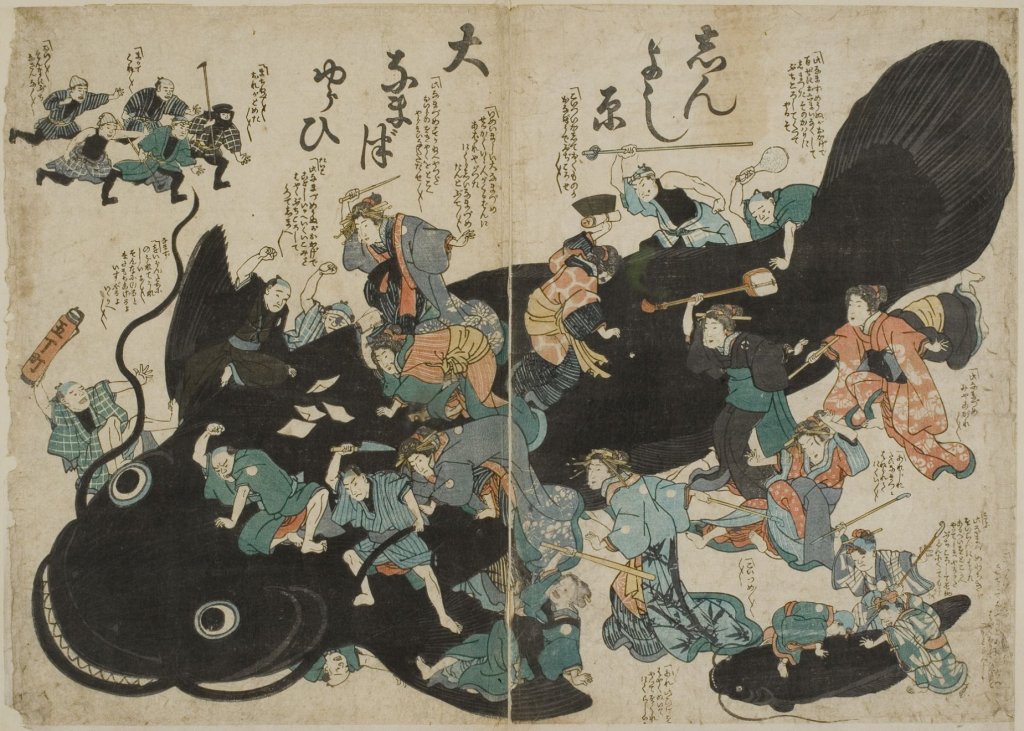
Experiencing such fear twice within a few months must be mentally devastating. I send messages to my friends in Kanazawa to make sure they’re okay. No, I didn’t dream it—the earth did indeed shake violently enough to trigger an alert all the way to Tokyo. The giant catfish said to live beneath Japan stirred, scaring millions of people but fortunately causing no casualties and only minimal damage. For now, we wait for the next tremor from this mythical creature, which, in ancient times, was believed to explain the fierce movements of the earth in the Land of the Rising Sun.

大鯰
Ōnamazu – big catfish.
大鯰 is a mythological catfish of gigantic size that, according to legend, lives under Japan. It is controlled by Takemikazuchi the god of thunder who is the main deity of the city of Kashima in Ibaraki prefecture.
Thanks to a sacred stone, 要石, the giant catfish is controlled by the god, but when the latter relaxes his vigilance, the monster becomes agitated and causes earthquakes in Japan. The catfish’s association with earthquakes appears to date back to the 16th century, when it was depicted in prints from the Lake Biwa region near Kyoto.
要石
Kaname ishi – stone of the foundation.
This legend later spread throughout Japan, made popular by eel fishermen who noticed that before an earthquake, the catfish moved frantically. But this story is not just a legend; it could even be described as popular wisdom, since in 1930 Japanese seismologists demonstrated that catfish kept in aquariums would become significantly agitated several hours before an earthquake.

