

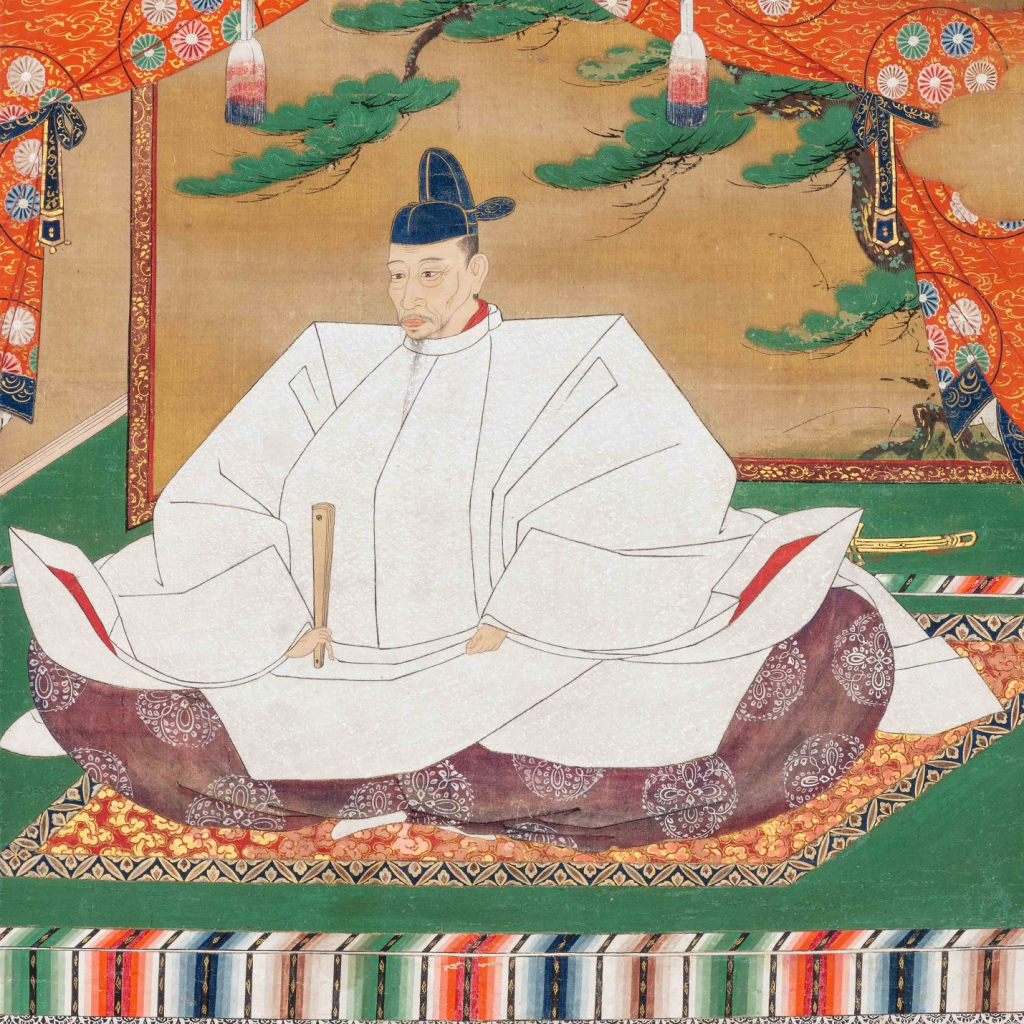
Toyotomi Hideyoshi (1537-1598) is the second great unifier of Japan, and his story is unique: he was the son of a peasant from the province of Owari. During the Sengoku period, many peasants also served as warriors, as wars demanded a vast number of men. However, it was extremely rare for a peasant to climb all the ranks of the military hierarchy.
At the age of 20, Toyotomi Hideyoshi entered the service of Oda Nobunaga and eventually became one of his main daimyō. Upon learning of Nobunaga’s death—just after Hideyoshi had defeated the powerful Mori clan—he rushed back and won the Battle of Yamazaki against the coup plotters, whom he subsequently executed. He continued Nobunaga’s work of unifying Japan, completing it in 1592 by capturing Nagoya at the head of an army of 500,000 men.
Continuing the work of his late master was no simple task: many contenders sought to succeed Nobunaga, including his sons and other daimyō, such as Tokugawa Ieyasu. Moreover, Hideyoshi’s peasant origins worked against him.
However, this was also a time when warlords built their reputations on the battlefield, and Toyotomi Hideyoshi was a master in this regard. His reputation as a brilliant strategist was already well-established, and he solidified it by defeating his opponents on the field. In 1585, he was adopted by an allied noble family, which allowed him to attain the title of Naidaijin (Minister of the Center), the second-highest position in the state after the emperor.
Armed with this administrative power and several hundred thousand bushi, Toyotomi Hideyoshi completed the unification of Japan in just six years. He conquered Kyūshū, the large southern island, with an army of 200,000 men. He banned Christianity and expelled Jesuit missionaries from Nagasaki—missionaries who had been granted control of the prosperous port by Oda Nobunaga. He also strengthened the power of the bushi by prohibiting peasants from bearing arms. This was somewhat ironic given his peasant background, but it was as if he were closing the door behind him. This measure would have a tremendous impact on the peace that would follow a few years later.
In 1592, after the capture of Nagoya, the unification of Japan was complete. Most daimyō were either subdued or dead, and Toyotomi Hideyoshi stood as the sole ruler. However, this did not yet mark the definitive end of the century of wars characteristic of the Sengoku period.

via Wikimedia Commons
The question then is what to do with these hundreds of thousands of bushi who have never known anything but war in their lives. What mission, function, occupation to give them? This problem was not really solved until more than 20 years later by his successor, Tokugawa Ieyasu.
But Toyotomi Hideyoshi laid the foundation. After banning the weapons of the peasants, he will detach the warriors, the bushi, the samurai from their lands. They will no longer be able to live among the peasants who work on the land; they will be responsible for collecting taxes for the benefit of the daimyō. To this end, Hideyoshi created a new system of wealth assessment based on the rice harvest, the kokudaka, and he had accurate surveying of land by commissioners. He created a new cadastre that completely replaced the old one and redefined hierarchical relationships throughout Japan.
In Hideyoshi’s new Japan, the peasant can no longer become a warrior, and the warrior must become a city dweller, an administrator, and move away from the land. This is the beginning of the end of the feudal system, which does not go without violence, as shown by what Hideyoshi demanded from his daimyō:
The intentions I have made known to you [concerning the survey of the lands], it is necessary that you pass them on to the local warriors and peasants so that they obey. If men who have been informed do not obey, if it is the master of a castle, take his castle and without sparing anyone, slaughter everything. For the peasants and others, if they do not obey, everything must be slaughtered, whether it is a village or two”.
Translated by Francine Hérail. Quoted in Souyri, Pierre-François. Les guerriers dans la rizière. La
grande épopée des Samouraïs. Paris : Flammarion, 2017
But a warrior is still a warrior, and in 1592, Toyotomi Hideyoshi made another decision: he decided to invade China. He attacked the Ming dynasty! To do this, he first had to cross Korea, the closest point from which to land on the continent from the Nagasaki region.

See page for author, Public domain, via Wikimedia Commons
In six years, more than 300,000 men took part in two attempts to invade Korea, which went as far as Manchuria. But each time, China sent reinforcements to the Koreans, who resisted despite or because of the atrocity of the massacres, and successfully attacked Japanese supply lines.
This insane project never came to fruition and caused hundreds of thousands of civilian and military deaths on both sides. A late 19ᵉ century American historian, George H. Jones, estimates that there were 1 million deaths during this campaign. Rape, torture and pillage were the rule among the bushi, but also in the Chinese and Korean armies.
Politically, the invasion created destabilisation within a newly unified Japan. When Toyotomi Hideyoshi died in 1598, the Japanese state was weakened by the Korean War and the youth of his legitimate heir, Toyotomi Hideyori, who was just 5 years old.
With foresight, Toyotomi Hideyoshi appointed a council of five wise men before his death, in fact the five main rivals to his succession, including Tokugawa Ieyasu, whom he entrusted with administering the country until his son was old enough to do so. He thus tried to prevent the dilution of central power, but everyone’s ambitions were too strong, and the war began again.

Bibliography
- Souyri, Pierre-François. Nouvelle histoire du Japon. Paris : Perrin, 2010.
- Souyri, Pierre-François. Les guerriers dans la rizière. La grande épopée des Samouraïs. Paris : Flammarion, 2017


