


狩野宗秀 (Kanō Sōshū, 1551 – 1601),
Public domain, via Wikimedia Commons
Japan’s first unifier, Oda Nobunaga, spent his life on the battlefield, conquering large parts of the country. He committed seppuku in 1582 following a coup d’état provoked, among other things, by his legendary ferocity. Nonetheless, he changed both the way war was waged and the way the Japanese state was conceived. He was the first to have the ambition of conquering the whole country and making it one. Even today, despite the atrocities attributed to him, he enjoys great popularity in Japan because of his ambition for a unified state under the authority of a shōgun, something no shōgun or emperor had achieved before.
Oda Nobunaga was the daimyō, the governor and military leader of a small province in central Japan that has now disappeared: Owari. This is west of Nagoya, about halfway between Tokyo to the east and Kyoto to the west.
When his father died in 1551, he became his legitimate successor at the age of 17. From then on, he set about unifying the province of Owari, which had been divided by family tensions. In 1555, he had his uncle massacred at Kiyosu Castle.

No machine-readable author provided. Gilyellows assumed (based on copyright claims), CC BY-SA 3.0, via Wikimedia Commons
The following year, his brother Oda Nobuyuki rebelled against him, but he defeated him on the battlefield while being forced by his mother to spare him. He will wait a while before setting a trap at Kiyosu castle and killing him.
One year later, Imagawa Yoshimoto, one of the most important daimyō in Japan, made his way to Kyoto with 30,000 men and decided to take possession of Owari province. With only 3,000 men to face him, Oda Nobunaga knows he is lost in a classic battle. He decides then with a coup de force: he attacks at night, under the storm, the command post of Imagawa.
The surprise is total. The daimyō and his main generals are killed, which puts the rest of the army on the run. Nobunaga had 3,000 soldiers beheaded for example. Above all, he wins a victory that all of Japan is talking about, so much the forces in the presence were disproportionate and his stroke of daring admirable. The legend of Nobunaga was born at the battle of Okehazama.
The Imagawa clan is weakened, and Nobunaga takes advantage of this to seal an alliance with the Matsudaira clan, convincing Tokugawa Ieyasu, third unifier of Japan and future founder of the Edo period.
For 18 years, Oda Nobunaga has been constantly expanding his territory at the cost of victories and sometimes painful failures. He becomes totally merciless. In his struggle against the Buddhist monk-soldiers, the Tendai, he will eventually destroy the symbolic temple of Mount Hiei near Kyoto, the Enryaku-ji, while having many civilians massacred. Women, children, priests: no one is spared, even to the disgust of his own officers. This earned him the nickname of “King demon”.
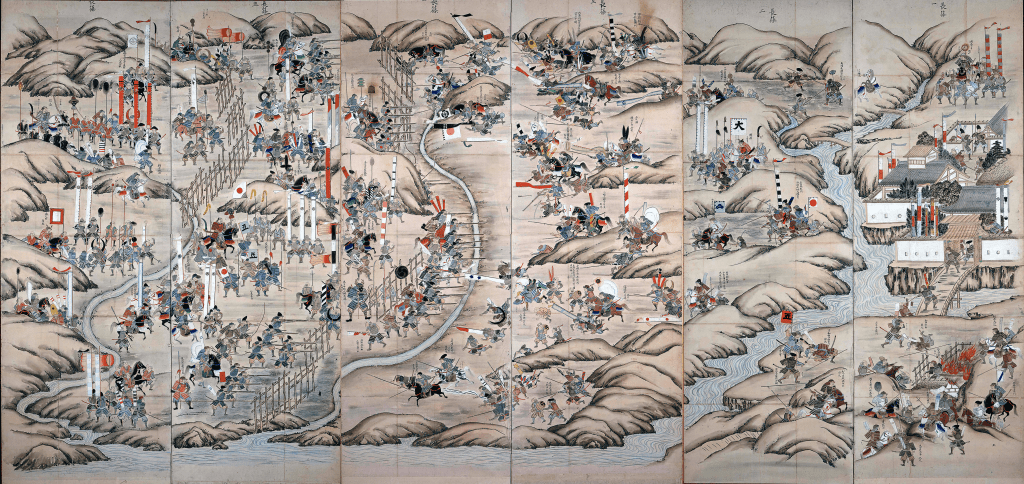
Unknown author (Edo period, circa 18th century), Public domain, via Wikimedia Common
In 1575, Oda Nobunaga won the battle of Nagashino against the Takeda clan, the first battle to be described as modern in Japan. To counter the enemy cavalry, Nobunaga had wooden palisades erected to protect his harquebusiers, who fired salvo after salvo at the enemy. In so doing, he demonstrated the superiority of modern weapons over the traditional combat techniques used until then by warlords. Slowed down by rain and a torrent, the fearsome samurai horsemen of the Takeda clan are 50 metres from the palisades built by Nobunaga, the ideal distance for arquebus fire to pierce the horsemen’s armour. This important episode is recalled in Akira Kurosawa’s film Kagemusha (1980).
In 1582, Nobunaga is betrayed by one of his generals, Akechi Mitsuhide. He is caught in a temple in Kyoto, accompanied only by a few personal guards. He is forced to commit seppuku. The reasons for the betrayal are not clear, but they must have a connection with the climate of the time and the fierce personality of Oda Nobunaga.
The traitor Akechi will not enjoy his success for long. His nickname is Jūsan kūbō, the 13-day shōgun. It is the time that will take the most important of Nobunaga’s generals, Toyotomi Hideyoshi, to overthrow him and position himself as a true successor of Oda Nobunaga.
Oda Nobunaga has succeeded in what no one had done before: unifying the central part of Japan, at the cost of terrible massacres, but with a true political vision of a united Japan.
He modified the military tactics, using the muskets brought by the Portuguese in the early 16th century and creating the first infantry units, which would take over the samurai horsemen fighting with bow and sword. He also demanded absolute obedience from his vassals and men, tolerating no dissent and ruthlessly repressing them with unheard of violence.
But he was not only a military man: he also had an economic vision, moving Japan from an agricultural economy to an industrial and tertiary economy through administration and transport. He built roads not only to move his armies, but also to facilitate trade.
Oda Nobunaga was a cruel demon, but he was the first to bring Japan out of feudalism. He will be followed by Toyotomi Hideyoshi and Tokugawa Ieyasu.

Bibliography
- Souyri, Pierre-François. Nouvelle histoire du Japon. Paris : Perrin, 2010.
- Souyri, Pierre-François. Les guerriers dans la rizière. La grande épopée des Samouraïs. Paris : Flammarion, 2017.


